

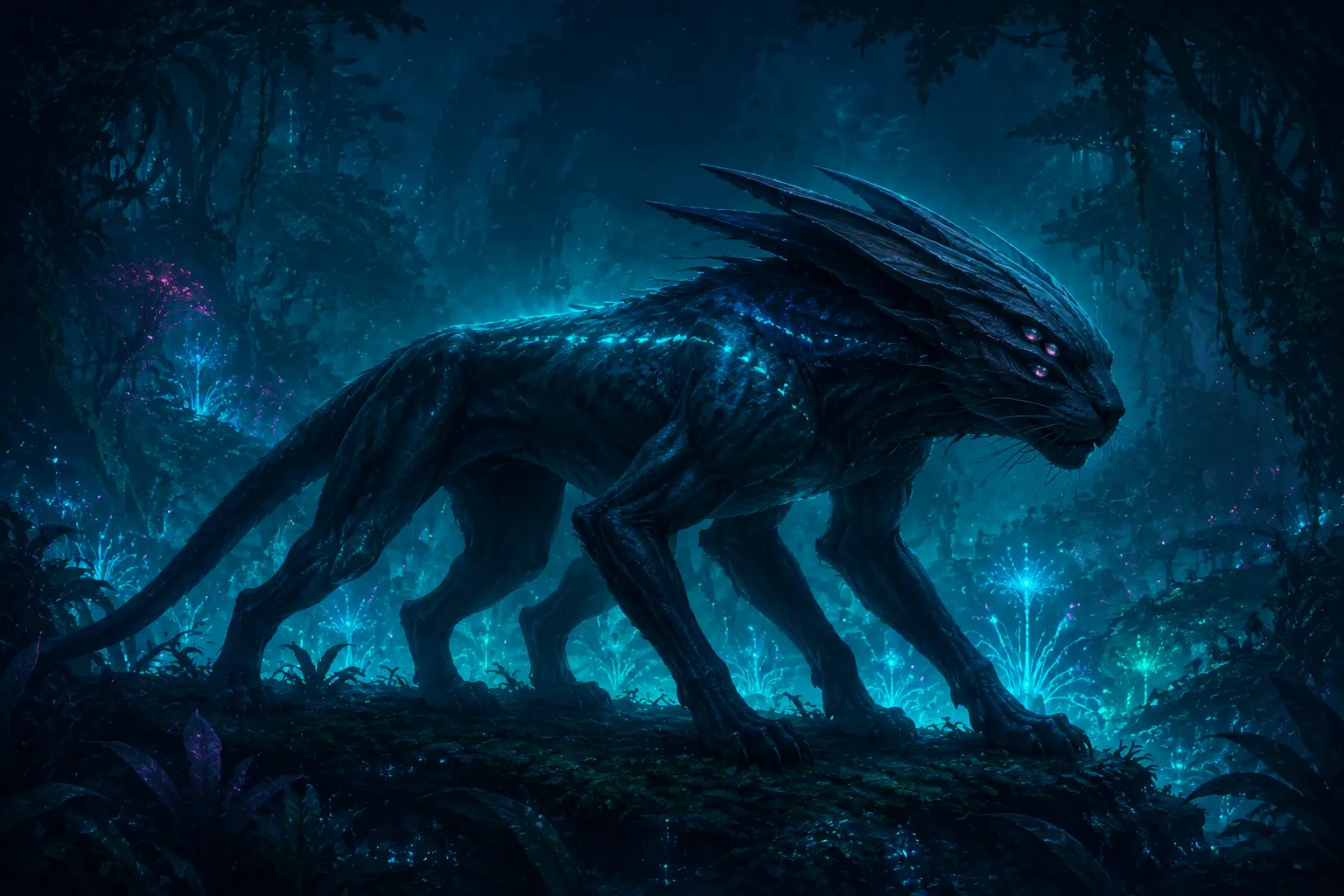
The first humans to walk Pandora's forests kept catching themselves doing something faintly embarrassing. They kept naming things. That low black shape pacing the understory was a panther. The pack that ran down the hexapede in a coordinated rush was a wolf-pack. The thing wheeling on the thermals above the Hallelujah Mountains was an eagle, or near enough to make no difference. Over and over, on a moon four light-years from any cat or wolf or eagle that ever lived, the human eye found old friends.
And the strange part is not that the names came easily. The strange part is that they kept being right — right about the job, at least. The black shape really was an ambush predator that killed by pouncing from cover. The pack really did hunt cooperatively, herding and exhausting larger prey. The wheeling thing really was an apex aerial hunter that struck from above. The ecological roles transferred perfectly. It was only when you looked closely — six limbs where there should be four, a fan of four eyes where there should be two, breathing slits along the flanks where there should be a nose — that the recognition curdled into unease. You knew this animal. You had never seen anything like it.
This is worth stopping on before the unease carries you off, because it points at one of the deepest questions you can ask about life anywhere. Pandora did not inherit its animals from Earth. By every account its biosphere arose on its own, from its own chemistry, on its own timeline, with its own foundational body plan — six limbs, not four; lateral breathing membranes, not lungs vented through a single throat; a neural whip-cord that plugs one creature into another, which Earth has nothing remotely like. The starting material is wrong. The blueprint is wrong. And yet the output keeps rhyming with home: a grazer here, an apex predator there, a pollinator, a pack hunter, a filter-feeding leviathan in the sea.
So which is it? Is the resemblance a cheat — a Hollywood art department reaching for shapes an audience would read instantly — or is it telling us something true and a little frightening about how life works? The honest answer is the second one, and the law behind it is the most useful idea this chapter has to give. Once you have it, you can do something that sounds impossible: you can look at a world you will never visit, reason about its sunlight and its gravity and its predators, and predict the shapes of animals no one has ever seen. Not their ancestry. Not their colour. Their shapes.
Let us find the law.
The job comes first
Start with the panther, or rather with the job the panther does.
An ambush predator that kills large prey has a problem to solve, and the problem is set not by biology but by physics. It must close distance from concealment faster than the prey can react, which demands explosive acceleration — so it needs powerful hindquarters and a spring-loaded spine. It must hold and kill struggling prey far stronger than any single bite, which demands grappling limbs tipped in claws and a jaw that can crush or suffocate. It must hunt in the dark, when its prey is least ready, which demands eyes built to gather what little light there is. None of these requirements care what planet you are on. They are dictated by the speed of a fleeing animal, the strength of muscle, the behaviour of light. Hand the same problem to any lineage of any biochemistry, give it enough time and enough generations, and the good solutions form a short list — because most of the possible solutions simply do not work, and selection quietly deletes them.
This is the heart of convergent evolution: when unrelated lineages are squeezed by the same problem, they tend to arrive at the same answer, because the answer was never really theirs to choose. The thanator has the panther's springing build and grasping forelimbs and night-gathering eyes not because it is a cat — it shares no ancestor with a cat, no gene, no continent, no world — but because ambush predation has a shape, and any animal that takes up the trade gets pulled toward that shape whether it descends from a cat or a six-legged Pandoran something.
If the resemblance is real and not a coincidence, it should be predictable — it should show up again and again wherever the same job appears, not just once where an artist happened to want a cat. And that is exactly what convergence does. On Earth the fast-swimming open-water hunter has been invented at least three separate times, by three lineages that could hardly be less related: the shark, a fish; the ichthyosaur, a reptile; the dolphin, a mammal. Three different starting bodies — gilled fish, scaled reptile, furred air-breather — and all three converged on the same torpedo: streamlined fusiform body, dorsal fin for stability, tail for thrust, the lot. Drop a fast predator into open water and the water itself dictates the body. The animal barely gets a vote.
Same job, different substrate
Earth panther
Pandoran thanator
Role features (converged)
In Job mode both wear the same pounce — the spring-loaded haunch, the grasping forelimb, the forward hunting eyes. Ambush predation has a shape, and any lineage that takes up the trade is pulled toward it.
So the thanator is not a borrowed cat. It is an independent answer to the cat's question, worked out from scratch by a lineage that never met a cat — which is a far stranger and far more interesting thing for it to be. But to make that claim stick, we need more than a handsome analogy. We need to know that the niche — the job — is a real thing in nature, something with enough structure to pull bodies toward it. We need to define it.
What a niche really is
In ordinary speech a niche is a little nook, a place a thing fits. Ecology means something far more precise and far more powerful, and the precise version is what makes prediction possible.
Think of every requirement an animal has, and every condition it can tolerate, as a separate axis. How warm can it be before the animal cooks; how cold before it freezes. How big can its prey be; how small before hunting them costs more energy than they return. How much oxygen, how much moisture, how much cover, what time of day it can operate. Each of these is a dimension, a range with a comfortable middle and lethal edges. Stack all of them together — dozens, hundreds of axes — and the region of that vast space in which the animal can actually survive and reproduce is its ecological niche. Not a place. A volume in the space of all possible ways of making a living. The ecologist G. Evelyn Hutchinson gave this its modern form in 1957, and the phrase he used — an n-dimensional hypervolume — sounds forbidding but means something simple: a niche is the complete list of conditions under which a kind of life can persist, treated as a shape in many dimensions at once.
Two refinements turn this from a definition into a tool. The first is that the niche an animal could occupy if it had the world to itself — its fundamental niche, the full range its body can physically tolerate — is almost never the niche it actually occupies. Out in the real world, competitors and predators and parasites fence it in, and what is left, the cramped subset it truly lives in, is its realized niche. An animal is forever pressed into a smaller life than its biology alone would allow, by the simple fact that other animals got to parts of the space first.
The second refinement is the one with teeth, and it is nearly a law. Two species cannot occupy exactly the same niche in the same place indefinitely. If they truly overlap — same food, same hours, same method, same everything — then one of them will, inevitably, be a hair more efficient, and over enough generations that hair compounds until the loser is driven out entirely. This is the competitive exclusion principle, demonstrated cleanly by the biologist Georgii Gause in the 1930s with nothing but two species of pond microbe and a few test tubes: grown separately, both thrived; grown together on a single food, one always wiped the other out. Complete competitors cannot coexist. The corollary is the engine of everything that follows: if two species do coexist, they must differ — they must have split the space between them somehow. Nature does not tolerate redundancy. Every niche tends to get filled, and tends to get filled once.
Now the claim about Pandora can be stated sharply. If niches are real openings posted by environments, and if competitive exclusion guarantees each gets filled about once, then any world with forests and oceans and prey will post the same broad set of jobs — grazer, browser, ambush hunter, pursuit hunter, scavenger, pollinator, filter-feeder — because those jobs fall out of the physics of energy, motion, and light, not out of Earth's particular history. A separate biosphere, handed the same job listings, will hire its own employees and shape them to the work. The result will rhyme with Earth not because anyone copied anyone, but because both were answering the same advertisement.
But is this real, or is it a just-so story that sounds good? Here ecology hands us something rare and precious: a natural experiment, run many times over, with a clean result.
The experiment that nature ran four times
In the Caribbean there is a genus of small lizards, Anolis, that has quietly performed one of the most important experiments in evolutionary biology — performed it without being asked, on four separate islands, with the answer key sealed until biologists thought to look.
On each of the Greater Antilles — Cuba, Hispaniola, Jamaica, Puerto Rico — anoles colonised long ago and then radiated, splitting into a spray of species adapted to different parts of the forest. And here is the thing that should raise the hair on your arms: on every island they split the same way. Each island evolved a lizard with short legs and a slim body that creeps along the tops of twigs — call it the twig type. Each island evolved a stocky, long-legged form that lives on broad tree trunks near the ground. Each evolved a giant that lives high in the crown, a slender one for grass and reeds, and so on through the same roster of about six recurring forms. Biologists named these recurring types ecomorphs — body-types defined by the part of the habitat they exploit rather than by ancestry — and the punchline is that the twig anole of Cuba is not closely related to the twig anole of Puerto Rico. Each island built its own twig specialist independently, from its own local stock. The trunk-ground type on Jamaica and the trunk-ground type on Hispaniola are cousins by job, strangers by blood.
This is convergence caught in the act, replicated, with controls. The "islands" are the replicates; the recurring ecomorphs are the result; the fact that matching forms are not closest relatives is the proof that each arose on its own. Run the tape of anole evolution four times on four islands and you get four near-identical casts. The niches were real, the same niches existed on each island because the forests were structurally alike, and evolution filled them with such fidelity that you can predict an island's lizard line-up before you survey it.
If a single genus of lizard does this across four islands separated by a few hundred kilometres of sea, then the same logic, scaled up, is what stares back at us from Pandora across four light-years. The thanator, the viperwolf, the banshee are Pandora's ecomorphs — the ambush-predator type, the pack-hunter type, the aerial-raptor type — filled by a separate radiation on a separate world, from separate stock, to the same job descriptions the forests of any sufficiently Earth-like world will post. We are not looking at Earth's animals transplanted. We are looking at Earth's jobs re-advertised, and freshly hired for.
How deep the rhyme goes
It would be easy to think convergence is a skin-deep thing — that selection sculpts the silhouette and stops, and that underneath, the cat and the thanator are built on utterly different machinery. Sometimes that is true. But the unsettling discovery of the last few decades is how far down convergence can reach when the problem is tight enough, and three Earth cases are worth holding in mind as you look at Pandora, because each one goes deeper than the last.
The first is the eye. A camera eye — a dark chamber, an aperture, a focusing lens, a sheet of light-sensitive tissue behind — has evolved independently in vertebrates like us and in cephalopods like the octopus. The two eyes are so alike that the same physics textbook diagram serves for both. And yet they are wired backwards from each other: in our eye the light-sensing cells point away from the light and their wiring is stuffed in front of them, which forces a hole in the retina — our blind spot — where the cables punch through to escape. The octopus's eye, built from scratch on its own lineage, got it "right": its sensors face the light and the wiring runs out the back, and it has no blind spot at all. Same optical solution, opposite construction, because each lineage reached the design through its own embryology. The function converged; the plumbing kept its accent.
The second goes deeper, into the genes. Bats and toothed whales both navigate and hunt by echolocation — firing sound, reading the echo — a feat of biological sonar that demands exquisitely tuned hearing. When biologists looked at the gene for prestin, a protein that tunes the sensitivity of the inner ear, they found something that should not happen by chance: bats and dolphins, separated by a hundred million years and an ocean of ancestry, had independently evolved many of the same mutations in that one gene. Selection, hunting for high-frequency hearing, kept finding the same few changes to the same protein, in the dark, twice. Convergence had reached all the way down to the letters of the DNA.
And yet — this is the turn the whole chapter has been walking toward — convergence never erases history completely. Look again at those three open-water torpedoes. The shark and the ichthyosaur swing their tails side to side, the way a fish always has. The dolphin swings its tail up and down, in a horizontal fluke, because it descends from land mammals whose spines flexed vertically as they ran, and evolution could only rework the body it was handed. The dolphin became a fish in almost every respect the water demanded — and kept the mammal's up-and-down spine as a signature it could not file off. The eye converged but kept its blind spot. The prestin gene converged but the bat is still a bat and the whale still a whale in ten thousand other genes. Convergence pulls hard toward the good solution, but it always drags an anchor of ancestry behind it, and the anchor leaves a track.
That track is the "not quite". And it is exactly where Pandora becomes most honest.
The tells of a separate world
If the thanator were only a panther — if convergence ran all the way down and erased every trace of where it came from — Pandora would be a cheat, a moon of Earth animals in alien paint. The reason it is something richer is that the anchors are everywhere, and on Pandora they are not subtle vertical-versus-horizontal tail-beats. They are loud.
Count the limbs. Almost every large land animal on Pandora has six, arranged as the moon's deep body plan dictates — the thanator runs on six, the direhorse on six, the hexapede on six. No amount of convergence on the "big cat" job gave the thanator four legs, because four was never on Pandora's menu; its lineage started with six and selection had to build a cat out of six, the way the dolphin had to build a fish out of a mammal. Count the eyes: four where Earth predators have two, a separate pair tuned, by most readings, to the infrared, an entire sensory channel Earth's cats simply lack. Look at the breathing: not a nose feeding a single pair of lungs but membranous slits along the flanks, a wholly different solution to getting oxygen that the chapter on Pandoran respiration takes up in earnest. And then the thing with no Earth analogue at all — the neural queue, the living cable that lets a Na'vi or a creature plug directly into another nervous system. There is no panther part that converged into that. It is a piece of pure Pandoran ancestry, shared down the moon's whole tree of life, that no Earthly job description ever called for.
This is what "convergent but not quite" means, stated plainly. The roles converged — Pandora and Earth fill the same ecological jobs because the jobs are written by physics, not by planet. The forms converged at the level of silhouette and stance, because the good answers to "ambush predator" or "pursuit hunter" are a short list anywhere. But the substrate — the body plan, the count of limbs and eyes, the manner of breathing, the queue — stayed stubbornly, diagnostically Pandoran, because convergence reworks an inheritance, it does not replace it. The thanator is the panther's answer written in a foreign alphabet. You can read the meaning; you can never miss that it is foreign.
What converged — the job and the shape
What stayed Pandoran — the inheritance
There is a particular Earth cautionary tale that belongs here, because it warns against the very mistake the human namers on Pandora kept making. The marsupial "sabre-tooth", Thylacosmilus, looked so like the placental sabre-tooth cat Smilodon that for a long time they were treated as twin answers to the same predatory question. Closer study undid the easy story. Thylacosmilus lacked the stabbing bite the resemblance implied; its great canines grew continuously from open roots, its jaw muscles and neck told a different mechanical tale, and current readings cast it less as a cat-like killer than as something stranger, perhaps a specialised feeder on soft viscera. The silhouette said "sabre-tooth cat". The animal, read carefully, said "marsupial doing something its own way". Mistake the convergent shape for a convergent animal and you will get the creature wrong — on Earth, and far more so on Pandora.
Sharing the table
There is a second half to niche theory, and it explains something the forest of Pandora shows you the moment you stop staring at the predators and look at what they eat.
A Pandoran forest does not hold one kind of plant-eater. It holds a crowd of them — the small browsing hexapede stepping delicately through the understory, the heavy direhorse moving in herds, the great hammerhead titanothere shouldering through the brush, and out on the open plains the migrating sturmbeest in their thousands. Earth is the same: a savanna carries giraffe and elephant and zebra and gazelle and a dozen kinds of antelope, all of them, loosely speaking, "grazers", all in the same country. Competitive exclusion said two species cannot share a niche. So how do a dozen plant-eaters share a forest?
The answer is that they do not share a niche — they split one. This is niche partitioning, and it is the relief valve that competitive exclusion forces open. Where many species press on the same resource, selection drives them apart into ever-finer subdivisions of it, until each is doing a job slightly different from all its neighbours and the deadly overlap is gone. The giraffe takes the high leaves no one else can reach; the gazelle crops the short grass; the elephant breaks whole trees; the zebra eats the coarse grass tops and the wildebeest the tender shoots beneath. They look like competitors. They are, in the fine grain, employees in different departments of the same firm.
The classic demonstration is humble and perfect. In the spruce forests of New England, five species of warbler — small insect-eating birds, near-identical, all feeding in the same trees — appeared to flatly violate competitive exclusion. The ecologist Robert MacArthur watched them, patiently, for a long time, and found the hidden partition: each species fed in a different zone of the tree. One worked the high outer needles, one the dense inner branches, one the very top, one the lower trunk, each keeping to its layer, each hunting in a slightly different way at a slightly different height. The tree that looked like one niche shared five ways was really five niches stacked vertically, and the birds had divided it so cleanly that the appearance of conflict dissolved. Coexistence, it turned out, was built out of difference. The price of living in the same place was being good at subtly different things.
One forest, divided into floors
Click a layer to see who feeds there.
This is why the number and variety of plant-eaters on Pandora is not a worldbuilding indulgence but a near-requirement. A forest that productive, with that much plant matter on offer at that many heights and textures, posts not one herbivore job but a whole tiered ladder of them — ground-shoot specialist, mid-canopy browser, bulk grazer, high-foliage reacher — and competitive exclusion guarantees that if Pandora's biosphere is healthy and old, those jobs will have been split apart and filled by distinct, differentiated animals. The crowd of grazers is exactly what a mature, well-partitioned forest should contain. Their differences from one another are not noise. They are the fingerprints of competition long since resolved.
And a related force, quieter, finishes the sculpting. Where two similar species live side by side and compete, selection pushes them to become more different precisely where they overlap — a process called character displacement. Two seed-eating finches sharing an island will, over generations, tend to evolve beaks of more different sizes than either shows where it lives alone, because the individuals least like their competitor eat best and leave the most offspring. Coexistence does not merely permit difference; it actively manufactures it. On Pandora as on Earth, the very pressure of a crowded table is what carves the diners into a set of specialists who can all, just barely, dine together.
One stock, many trades
We have explained why Pandora's jobs match Earth's, and why each job is filled once, and why the plant-eaters fan out into a differentiated crowd. One thing remains: where did all these differentiated Pandoran animals come from? The same place the Caribbean's anoles came from — a single ancestral stock, radiating.
When a lineage finds itself in a world full of empty niches — a new island, a cleared landscape, a young biosphere — it does not stay one kind of thing for long. The open jobs are an invitation, and the lineage answers by diversifying with sometimes startling speed, throwing off descendant forms specialised to one opening after another until the available space is filled. This is adaptive radiation: one ancestor fanning into many, each shaped to a different way of life, the whole spray of them tracing back to a common root not far below. Darwin's finches did it on the Galápagos; the anoles did it on each Antillean island; Hawaii's honeycreepers did it among the volcanoes. A founder arrives, the empty niches beckon, and evolution pours the lineage into every mould the new world offers.
Pandora's entire bestiary is, on this reading, one enormous adaptive radiation off the moon's foundational six-limbed body plan — the hexapod ground-stock fanning out over deep time into runners and climbers and fliers and swimmers, into grazers and hunters and gliders, each lineage poured into a different one of the world's standing jobs. And the franchise, almost as if it knew the theory, left a fossil of the process standing in plain sight.
The prolemuris is a creature that does not quite make sense until you see it as a snapshot of a radiation in motion. It lives in the canopy, a lemur-like climber, and it carries its Pandoran six-limb heritage in a strange, half-finished way: its forelimbs bifurcate from a single upper arm, splitting into two only toward the ends — an anatomy that the old fusion reading treated as six limbs in the slow act of becoming four. And where most Pandoran animals carry paired neural queues, the prolemuris has a single one — like the Na'vi, and unlike its six-armed forest neighbours. It sits, anatomically, partway between the deep hexapod stock and the tall four-limbed Na'vi; it is a suggestive living comparison, not proof of the path to the Na'vi.
Whether the prolemuris is truly on the line to the Na'vi or merely near it, canon does not finally settle, and we should not pretend it does. But as an illustration it is precious, because it makes the abstract concrete: a body plan is not fixed, a lineage in a world of open niches will be reshaped toward them, and the in-between forms — usually lost, usually known only from fragments on Earth — here stand up and climb a tree in front of you. The radiation that filled Pandora with its panthers and wolves and deer left this one page un-erased.
Replaying the tape
All of this lands on one of the great open arguments in biology, and Pandora is the most vivid thought experiment anyone has ever staged for it.
The palaeontologist Stephen Jay Gould posed the question in a famous image: rewind the tape of life to its beginning, he said, and play it again, and you would get a living world utterly unlike ours — different animals, different forms, perhaps no creature that ever stood on two legs to wonder about it. Life, on his telling, is ruled by contingency: a chain of accidents and mass extinctions and lucky survivals so long that the particular cast we ended up with was one outcome among countless equally possible ones. Replay the tape and the dice fall differently. There is no reason to expect a second run to rhyme with the first.
Against him stood the palaeontologist Simon Conway Morris, who looked at the same fossil record and drew the opposite lesson from the sheer abundance of convergence. If eyes evolved dozens of times, and the streamlined swimmer three times, and the crab-shape so many times that biologists coined a word — carcinisation — for the way crustacean after crustacean keeps turning into a crab, then life is not a free fall through accident. It is being funnelled, again and again, toward a limited set of good solutions that exist independently of who stumbles into them. Replay the tape, Conway Morris argued, and you would get the eye again, and the fast swimmer, and very possibly something doing the clever-social-tool-user job that we do — because those niches are real and the routes into them are few. Convergence was his evidence that the outcomes are, broadly, inevitable.
The modern resolution is not a fudge but a genuine synthesis, and Pandora illustrates it better than any argument could. Both men were right about different layers. At the level of role and broad form — Conway Morris's level — life is predictable, funnelled, convergent: posed the same problem, it reaches for the same answers, on this continent or that island or, we are wagering, that moon. There will be an ambush predator; it will be low and fast and forward-eyed. At the level of specific structure and lineage — Gould's level — history rules, contingency bites, and the particular body that fills the role is a frozen accident of which stock happened to be in the neighbourhood when the job opened. There will be an ambush predator, but whether it is built from four limbs or six, two eyes or four, a single airway or a row of flank-slits, is contingency's call, and contingency on a separate world will answer differently every time.
That is Pandora in a sentence. Convergent — because the jobs are universal and the good answers few, so the moon's ecology rhymes with Earth's down to the recognisable silhouettes. But not quite — because the stock that filled those jobs carried its own deep history, six-limbed and four-eyed and queue-bearing, and that history signs every animal in an alphabet Earth never used. Gould's tape, replayed on another world, would give you Conway Morris's roles wearing Gould's accidents. Pandora is what that looks like.
Replay the tape
The role (fixed)
Ambush predator — low, fast, forward-eyed
The stock (rolls each replay)
Earth — placental cat
Substrate
4 limbs · 2 eyes · vertical spine · fur
Back to the first sight of the panther
Go back, then, to that first encounter in the dark — the low black shape over its kill, and the human mind reaching, before thought, for the word panther.
The reaching was not a failure of imagination. It was good biology, run in an instant. The shape is a panther's shape, because the job the animal does is the job a panther does, and that job has a short list of good answers anywhere in the universe — the spring, the claw, the night-gathering eye — and Pandora's separate evolution, handed the same problem, was funnelled to the same short list. You recognised the role because roles are real, and universal, and you have an eye trained on a planet that filled the same ones.
And the unease that followed — the six legs, the four eyes, the breathing slits, the queue — that was good biology too, the second half of it. Because the animal that fills a universal role is never universal itself. It is a particular lineage with a particular past, and on Pandora that past is wholly its own: a six-limbed stock that rose on its own chemistry and radiated into its own forest, never having met a cat, building one anyway out of the only parts it had. You will never mistake it for Earth, because the path it took to the panther's shape was its own from the very first step.
Convergence leaves you with a portable lesson, one you can take from Pandora to any world you will ever wonder about. It tells you that life, anywhere, is partly legible in advance — that the silhouettes are predictable, that an alien forest will hold its grazers and its hunters and its gliders in shapes you could sketch before you landed. And it tells you, in the same breath, that the animals will always surprise you, because the inheritance underneath the shape is contingency's, and contingency never repeats. Convergent enough to recognise. Different enough to be worth the journey. That is how you read a living world you did not grow up on — and Pandora, four light-years off, is the finest practice any of us is likely to get.
What stays open
The chapter assumes a fully independent origin — separate chemistry, separate body plan — which is what makes the convergence so striking. Canon leans this way but never proves it. If, against expectation, Pandora and Earth shared deep ancestry (a panspermia scenario), the resemblances would be partly inherited rather than purely convergent, and the whole argument would soften from 'independently re-derived' to 'a distant family echo'. The six-limbed body plan and the neural queue are the strongest evidence for genuine separateness.
Convergence predicts that similar environments post similar jobs — but it does not guarantee every job is filled, or filled the same way. Earth has niches no animal occupies and oddities no other world need share. That Pandora's roster lines up quite so neatly with a human observer's expectations is partly real ecology and partly the franchise reaching for legible shapes. The honest reading: the broad guild structure is sound science; the tidy one-to-one correspondence is flattered by storytelling.
Canonical material shows the prolemuris with a bifurcated forelimb and a single queue, placing it anatomically between the six-limbed stock and the four-limbed Na'vi — but whether it lies on the direct ancestral line, or merely resembles an intermediate, is not settled. As an illustration of a body plan caught mid-radiation it is invaluable; as a proven Na'vi ancestor it is inference, not fact.
The queue links creatures across enormous taxonomic distance — forest hunters, flying ikran, marine ilu, the Na'vi themselves — which implies it is a very deep, very early feature of the moon's whole tree of life. But its origin, the selective pressure that first favoured a cross-organism neural plug, has no canon explanation. It is the one Pandoran feature with no Earth analogue to reason from, and the deepest 'not quite' of all.
Read next
Six Limbs and the Bilateral Lattice
Lay the skeletons of a thanator, a banshee, and a tulkun side by side and you see one blueprint repeating - six limbs, four eyes, a pair of queues sprouting at the temples. Then comes the ten-foot Na'vi, and the blueprint shatters - four limbs, two eyes, a single queue. The whole of this chapter is the question of why a planet would cast nearly all its life from one mould, and why its cleverest species is the lone exception - a mystery that Earth's own evolutionary biology, it turns out, already knows how to solve.
26 min read
Building the Pandoran Tree of Life
On a dim specimen bench: a thanator skull, an ilu flipper, a tulkun vertebra, and a Na'vi skeleton standing among them. The one tool every Earth phylogeneticist now reaches for first is missing - there is no DNA. Canon is silent on Pandoran molecular biology. And yet the tree can still be drawn, because for a century before sequencing, Earth built its own tree of life from bones alone. The real question is not whether the tree is knowable, but which similarities reveal kinship - and which ones lie.
26 min read
What Is Pandoran Life Made Of?
The avatar floating in its tank is an impossible animal: half human, half Na'vi, a single genome stitched from two worlds four light-years apart — and it lives. For that splice to work, Pandoran life and Earth life must be the same stuff at the deepest level. So what is life made of, and how much of it is forced?
28 min read
Hunters and the Hunted
A viperwolf pack closes its ring on a hexapede in the dark, and you watch a story - hunter, prey, a desperate sprint to safety. But pull back far enough to see not one hunt but ten thousand, and the story turns into a machine: the numbers of hunter and hunted rise and fall together but out of step, locked in a dance neither side chose to begin. The secret is not in the fangs or the speed. It is in a pair of equations simple enough to write on a napkin, powerful enough to explain why culling one species makes another explode, and universal enough to run identically on a moon four light-years from Earth.
34 min read