
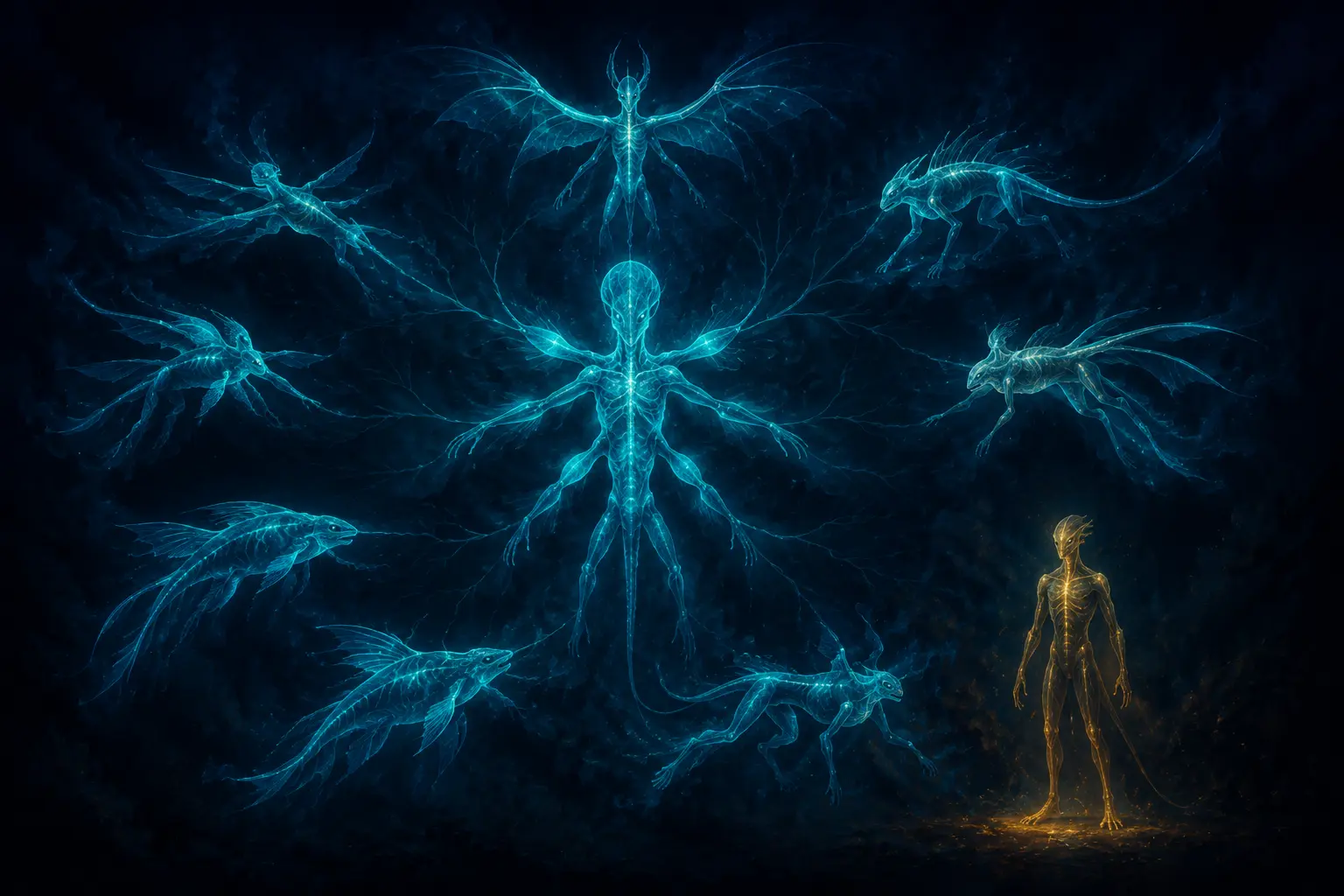
Lay three Pandoran skeletons side by side on a dark bench — a thanator that runs down prey through the understorey, a mountain banshee that rides the thermals off the Hallelujah ridges, a tulkun that sounds to the cold deeps of the Eastern Sea — and at first you see only their differences: the running legs, the great wing-arms, the flippers. Look a moment longer and the differences dissolve into a single, stubborn sameness. Six limbs, arranged the same way. Four eyes, in two pairs. A pair of fine neural braids — the queues — rising from the temples. The same lightweight, holey, carbon-threaded bone. The same lateral breathing slits down the flanks. You are not looking at three designs. You are looking at one design, spoken in three dialects.
This is the first thing a visiting biologist notices about Pandora, and it is genuinely strange. On Earth a fish, a bat, and a tiger do not share a body plan this tightly — they share a distant skeleton of four limbs, yes, but everything above that has wandered for hundreds of millions of years. On Pandora the wandering seems hardly to have happened. Nearly every large animal on the moon, in the air and on the ground and under the sea, is stamped from the same six-limbed press. And then, walking through the middle of this orderly bestiary on two legs, comes the exception that the whole chapter is really about: the Na'vi, who have four limbs, two eyes, and a single queue, and who breathe not through flank-slits but through a nose. The cleverest creature on Pandora is the one that breaks Pandora's rule.
That is the mystery. Why would a world build almost all of its life to one template — and why would its one sapient lineage be the only thing to abandon it? The answer is not in the Avatar films, which never explain it, and it is not something we are free to invent. But it is, remarkably, sitting in plain sight in a branch of Earth biology that spent the last half-century learning exactly how bodies get built and rebuilt. To read the riddle of the six limbs, we have to learn to read the instructions that draw a body in the first place.
A pattern is a clue, not a coincidence
Start with what the sameness means, because a biologist reads a shared pattern the way a detective reads a shared fingerprint. When several species all carry the same complicated, specific feature, there are only two explanations on the table. Either each lineage invented the feature independently because the environment pushed them toward it — or they all inherited it from a common ancestor who had it first. The first is called convergence; the second is common descent. Telling them apart is one of the oldest games in biology, and the rule of thumb is this: the more arbitrary and intricate the shared feature, the less believable convergence becomes.
A streamlined torso can evolve again and again — a dolphin, an ichthyosaur, and a shark all arrived at the same fishlike shape from wildly different starts, because water imposes one efficient form on anything that swims fast. That is convergence, and it is real. But a streamlined shape is simple; the sea more or less dictates it. Now ask convergence to deliver something arbitrary and detailed — not "be streamlined" but "build precisely six limbs, in two pectoral pairs and one pelvic pair, plus exactly four eyes, plus a pair of living data-cables at the temples wrapped in sensitive sheaths, plus bone shot through with carbon fibre." There is no law of physics that demands that particular combination. A planet could run perfectly well on four limbs, or eight, or on creatures that breathe through their faces. The fact that Pandora keeps producing that exact, fussy specification, over and over, in animals as different as a flying predator and a deep-sea giant, is not something the environment can plausibly have hammered out independently each time.
So the orderly sameness is not a puzzle to be explained away — it is a conclusion. Pandora's animals look alike because they are alike: descendants of a single ancestral creature that already had six limbs, four eyes, paired queues, and carbon-threaded bone, and that passed this whole package down to a radiation of descendants who then bent it — but never broke it — to run, fly, and swim. A terrestrial biologist handed this bestiary would not hesitate. She would group every one of these animals, from the thanator to the tulkun, into a single branch of the tree of life, united by their shared signatures, and she would call that branch monophyletic — one ancestor, all its descendants. The whole zoo is one family.
Cladogram of the bilateral lattice
And that is exactly what makes the Na'vi so awkward. They sit inside this family — they have the queue, they have the carbon-laced bone, they plug into the same neural sockets as the rest — and yet they have thrown away three of the family's defining signatures at once. Two of their limbs are gone. Two of their eyes are gone. One of their queues is gone. To understand how a member of a family can shed the family's own hallmarks, we have to stop looking at the finished skeletons and go back to the workshop where bodies are drawn.
The body's hidden blueprint
Here is the idea that cracks everything open, and it took Earth science most of a century to find it. An animal's body is not assembled part by part from a giant parts-list, the way you might build a model from a thousand named pieces. It is drawn, early in the embryo, by a small set of master genes that lay down a coordinate system — a kind of invisible grid — and then label each region of that grid with an address. The body parts come later, built by local cells reading the address they find themselves at. Change the addresses and you change the body, without ever touching the machinery that builds a limb or an eye. This whole field — how genes draw bodies, and how changing the drawing changes evolution — is called evolutionary developmental biology, evo-devo for short, and it is the key to the six limbs.
The thing being drawn is the body plan: the fundamental architecture an animal is built on. Almost every animal you can name, on Earth or on Pandora, belongs to a vast group called the Bilateria, defined by one deep feature — bilateral symmetry, a body with a left and a right that mirror each other along a head-to-tail line. That line is the master axis, and the embryo's very first job is to set it up: which end is head, which is tail, which side is back, which is belly. Once that grid exists, everything else is positioned against it.
The genes that write addresses
The labels written onto that grid are the work of one famous family of genes — the Hox genes — and they are worth meeting properly, because they are the engine behind both the six limbs and the Na'vi exception. A Hox gene does not build anything. It is not a gene "for" a leg or "for" an eye. It is a label-maker. Each Hox gene switches on in a particular stretch along the head-to-tail axis and stamps the cells there with an identity: you are neck, you are mid-body, you are tail-end. The cells then build whatever their local toolkit knows how to build at that address — a rib here, a limb there — but it is the Hox label that tells them where they are and therefore what to make.
The most beautiful part is how these genes are arranged. Inside the genome the Hox genes sit in a tight row, like books on a shelf, and — astonishingly — the order of the books on the shelf matches the order of the body regions they govern. The gene at one end of the row labels the head; the next one back labels the region just behind the head; and so on down the shelf to the gene that labels the tail. The physical order of the genes mirrors the physical order of the body. Nature almost never lines its machinery up this neatly, and that it does so here, identically, in a fruit fly and a mouse and a person, is one of the great tells that all animals are drawing their bodies with the same inherited pen. Each Hox gene carries a near-identical little stretch of DNA called the homeobox, the part that lets it grab hold of DNA and act as a switch — and finding that same homeobox sequence in creatures separated by six hundred million years was the discovery that lit the whole field up.
The Hox address system
Hover or tap a gene to see the body region it labels.
You can prove a label-maker is a label-maker by moving a label and watching a part appear in the wrong place. This is exactly what the founders of the field did, in the fruit fly, and the results are some of the most vivid in all of biology. There is a mutation called Antennapedia in which a leg-building region's address gets pasted onto the head, where the antennae grow — and the fly dutifully grows a pair of perfectly formed legs out of its head, in the sockets where its antennae should be. The leg-building machinery was fine all along; it simply received the wrong address and built a leg where it was told. A second mutation, Ultrabithorax, switches off the address that normally tells a fly's rear body segment to make small balancing knobs instead of wings — and the segment, reading the now-blank address, reverts to the default of the segment in front of it and grows a second full pair of wings. A four-winged fly, made not by inventing a new wing but by changing one positional label. This kind of one-part-becomes-another transformation has a name — homeosis — and it is the proof that bodies are addressed, not hand-assembled.
One toolkit, endless forms
If the building machinery is shared, how shared is it? The answer, discovered in a series of experiments that genuinely shocked the biologists who ran them, is: almost unbelievably shared. The textbook case is the eye. For a century, biologists assumed that the camera-eye of a vertebrate and the compound eye of an insect had evolved entirely separately — they look nothing alike, after all, and the last ancestor that both shared was a wormlike thing that probably had no proper eyes at all. Then Walter Gehring's lab found that the master switch that orders an eye to form — a gene called Pax6 — is the same gene in a fly and a mouse. The same. And to prove it, they took the mouse version of the gene and switched it on in the wrong places in a fly embryo — on the legs, on the wings, on the antennae — and the fly grew complete, functioning compound eyes there. Not mouse eyes. Fly eyes. The mouse switch flipped, and the fly's own local toolkit built the only kind of eye it knew how to build, wherever the switch was thrown.
That experiment rearranged how biology thinks. It means the deep machinery for building major organs is not reinvented lineage by lineage; it is a single, ancient inheritance, conserved across almost the whole animal kingdom — a phenomenon called deep homology. Sean Carroll, who did as much as anyone to bring these ideas to a wide audience in his book Endless Forms Most Beautiful, gave the inheritance its enduring name: the genetic toolkit. Every animal, he argued, builds its body from broadly the same ancient set of tools — the same eye-switch, the same limb-initiator, the same Hox address-makers. The staggering diversity of animal form is not the diversity of the tools. It is the diversity of how the tools are used.
And that raises the obvious question: if every animal carries the same toolkit, where does all the difference come from? The answer is the quiet hero of this whole story. Around each master gene lies a field of non-coding DNA — switches, in effect, that decide when, where, and how much the master gene turns on. These switches are the cis-regulatory elements, and they are where evolution does most of its real work. You do not have to risk redesigning a precious, deeply conserved master gene — a change there tends to break everything at once. You only have to retune one of its switches: add a spot of pigment to a wing here, suppress a limb on one body segment there, dial an organ's size up or down. Tiny edits to the switches, leaving the tools themselves untouched, are enough to turn one body plan into a thousand. The toolkit is universal; the switching is everything.
This is the lens we needed. Pandora's whole bestiary — six legs or two wings or six flippers — is one toolkit, thrown into different configurations by different settings of the same switches. And the Na'vi, the great exception, are not a different toolkit at all. They are the same tools, with three switches turned off.
The exception, and a tempting wrong answer
So: how did a creature inside the six-limbed family end up with four limbs? For years the popular answer — printed in an early Avatar companion guide and repeated ever since — was fusion. The Na'vi's ancestors, the story went, had the standard six limbs, and at some point the front and middle pairs of arms simply merged, two limbs flowing together into one, leaving the four-limbed Na'vi we see. It is an intuitive picture. It is also, by the logic of how bodies are actually built, almost certainly wrong — and the official canon has since quietly retired that guide, leaving the question genuinely open. That gives us licence to do what a real biologist would do: throw out the fusion story and reason from how limb number actually changes.
The trouble with fusion is mechanical and developmental at once. Limbs are not soft clay that can be pressed together; each is a fully articulated structure with its own bones, its own muscles, its own nerves and blood supply, built from its own patch of embryo. To fuse two mature limbs into one clean limb you would have to merge two complete skeletons seamlessly — and the giveaway is that the result would carry the scars. A fused forearm should contain doubled bones: two radii, two ulnae, crammed together where two limbs became one. But the Na'vi forearm is anatomically immaculate — one humerus, one radius, one ulna, the textbook layout of a single limb that was always single. There is no doubling, no seam, no relic of a second arm. Whatever happened to the Na'vi's missing limbs, they did not get folded into the surviving ones.
Limb fusion (rejected)
Two complete limbs press together into one. Prediction: the survivor carries doubled bones — two radii, two ulnae — and a visible seam. The Na'vi forearm shows none of this. Mechanically, mature limbs do not merge cleanly. The old companion-guide story, now out of canon.
Limb loss (the Earth way)
One limb pair is simply never built — its developmental switch is turned off, so no limb bud ever forms. Prediction: the surviving limbs are perfectly normal, just fewer. This is how snakes lost their legs. It matches the Na'vi exactly.
There is a far better model, and Earth has already run the experiment for us — in snakes. A snake is a tetrapod that has lost its limbs, and we know in fine detail how it happened. It was not that snake legs withered or fused. It was that the switch which turns the limb-building program on — a far-flung regulatory element controlling the Sonic hedgehog gene, the signal that drives a limb bud to grow — accumulated mutations and went dark. With the switch off, the limb bud never gets the signal to grow out, and so no limb forms at all. The building machinery is still there, intact, untouched; it simply never receives its start command in that region. Pythons, which switched the limb program down only partway, still carry tiny vestigial leg-spurs as proof; advanced snakes, whose switch is fully dead, have nothing. Crucially, because only the switch was broken and not the Sonic hedgehog gene itself, the gene carries on doing its many other essential jobs elsewhere in the body — patterning the brain, the organs — without disruption. That is the whole genius of editing switches instead of tools.
Read the Na'vi through the snake and the riddle resolves. The Na'vi did not fuse their middle limbs into their front ones. Their lineage simply switched off the developmental program for the middle limb pair — silenced one address — so that those limbs were never built in the first place. The front arms and the hind legs, their own switches untouched, grew out perfectly normal. Four immaculate limbs, not because two were merged, but because one pair was quietly never made. The same edit that took the legs off a snake took the middle arms off the ancestors of the Na'vi.
Reading the prolemuris
There is a living creature on Pandora that looks like a freeze-frame of this very process, and it is worth dwelling on because it is the closest thing we have to a witness. The prolemuris is a slender, arboreal animal of the canopy, and it sits oddly between the six-limbed bestiary and the four-limbed Na'vi. It already has just two eyes, not four, and a single queue, not a pair — the Na'vi reductions, already underway. But its arms are the strange and telling part. From each shoulder a single upper arm extends — one humerus — and then, at the elbow, it splits: the forearm divides into two complete forearms, each with its own hand. One shoulder, one upper arm, two forearms, two hands.
The fusion story loved the prolemuris, reading those split arms as limbs caught halfway through merging — two arms in the act of becoming one. But the developmental reading is the opposite, and far more elegant. A limb grows under the command of a small signalling centre at its growing tip, which drives the limb outward and is marked by the activity of a gene family called Distal-less — the universal "grow a limb outward from here" instruction. Normally there is one such tip-centre per limb, producing one limb. In the prolemuris, the most natural model is that the single limb bud begins normally, builds one shared upper arm — and then, partway down, its growth-tip splits in two, and each half carries on independently, each building its own forearm and hand from the elbow down. Not two arms fusing into one. One arm budding into two at the tip.
Either way, the prolemuris tells us the lineage leading toward the Na'vi was already deep in the business of editing its limbs and reducing its sensory hardware — exactly the tinkering the snake model predicts. It is not the Na'vi's ancestor, precisely, but it is a cousin frozen mid-edit, and it shows the edits are the kind evolution makes all the time: not grand fusions, but switches thrown, tips split, addresses rewritten.
One toolkit, three switches
Now we can put the whole bestiary together under one machine. Picture the ancestral Pandoran body as having not two limb-building zones, like Earth's tetrapods, but three — call them Pectoral-A near the shoulders, Pectoral-B just behind it, and Pelvic at the hips. Each zone is a switch that can be turned up, dialled down, or shut off entirely, and each zone's output can be sculpted into legs, wings, flippers, or claws by the local toolkit. That is the entire kit. Every animal on Pandora is one setting of those three switches.
Turn all three up and you get a thanator: six heavy running legs, the full ancestral six-limbed runner. Take the two pectoral zones and remodel them into great flight membranes while dialling the pelvic zone down to vestigial claws, and you get the mountain banshee — wings up front, the hindlimbs reduced to little grappling hooks for clinging to cliffs. Keep all three but reshape them for water and you get the six-flippered swimmers. And then take the ancestral runner, leave Pectoral-A to become a pair of agile arms, leave the pelvic zone to make ordinary legs — and switch Pectoral-B off. The middle limbs are never built. What walks out is a four-limbed creature with immaculate arms and legs, standing upright, freed of its middle pair: the body plan of the Na'vi.
One toolkit, three switches
Thanator — six running legs
Notice what the toggle is really showing: at no point does anything get added or merged. Every creature on Pandora, from the most fearsome predator to the sapient Na'vi, is the same ancestral kit with its switches set differently. The diversity is real but it is shallow in the genome — it lives in the regulatory settings, not in the tools. This is precisely Carroll's lesson, transplanted to another star: endless forms, most beautiful, from a single conserved toolkit, by the editing of switches. Pandora simply took the lesson further than Earth did, holding more of its bestiary to one template — until one lineage started throwing switches off and walked out of the pattern.
Eyes, queues, and the breath
Limbs are the loudest of the Na'vi's losses, but they are not the only ones, and the same logic accounts for the rest.
The Na'vi have two eyes where the lattice has four. The simplest reading, in the language we now have, is a switch again: the ancestral eye-building program ran twice, making a primary pair and a secondary pair, and somewhere on the line to the Na'vi the switch for the secondary pair went dark — the same Pax6 eye-master we met in the fly, with one of its regional switches silenced, so the second pair of eyes was simply never built. Four eyes to two, by the same trick as six limbs to four.
The queue is subtler and more speculative, because canon tells us less about how it forms. The lattice carries a pair of queues, one at each temple; the Na'vi carry a single queue at the back of the head. A reasonable guess, and we should flag it as a guess, is that this is a story about the body's midline. The machinery that decides left-from-right in an embryo can, if retuned, pull a normally-paired structure together onto the centre line — fuse two organizing centres into one at the midline — and a single central queue is what you would get. It is a guess consistent with how laterality works on Earth, no more.
The breath is the strangest reduction of all, and the most honest place to admit how much we are inferring. The lattice breathes through the operculum — paired slits down the flanks that feed air straight to the lungs, bypassing the head entirely. The Na'vi have no opercula at all; they breathe, like us, through a nose. To go from one to the other, an ancestral lineage had to do two things at once: switch off the flank-breathing program and switch on a cranial breathing passage that had been suppressed since deep in Pandoran history. That is a larger and more coordinated change than silencing a limb, and canon offers no fossils to show the steps. We can say the kind of change — a shift in which developmental program runs, and when — is the sort of thing evolution does. We cannot say we have watched it happen. It is the biggest open edge in the whole reconstruction.
Honest edges
It is worth being plain about what we have done here, because the line between knowing and guessing is exactly what this book is for. The hard, canonical facts are the anatomy: the six-limbed lattice and its shared signatures, and the four-limbed, two-eyed, single-queued, nose-breathing Na'vi inside it, with the prolemuris sitting in between. Those are given. The grand framework we hung on them — Hox addresses, the shared toolkit, Pax6, limb loss by switched-off enhancers — is real Earth science, as solid as biology gets, and the snake is a genuine worked example of exactly this kind of limb loss. What is inferred is the bridge: the claim that Pandoran life uses the same kind of machinery, and that the Na'vi's losses are switch-offs rather than fusions. That inference is strong — it is the only model that fits the immaculate, unscarred Na'vi skeleton — but it is an inference, not an observation.
And then there is what stays frankly speculative, and we have tried to label it as we went: the three-zone limb model in its specifics, the midline-fusion story for the queue, the order in which eyes, queues, and breath were edited, and above all the absence of any fossil intermediate to show the steps. There is no Pandoran fossil record on the table that catches the six-limbed ancestor in the act of becoming the four-limbed Na'vi. The prolemuris is a living hint, not a documented ancestor. We have reasoned from anatomy and from Earth's deep playbook to the most parsimonious story — and parsimony, the preference for the explanation that asks for the fewest unsupported leaps, is the right tool here. But a hint is not a lineage, and a parsimonious story is a hypothesis, not a chronicle.
The signature in the bone
Come back, at the end, to the three skeletons on the bench. What looked at first like three different animals turned out to be one sentence written three ways — and the grammar of that sentence is the same grammar that writes a fruit fly, a snake, and you. A body is a set of addresses; the parts are built by a toolkit so old and so shared that a mouse's eye-switch will grow eyes on a fly; and the breathtaking variety of animals, on Earth or under a gas giant four light-years off, is mostly the variety of which switches are thrown. The six limbs of Pandora are a synapomorphy — a shared signature of one deep ancestor — and the Na'vi, walking through the middle of that signature on two legs, are not a contradiction of it but its most elegant variation: the same kit, three switches quieter, every surviving part still bearing the family's mark.
The deepest thing Pandora teaches here is the one easiest to miss. The Na'vi are not the lattice's opposite. They are the lattice, edited — kin to the thanator and the tulkun in the only way that finally matters, which is ancestry. The queue at the back of a hunter's neck is the same organ, relocated, that rides the temples of every great beast she will ever bond with. That is why the bond works at all. To read the six limbs honestly is to discover that the most human-seeming creatures on Pandora are written in the planet's own deep hand — and that the alphabet, when you finally learn to read it, is one we already know.
What stays open
The anatomy points hard at loss: a fused limb should carry doubled bones and a seam, and the Na'vi forearm has neither — it is the clean, single-boned layout of a limb that was always single. Limb loss by a switched-off enhancer is also the mechanism Earth actually uses, as in snakes. Fusion of mature limbs is mechanically extreme and leaves traces the Na'vi lack. So loss is far better supported — but with no fossil sequence, it remains an inference from anatomy, not a recorded fact.
Canon simply gives no Pandoran fossil record for this transition. The prolemuris is a living animal with intermediate features — two eyes, one queue, a split forelimb — but it is a present-day cousin, not a dated ancestor. The gap is real and unresolved; we reason across it with Earth's developmental playbook and the principle of parsimony, not with specimens.
This is the largest leap in the reconstruction. It requires switching off the ancestral operculum program and switching on a cranial airway suppressed since deep Pandoran history — a coordinated change bigger than silencing a limb. The kind of change is one evolution makes; the specific steps are unrecorded. It is the chapter's most speculative edge.