

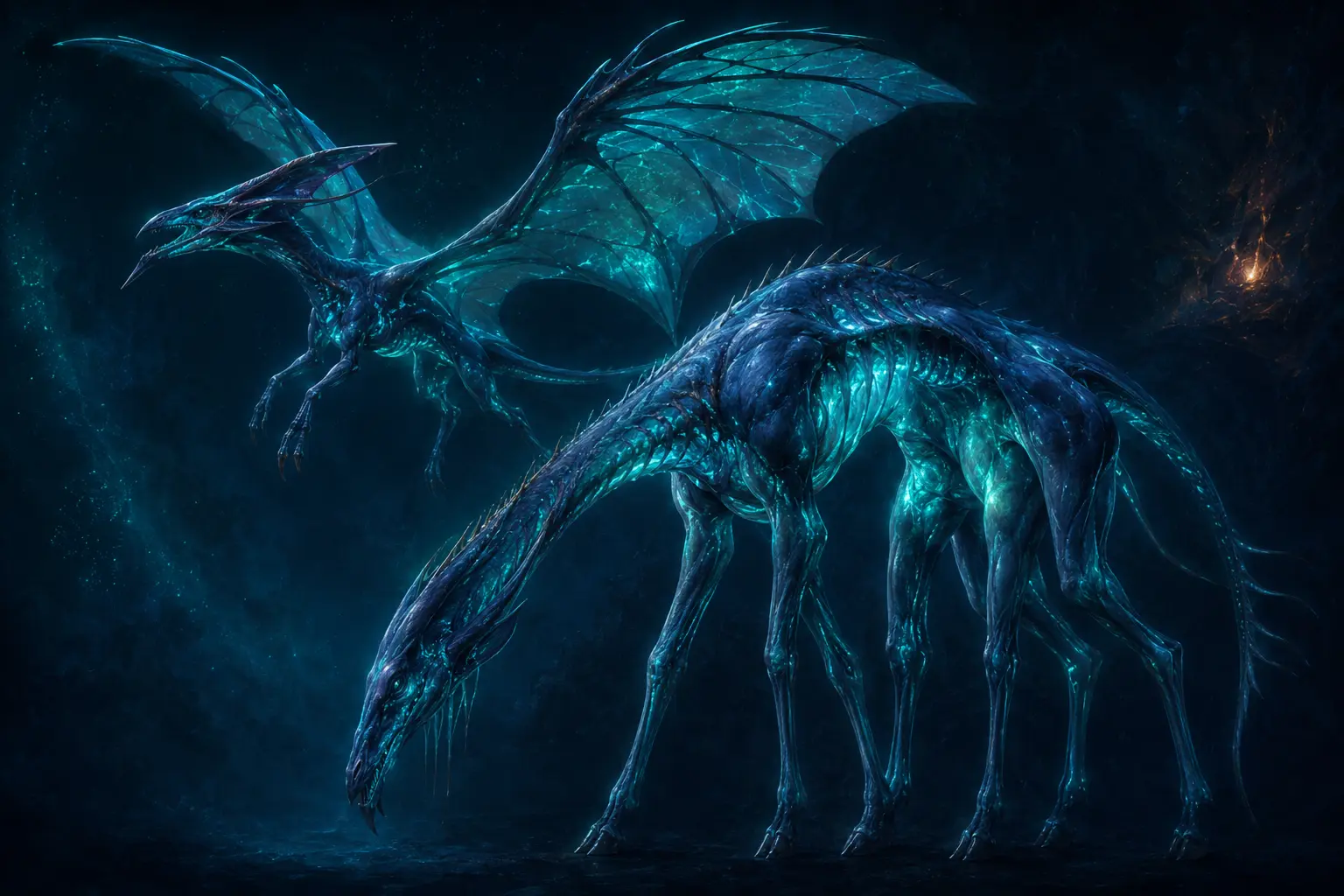
Lay a pa'li and an ikran side by side on the dissection bench and you are looking at two things that, by the plain physics of bodies, ought not to exist. The first is a horse the size of an elephant. It stands four metres at the shoulder, runs down open ground at ninety-five kilometres an hour, and does it on legs that look far too slender for the job — legs that, by Earth's rules, every galloping stride should snap like green wood. The second is a flying animal with the wingspan of a small aircraft, fourteen metres tip to tip, that launches itself off a sheer cliff with a fully grown Na'vi clinging to its back — a feat of lift that no creature in Earth's entire fossil record could manage, not even close.
Neither of these animals is magic. That is the whole wager of this chapter. Everything that makes them seem impossible — the slender legs under the elephantine body, the airliner wingspan that still beats and climbs — is the predictable output of a few physical laws, run on a planet where three of the input numbers have been changed. To see why, we have to do what a comparative biologist does with any astonishing animal: stop admiring it and start measuring it. We have to weigh it against the laws that govern every body that has ever lived, and find exactly where Pandora bends them.
The laws in question have a name. The study of how an animal's shape, strength, and inner workings must change as its size changes is called allometry, and the broader science of how living bodies move and bear loads is biomechanics. They are not exotic. They are the same rules that explain why an ant can carry fifty times its weight and an elephant cannot jump, why a mouse's heart races and a whale's barely ticks, why there are no land animals the size of a cargo ship. Learn to read the pa'li and the ikran through these rules and two things happen at once: the animals stop being fantasy and become specimens, and the rules themselves — abstract, easy to nod past — suddenly have teeth.
The pa'li, on the table
Begin with the direhorse, because it is the simpler impossibility. The canon gives us its dimensions cleanly: roughly four and a quarter metres from nose to haunch, four metres at the shoulder, built on the six-limbed frame that runs through nearly all of Pandora's large land animals. Three pairs of legs, not two. The front and rear pairs are long and stretched for stride, swinging in the cursorial rhythm of a dedicated runner; the middle pair is the interesting one, shorter and planted, used for traction and for the violent sideways pivots a four-tonne animal needs to turn at speed without simply sliding off its own momentum. Above this runs a long, muscular neck ending in a small streamlined head, and a tubular sucker-mouth with a giraffe-like tongue for drinking nectar from the great pitcher-plants it pollinates. Down each flank, instead of a breathing nose, run the paired slits of the operculum — the flank intakes that feed air straight to the lungs.
What canon conspicuously does not give us is a weight. There is no stated mass for the pa'li anywhere in the official material — a genuine gap, and a frustrating one, because mass is the number everything in biomechanics hangs on. So we do what a field biologist would do with an unweighed carcass: we estimate it from size, using an animal we can weigh. Take a large Shire horse — about two and a half metres long, around twelve hundred kilograms. If the pa'li were simply a Shire scaled up to its full length, keeping the same proportions, how heavy would it be? The answer is not "a bit more." It is the first hard lesson of scaling, and it is brutal.
Why size is never free
Here is the rule that governs every body, written by Galileo almost four centuries ago and never once broken since. When you scale an object up while keeping its shape the same — a process called isometry — its different dimensions grow at wildly different rates. Length grows as length. But surface area, which depends on two dimensions, grows as the square of length: make something twice as long and its skin, its cross-sections, its wing area all become four times larger. And volume — and therefore weight, since weight is just volume times density — grows as the cube of length: twice as long means eight times as heavy. This is the square-cube law, and the entire drama of large bodies flows from the mismatch it describes: as a thing grows, its weight races ahead of the area available to support it.
The square-cube scaling trap
Scale an animal up and watch mass outrun wing area
Follow that through to the skeleton and the trouble becomes concrete. An animal's weight presses down through its bones, and a bone's ability to resist that press depends on its cross-sectional area — the thickness of the strut. But weight grows as the cube of length while bone cross-section grows only as the square. Divide the one by the other and the stress on every bone rises in direct proportion to body length. Double an animal's size and you have doubled the load each bone must bear, even as that bone has grown proportionally no thicker. Keep scaling and you reach a point where the animal's own weight will shatter its skeleton the moment it tries to move. This is why you cannot simply photograph a mouse and blow it up to the size of a horse: the blown-up mouse, with a mouse's slender proportions, would collapse under itself. Its shape would have to change.
Run our Shire horse up to the pa'li's length this way — scaling the mass by the cube of the length ratio — and the twelve-hundred-kilogram horse becomes something close to five tonnes. The pa'li, taken as a scaled-up horse, should weigh as much as a large Asian elephant. And that single number is the source of everything strange about it. Because an elephant does not, and cannot, run at ninety-five kilometres an hour. An elephant cannot truly run at all — at full speed it manages a fast amble, never fully airborne, because its five-tonne body has already spent its entire skeletal safety margin just standing up. The pa'li has the mass of an elephant and the gait of a racehorse. By the square-cube law, that combination should be a pile of broken bone.
Building a runner that big
So how does Earth build its large runners, and where does the pa'li break the pattern? Real animals, faced with the square-cube law, have only a few options, and biomechanists have mapped them precisely. The smallest animals can afford to ignore the problem — a shrew's bones are so over-strong for its featherweight body that it can keep slender, geometrically scaled limbs. But as mass climbs, animals are forced toward what is called elastic similarity: their leg bones grow disproportionately thick and short, becoming the stout columns you see under a rhino or an elephant. The bone gets stubby because that is the only way to keep the stress inside it survivable. Grace is traded away for sheer cross-section. A graviportal giant — an elephant, a sauropod — is an animal that has paid for its size by surrendering speed, buying structural safety with thick, pillar-like legs swung slowly.
The pa'li refuses this trade. It carries an elephant's mass on a runner's slender legs, and it gallops. By the rules we have just laid out, that should be impossible — so one of the rules' inputs must be different. Two of them are.
The first is the bone itself. Pandoran skeletons are not built of plain calcium-phosphate like ours; they are shot through with a naturally grown carbon-fibre composite, the same trick a human engineer uses to make a bicycle frame both lighter and stiffer than steel. The relevant property is stiffness — resistance to bending and buckling — and carbon fibre delivers far more of it per gram. A bone perhaps three times stiffer than ours can resist the same buckling load with markedly less material. Work the numbers through the buckling equation and a stiffness tripled lets the bone be roughly a quarter thinner while standing up to the same force. That is the pa'li's slenderness, accounted for: not a body that escaped the square-cube law, but one built from a better material, so the law's penalty is paid with thinner struts. The legs look too slender for the mass because, by Earth's materials, they would be. By Pandora's, they are exactly enough.
The second changed input is gravity. Pandora pulls down at about four-fifths of Earth's strength, and weight is mass times gravity, so the same body weighs a fifth less there. Every load we have been tracking — the stress in the bone, the force of each footfall — is eased by that fraction before the animal even moves. And gravity reaches into the gait itself, in a way that is worth seeing properly, because it is one of the most elegant results in all of locomotion science.
When biomechanists want to compare how a mouse and a horse run — animals of utterly different size — they use a single dimensionless number that strips size away, the Froude number. It measures speed against the pull of gravity on a leg of a given length, and its power is this: animals of any size change gait at the same Froude number. Walk becomes trot at a Froude number of about a half; the absolute ceiling of walking, beyond which an animal is forced to run or fall, sits near one. A dog and a draft horse break into a trot at the same Froude number despite their size gap — that is what makes the number so useful. And because the Froude number puts gravity in its denominator, lowering gravity lowers the actual speed at which each transition happens.
Froude gait dial
Put those together and the pa'li's gallop stops being a paradox. Under Pandora's gravity, with the pa'li's long legs, the walk-to-run transition arrives at a lower absolute speed than it would on Earth — the animal slips into its efficient, bouncing, tendon-sprung running gait early, and a running gait is kinder to the skeleton than a heavy walk, because elastic tendons catch and return the energy of each stride like a pogo stick, sparing the bones the full shock. Lighter footfalls from weaker gravity, slenderer-but-stiffer bones from carbon fibre, and an early shift into spring-loaded running: three effects stacking in the same direction. The elephant-massed body runs because, on Pandora, the bill for running at that size has been cut three ways at once.
Except that the Froude number was derived for animals with four legs, and the pa'li has six. That third pair is not decoration and not redundancy, and it is where the animal stops being a scaled-up horse. A running gait works by letting both stride pairs leave the ground at once — that airborne instant is what loads the tendons — but an animal cornering at ninety-five kilometres an hour needs something planted to push sideways against, and it needs it at exactly the moment the stride legs have let go. Those two demands pull in opposite directions, and the only thing that can satisfy both is timing: when in the stride the short middle pair comes down.
Six legs are a timing problem
When each foot is down decides support, spring, and the brace for a turn
The metabolic tax
There is a quieter scaling law working on the inside of the pa'li, and it sets the bill for simply being alive at that size. An animal's metabolic rate — the rate at which it burns energy — does not rise in step with its mass. It rises more slowly, as mass raised to the power of roughly three-quarters, a relationship so robust across the whole tree of life, from microbes to whales, that it carries its own name: Kleiber's law. Double an animal's mass and its energy demand goes up by less than double. Per kilogram, big animals are astonishingly economical; their cells idle slower, their hearts beat slower, they live longer and cooler than their small cousins.
For the pa'li this three-quarter law is a gift and a constraint at once. A gift, because a near-five-tonne body that paid full freight for its mass could never gather enough nectar to fuel itself; the economy of scale is what makes a giant nectarivore even thinkable. A constraint, because oxygen still has to reach all that slow-burning tissue, and here the flank-breathing opercula earn their place — they feed air in one continuous direction across the gas-exchange surface, the same high-efficiency, one-way flow that lets birds breathe at altitude, rather than the in-and-out tidal sloshing of our own lungs. We dwell on that respiratory engine elsewhere; here it is enough to see that it is the intake manifold bolted to a body whose energy budget is set by a three-quarter-power law. The pa'li's slow, deep, efficient physiology is not a separate marvel from its running. It is the same scaling story, told on the inside.
The ikran, and the harder problem
Now the flyer, and a harder problem by far — because flight punishes size more savagely than running does. Running animals fight the square-cube law through their skeletons; flying animals fight it through the air itself, and the air is a less forgiving creditor.
Start, as before, with the specimen. The mountain banshee spans twelve to fourteen metres across the wings and runs to about ten metres in body length. It is built, strikingly, on only four limbs, not the six of the pa'li and most Pandoran land animals — its lineage took the ancestral six-limbed frame and committed all four forelimbs-and-hindlimbs to flight, the front pair becoming the great membranous fore-wings and the rear pair the smaller "stabs" that act as stabilisers and, in a climb, as auxiliary thrusters. A keel of bone juts from its chest to anchor flight muscles canon describes as nearly twice as forceful per gram as a bird's, and its bones are hollow as well as carbon-threaded, a bellows of air running through the skeleton to cool the animal and lighten it at once.
That last detail deserves more than a passing mention, because "hollow" is doing a great deal of quiet work. Bone shot through with air spaces — pneumatic bone, in the anatomist's word — is not weakened bone. A tube is not a weakened rod; at equal stiffness it is a lighter rod, because bending is resisted almost entirely by the material furthest from the centre, and everything near the axis is mass carried for nothing. Hollow the core out and the same rigidity survives on a fraction of the material — which is exactly why bird and pterosaur wing bones are thin-walled shells rather than solid struts, and why the banshee can afford to run cooling air through the middle of its own skeleton. But the saving is not free forever. Thin the wall far enough and the bone stops failing by bending and starts failing by crumpling, the way an empty can gives way underfoot.
Hollowing a wing bone, without losing it
Same rigidity throughout — only the wall thickness and the material change
And here canon hands us not a gap but a contradiction. Community references routinely give the ikran a mass of one and a half tonnes. That figure is not just large; it is aerodynamically impossible. No animal massing fifteen hundred kilograms could fly on a fourteen-metre wing — the load on the wing would be so far beyond what any beating membrane can support that the creature would never leave the ground, on Pandora or anywhere else. The honest number, the one forced by the physics of flight, is far smaller: somewhere in the region of two hundred to two hundred and fifty kilograms, in the same range as Earth's largest-ever flyer. Why that limit is so unyielding — the two curves that cross and set an absolute ceiling on anything that flaps — belongs to IV.4 — Why Banshees Get to Be Big, which takes the wall apart properly. What concerns us on this bench is what the ceiling costs a body, and that we can read straight off the specimen.
The same budget, spent in the air
The pa'li bought its slender legs with two of Pandora's changed constants: better bone and weaker gravity. The banshee spends from the same purse, but it draws a different pair. Gravity carries over unchanged — at four-fifths of Earth's the animal weighs a fifth less, so it needs a fifth less lift to hold itself up. Bone reappears in a new form, hollowed as well as carbon-threaded. And a third constant, idle on the ground, finally does some work: air a fifth denser than Earth's means every square metre of wing gets more purchase on each downstroke, because lift is made by throwing air downward and there is simply more air to throw. What those last two do to the ceiling itself is the other chapter's business. Here the point is narrower and it is about anatomy. The concessions this body makes to stay under the wall — hollow bone, a keel out of all proportion, four limbs surrendered to flight and none left for walking — are what a skeleton looks like when it is built right up against a limit rather than comfortably inside it.
Notice what this does and does not say. Pandora did not produce a flying animal heavier than physics permits. The ikran weighs about what Earth's largest flyer weighed; it sits at the ceiling, not above it. What changed is where the ceiling sits — far enough that an animal of that mass can not merely glide but launch, climb, and haul a passenger, none of which Quetzalcoatlus could have done. The banshee is not a bigger animal than Earth allows. It is an Earth-limit animal living under kinder constants, with the slack spent on a rider.
The cable at the back of the neck
There is one more feature on the bench, and it belongs to neither animal alone. Where the pa'li's neck meets its skull, and behind the ikran's head, runs the neural queue — a living extension of the spinal cord, sheathed in skin, opening at its tip into a fan of fine pink tendrils. These are not decoration and not reins. When a Na'vi joins their own queue to the animal's, in the bond called tsaheylu, the tendrils interlace and the two nervous systems link directly — canon's own image is a biological data cable, brain to brain. Motor commands flow out, sensation flows back; the rider feels the wind through the animal's body and steers it as they would their own limb. Everything this chapter has measured — the slender carbon legs, the wing at the edge of the flight ceiling — describes the mount. The queue is what turns that mount into an extension of the rider. We open up its mechanism in its own chapter; here it is the final reminder that on Pandora the boundary between rider and ridden is, quite literally, a thing you can plug in.
Honest edges
It is worth being plain about which parts of this dissection are firm and which are reconstruction. The dimensions are canon: the pa'li's four metres and ninety-five kilometres an hour, the ikran's twelve-to-fourteen-metre span, the carbon-fibre bone, the flank opercula, the queue. The scaling laws are about as solid as science gets — the square-cube law, Kleiber's three-quarter law, Froude dynamic similarity, the flight power ceiling are all heavily evidenced Earth biomechanics, and Quetzalcoatlus is a real worked example of where Earth's flight ceiling actually fell.
What is inferred is the bridge between them: the masses, above all. Canon states no weight for either animal, so the pa'li's ~4 tonnes and the ikran's ~250 kilograms are estimates — the first from scaling a draft horse, the second forced by the flight ceiling and cross-checked against the wing loading a beating wing can sustain. They are good estimates, constrained from two directions, but they are estimates, and we have flagged them as inference throughout rather than smuggling them in as fact. The community's 1.5-tonne ikran we have rejected outright, not on taste but because it fails the physics by a factor of six. And a handful of things stay frankly speculative — the exact stiffness multiplier of Pandoran bone, the precise division of labour between the ikran's fore- and hind-wings, the detailed muscle physiology behind canon's "twice the force per gram." Where the research note itself marked a gap, we have left it a gap rather than papering over it with a confident number.
What the bench tells us
Come back to the two animals lying side by side. What looked at first like fantasy — an elephant that gallops, a pterosaur that carries a passenger — turned out to be ordinary physics fed three changed numbers. Stiffer bone, weaker gravity, denser air: that is the entire budget Pandora spent, and every impossibility on the table is bought with it. The pa'li's slender legs are a materials choice. Its gallop is a gravity effect. The ikran's rideable flight is an air-density-and-gravity effect sitting right at the same mass ceiling that capped Earth's greatest flyer. Nowhere did a law get broken. The laws did all the work; Pandora only changed what they were working with.
The bench has one more thing to hand us, and it outlasts the two animals on it. The size and speed and grace of bodies are not free design choices an evolving lineage can simply select. They are negotiated, every one of them, against physical laws that do not bend — the square-cube law, the Froude number, the flight ceiling — and the negotiation comes out differently on different worlds only because the constants those laws contain are different. Hand a biologist the pa'li and the ikran with no backstory, and from the bones alone she could read off the gravity, guess at the air, and deduce that the skeleton was made of something better than ours. The animals are a measurement of their planet. Learn to weigh them against the laws, and an alien creature stops being a marvel to gawp at and becomes what it truly is: data about the world that made it.
What stays open
Canon never says. Scaling a large draft horse up to the pa'li's stated length by the cube law gives roughly 5 tonnes, but the carbon-fibre skeleton and the bulky-nasal-cavity-free skull both shave that down, so the working estimate is nearer 3.8–4.2 tonnes. It is an inference from Earth analogues, constrained but unconfirmed — no official mass exists to check it against.
No. A 1.5-tonne animal on a 14-metre wing would carry a wing loading far beyond what any flapping membrane can support — it could not take off even in Pandora's dense, low-gravity air. The physics forces a mass near 200–250 kg, in the range of Earth's Quetzalcoatlus. The 1.5-tonne figure is community extrapolation that fails the aerodynamics by roughly sixfold, and we reject it on those grounds.
The threefold figure is an illustrative estimate, not a canon measurement. Canon establishes that the bone is a carbon-fibre composite and that it is lighter and stronger than Earth bone; the specific stiffness multiplier is chosen to make the pa'li's observed slenderness come out right. The direction is canon; the exact number is a worked assumption, and a real specimen could move it.