

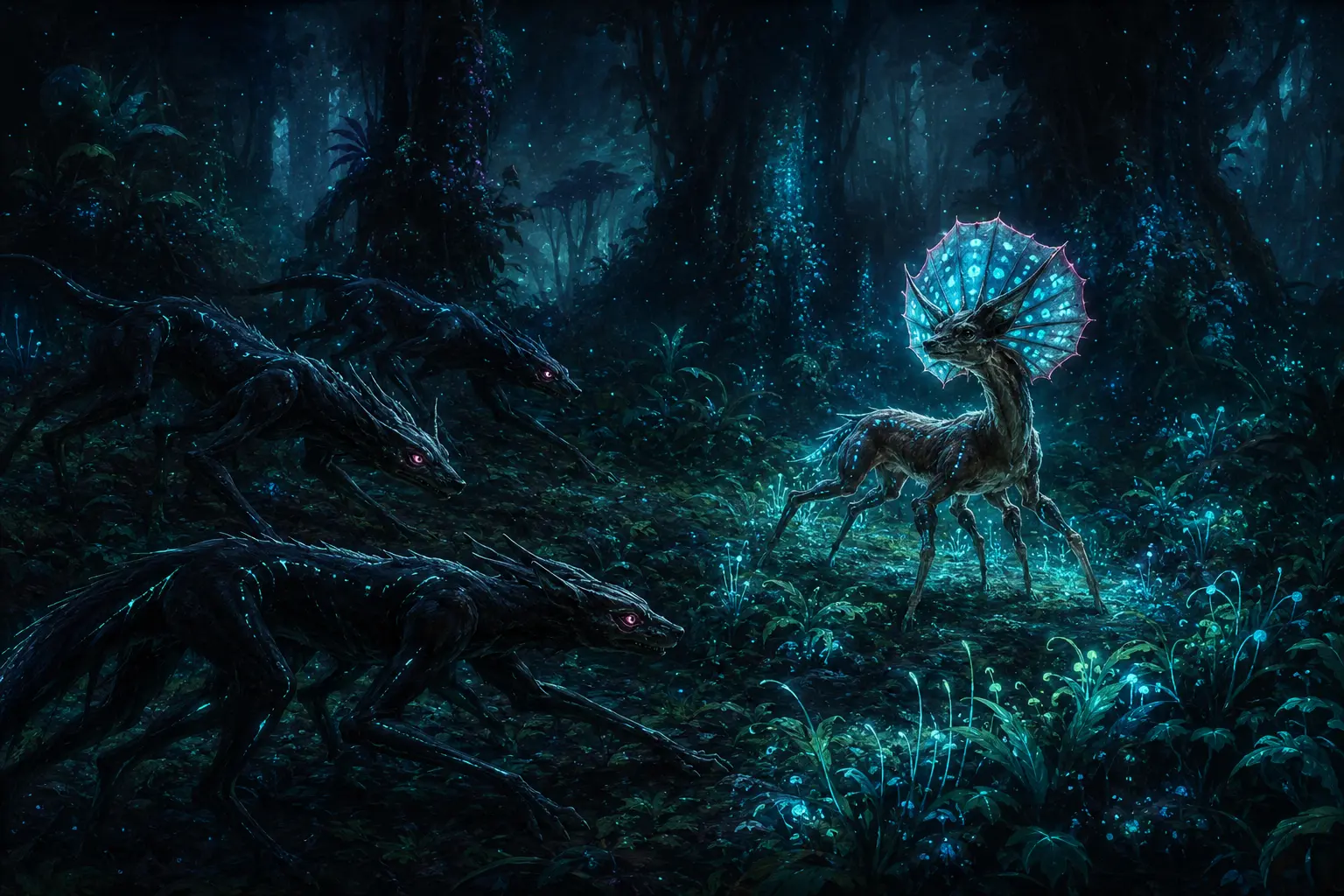
It happens in the dark, because almost everything on Pandora happens in the dark. A hexapede — the small, six-legged forest browser the Na'vi call yerik — has wandered a step too far from the herd, and the night has noticed. Four low shapes are already moving, fanning wide on either side of it without a sound, and the hexapede does the one thing evolution has left it: it throws open the bright fan of skin on its skull, flares the false eyes painted there, and runs.
You have seen this hunt, or one just like it, and you know how to watch it. There is a hunter and there is a hunted. There is a chase, a swerve, a moment where it could go either way, and then an ending — the pack eats, or the hexapede lives and the pack goes hungry a little longer. It is a story, and like every story it is about its characters: the viperwolf's coordination, the hexapede's speed, the particular fang and muscle and nerve that decide this one night.
But step back. Not far — just far enough that the single hunt blurs, and you are no longer watching one viperwolf and one hexapede but all of them, thousands of each, spread across a forest the size of a country, hunting and fleeing and breeding and dying through season after season. Something strange happens when you pull back that far. The story dissolves, and a machine appears underneath it. The number of hexapedes in the forest rises and falls in slow waves. The number of viperwolves rises and falls too — in the same rhythm, but always a beat behind. And the two waves are locked to each other, rising and crashing in a cycle that no individual animal intends and none can feel, a pulse beating under the whole forest that you can only see from high enough up.
This chapter is about that pulse: where it comes from, why it is so stubbornly regular, and why understanding it lets you predict things about Pandora's wilderness that no amount of staring at fangs ever could. The astonishing part — the part worth the climb — is that the pulse is not Pandoran. It beats on Earth too, in exactly the same rhythm, for exactly the same reason, and the mathematics that describes it is simple enough to fit on the back of a napkin. The hunt is alien. The machine underneath is not.
The question hiding in a full forest
Start with something so obvious it is easy to walk straight past: the forest is still full.
The viperwolf is, by every canonical account, a superb hunter. It runs down prey in coordinated packs of up to a dozen, communicating in a constant stream of yelps and gestures, organising a hunting party in seconds, climbing into the canopy on primate-like paws to take prey from above as readily as from the ground. It is good at its job in the way that should worry a hexapede very much. And it is not alone — the forest is layered with hunters, from the solitary thanator that fears nothing to the aerial banshees to the swarming stingbats, each excellent at killing the things it kills.
So here is the question. If the hunters are that good, why is there anything left to hunt? Run the naive arithmetic and it ends badly: efficient predators eat prey, eat them faster than they can breed, and clear the forest. Then the predators, with nothing left to eat, starve in their turn. The end state of "hunters that are very good at hunting" looks, on paper, like an empty forest and a pile of starved viperwolves. A few thousand years of that and Pandora's wilderness should be a silent, sterile place.
It is not. It is one of the most riotously full biospheres ever imagined, predators and prey crowded together in numbers that have evidently persisted for a very long time. Somehow the system does not run itself off the cliff that the simple arithmetic predicts. Something holds it back — some feedback the naive picture is missing — and that something is not a Pandoran peculiarity, not a quirk of alien biology or Eywa's guiding hand. It is a piece of plain mathematics that falls out the moment you write down, honestly, how a hunter and its prey affect each other's numbers. Let us write it down.
Two lines on a napkin
Forget the forest for a moment and keep only two numbers: how many hexapedes there are, and how many viperwolves. Watch what each does to the other, one honest step at a time.
Left alone, with no viperwolves to trouble them, the hexapedes would multiply. Each pair makes more, and those make more again, so the more hexapedes there are, the faster their number grows — the signature of anything that breeds. That is the first idea, and it is almost embarrassingly simple: prey, unchecked, increase.
Now add the viperwolves. A hexapede dies when a viperwolf finds it, and finding requires a meeting — a hunter and a prey in the same patch of forest at the same moment. How often do those meetings happen? That depends on how crowded the forest is with each. Plenty of both, and encounters are constant; rare either one, and they seldom cross paths at all. So the rate at which hexapedes are killed tracks the product of the two numbers — hunters times hunted — the simple combinatorics of how often two kinds of thing bump into each other in a shared space. That product drains the prey and, in the same motion, feeds the predators: every hexapede caught is the fuel for the next viperwolf pup. And the viperwolves, for their part, die off at their own steady rate whenever the hunting runs thin, starving in proportion to how many mouths there are to feed.
That is the whole model. Prey grow on their own and are eaten at a rate set by encounters; predators starve on their own and are replenished at a rate set by the same encounters. Two coupled lines — one for each population's rate of change — and a single shared term, the encounter product, that ties them together: it is a minus for the prey and a plus for the predator, the same hunt counted from both ends of the tooth.
These are the Lotka-Volterra equations, written independently by Alfred Lotka in 1925 and Vito Volterra in 1926, and for something scribbled in a few symbols they do something close to magic. You put in nothing but "prey breed, predators eat them when they meet, predators starve without them" — no biology of fangs, no cleverness, no Pandora — and out comes a prediction so specific it feels unearned. The two populations, the math says, will cycle. Not settle to a quiet balance, not crash to zero, but rise and fall forever in linked waves.
The coupled wheel
Same hunt, three models — watch how each answers a shock
And the cycle has a shape worth feeling in your bones, because it explains the "always a beat behind" you saw from the treetops. Start with plenty of hexapedes. Food is everywhere, so the viperwolves feast and breed, and their numbers climb — but climbing takes time, a generation of well-fed pups, so the predator peak arrives late, after the prey have already begun to suffer. Now there are too many viperwolves for the thinning hexapedes to sustain. The hunters overshoot, eat the prey down to scarcity, and then starve in the desert they have made — their own peak becomes their undoing. With the predators crashing, the surviving hexapedes are released, multiply back into the empty forest, and the whole wheel turns again. Predator follows prey the way a shadow follows a hand: bound to it, shaped by it, and always a quarter-turn behind. Neither population ever rests, and neither needs to. The balance is not a still point. It is a wheel.
The same wheel, turning on Earth
Here is where a sceptic should dig in. It is a pretty piece of mathematics, but mathematics will happily describe worlds that do not exist. Does anything actually behave this way, or is the cycle just an artefact of equations too simple to trust?
It behaves this way. The cleanest record comes from an unlikely archive: the account books of the Hudson's Bay Company, the fur traders who for nearly two centuries bought pelts across the Canadian north and wrote down, year by year, how many they took. Buried in those ledgers is one of the most famous graphs in all of ecology — the snowshoe hare and the lynx that hunts it. The hare numbers rise and crash in a wave about ten years long; the lynx numbers rise and crash in the same ten-year wave, riding always a step behind. Plot a century of pelt counts and you get the Lotka-Volterra cycle drawn in trade receipts: prey peak, predator peak trailing it, both crashing, both recovering, around and around for as long as the records run. Nobody designed the experiment. A company counting its furs accidentally kept a two-hundred-year logbook of the predator-prey wheel.
The honest footnote is that the real hare-lynx story is richer than two equations: the hares also exhaust their own food plants at the top of the cycle, so the crash is partly starvation, not just predation, and modern ecology treats it as a three-way interaction rather than a clean pair. We will get to those complications — they matter, and they are where the simple model earns its corrections. But the bones of the thing, the coupled wave with its tell-tale lag, are exactly what Lotka and Volterra drew with a pencil.
And the model did more than describe a cycle already seen; it once explained a genuine mystery. Volterra did not come to these equations as a puzzle for its own sake — his son-in-law, the marine biologist Umberto D'Ancona, handed him a riddle from the fish markets of the Adriatic. D'Ancona had noticed something strange in the catch records spanning the First World War: during the war years, when fishing all but stopped, the proportion of predatory fish — sharks, rays — in the catch went sharply up. Less fishing, more sharks. It seemed backwards. Why should leaving the sea alone favour the hunters over the hunted?
Volterra's equations answered it, and the answer is subtle enough to be worth its own moment — because it is the same logic that will indict the RDA at the end of this chapter.
Why the beautiful cycle is a lie
Now the cruelty. The Lotka-Volterra wheel is one of the most influential ideas in the history of biology, and as a literal description of any real forest it is wrong — wrong in ways that, once you see them, teach you more than the model's successes ever did.
The first flaw is hiding in the very first sentence we wrote. "Left alone, the hexapedes would multiply, and the more there are, the faster they grow." Follow that honestly and the prey, in the absence of predators, do not just increase — they increase without limit, faster and faster, forever, until a single forest holds infinite hexapedes. That is obviously absurd: real prey run out of food, of space, of clean water; their growth slows and stops at a ceiling the land can support. The model never heard of the ceiling. It lets its prey breed to infinity, and any model that does that is telling you a story about a world with no edges.
The second flaw is deeper and stranger, and it took decades to feel its full weight. The Lotka-Volterra cycle is neutrally stable — a piece of mathematical jargon for a very precise fragility. The wheel turns, yes, but nothing holds it to its track. Nudge the system — a hard winter, a lucky season, any of the thousand shocks a real forest delivers — and it does not return to the cycle it was on. It simply moves to a new cycle and keeps turning there, with no memory of the old one and no force pulling it back. The orbits are like marbles on a perfectly flat table: push one and it rolls to a new spot and stays, because nothing is sloped to restore it. A real ecosystem cannot live like that. Shock after shock would jostle it onto wider and wider cycles until one crash dipped to zero — and zero, for a population, is a wall you only hit once. A model whose balance any breath of wind can destroy is not describing something that survives for ages.
We can watch both flaws kill a real system, because someone tried to build the Lotka-Volterra world in a dish and film it dying. In the 1930s the Soviet biologist Georgii Gause put a predatory microbe, Didinium, in with its prey, Paramecium, in a drop of nutrient broth — a whole predator-prey universe on a microscope slide. The math predicted an eternal cycle. What Gause got was a bloodbath: the Didinium ate every last Paramecium with brutal efficiency, and then, with nothing left, starved to extinction. Not a cycle — a double funeral. The hunters were simply too good, the world too small and too smooth, and the wheel he had hoped to see ran straight off its edge on the first turn. He could only keep the system alive by cheating — adding fresh prey from outside on a schedule, propping up a cycle that could not stand on its own.
It took a subtler experiment to show what was missing, and the answer was texture. In 1958 the ecologist C. B. Huffaker built another little universe, this time out of oranges — food for a plant-eating mite, which was in turn food for a predatory mite. Arrange the oranges in a tidy cluster and the same massacre unfolded: the predators found the prey, ate them all, and starved. But then Huffaker complicated the world. He spread the oranges out, walled them off with barriers of petroleum jelly the predators struggled to cross, and gave the prey little posts to spin silk from and balloon away on the air to fresh, undiscovered oranges. Suddenly the system lived. In that broken-up, hard-to-cross landscape the prey could always keep one step ahead — colonising a far orange, breeding there, ballooning onward just before the predators arrived to wipe out the patch they had left. The cycle sustained itself for the first time, not because the biology had changed but because the space had. The forest's complexity — its hiding places, its distances, its refuges — was doing the stabilising the equations left out.
That is the key the smooth model was missing, and Pandora's forest is nothing but texture: a riot of canopy and root-buttress and tangled understorey, three-dimensional and shot through with hiding places, the precise opposite of Gause's fatal drop of broth. But texture in space is only half the repair. The other half is about the hunter itself — and a quiet limit the napkin model ignored.
A hunter is not a bottomless mouth
Look again at the encounter term, the hunters-times-hunted product that did all the work. It says that if you doubled the number of hexapedes, each viperwolf would simply kill twice as many. Quadruple them, four times as many — with no ceiling, a single viperwolf in an infinitely rich forest killing infinitely fast. But a viperwolf is not a bottomless mouth. After a kill it must chase, subdue, eat, digest, rest; that handling time is a tax on every meal, and no amount of surrounding abundance can rush it. Past some point the hunter is simply full, or simply busy, and stacking more prey in front of it changes nothing. The rate at which a single predator eats, plotted against how much prey surrounds it, is what ecologists call the functional response, and getting its shape right is most of the difference between the toy model and a real one.
The ecologist C. S. Holling sorted the possibilities into three shapes, and all three live on Pandora if you know where to look.
How fast one hunter eats
Drag the prey density — watch the share each hunter takes
On Pandora
Viperwolf
A learning, switching hunter that ignores rare prey until there is enough to be worth forming a search image for.
The straight-line Type I is the simplest: eat in direct proportion to what is available, up to a hard cap. It fits a filter-feeder that strains its food from a flow without chasing it — on Pandora, the great tulkun of the eastern sea cruising open-mouthed through clouds of plankton, taking in food at a rate that just tracks how thick the water is until the animal is sated. Search and swallow are the same act; there is no handling tax until the very top.
The bending Type II is the busy hunter's curve. At low prey density the predator's kill rate climbs steeply — more prey, more kills — but as prey grow abundant the curve bends over and flattens against the ceiling of handling time. A solitary thanator can only stalk, kill, and consume so many sturmbeest in a week no matter how thick the herds grow; past a point, more prey in the forest does not mean more kills, only less time spent searching between them. This is the most common predator curve on Earth, and it is quietly destabilising — because at low prey density the predator takes a larger fraction of what little remains, pressing rare prey toward rarer still.
The S-shaped Type III is the one that matters most for a forest staying full, because it bends the other way down low. At low prey density the predator barely responds at all — the kill rate stays nearly flat near the origin before rising steeply and then levelling off. Why would a hunter ignore prey when prey are scarce? Three reasons, all real: it has not yet formed a search image for something it rarely encounters, so it walks past what it isn't tuned to see; it switches its attention to whatever is more common and more worth the effort; and scarce prey can vanish into refuges the hunter cannot be bothered to ransack for so little reward. The viperwolf, with its learning and its switching and the hexapede's eyespot-fan trickery, hunts something close to this curve. And the gentle flat stretch near the origin is precious: it means that when hexapedes get rare, the pressure on them eases rather than tightening, a built-in mercy that lets a crashing prey population catch its breath and recover instead of being chased to the last one. The Type III response is a refuge written into the predator's own behaviour, and it is one of the strongest stabilisers a real ecosystem has.
The paradox of making things better
Put the missing ceiling back — let the prey grow only to the limit their food and space allow, their carrying capacity — and pair it with a realistic bending functional response, and the wheel finally behaves like something that could survive in a real forest. Instead of the fragile neutral orbits, the system now has a true resting balance it returns to after a shock: push it and it spirals back, the way a marble pushed in a bowl rolls back to the bottom. This is density dependence doing the work the toy model lacked — growth that throttles itself as crowding rises — and it is what lets predators and prey coexist for ages without either running off the cliff. The forest stays full because it is built, at every level, to pull itself back toward balance.
Which sets up one of the most beautiful and counter-intuitive results in all of ecology — a warning, really, dressed as a theorem. Suppose you wanted to help this balanced system. Suppose you enriched it — better soil, more rain, a richer base of plants — raising the prey's carrying capacity so the forest could feed far more hexapedes than before. More food, more prey, more predators, a lusher and healthier world: who could object? The math objects. Past a threshold, enriching the system does not make it more robust — it makes it explode. Raising the ceiling lets the cycles swing wider and wider, the booms higher and the busts deeper, until the troughs of the oscillation dip so close to zero that the smallest shock tips a population into extinction. By making the world richer, you have made it more likely to collapse. This is the paradox of enrichment, and it is the deepest lesson the simple wheel, once corrected, has to teach: stability and abundance are not the same thing, and a system humming along in modest balance can be shaken to pieces by the well-meaning gift of plenty. Hold that thought. When the RDA arrives, it will break this forest in more than one direction at once, and this is one of them.
The view from the top
So far we have watched a single pair — one hunter, one hunted — and that pair already taught us most of the machine. But a forest is not a collection of separate pairs. It is a web, and the most interesting thing a predator does is not always to the animal in its jaws. Often it is to an animal three steps away that it never touches at all.
Begin with the heaviest prey, because they make the logic vivid. The hammerhead titanothere is a wall of an animal — over twenty feet tall, armoured across the skull and shoulders, effectively immune to anything the forest can throw at it. Canon names just two predators able to bring down a healthy adult: the thanator from the ground, and the great leonopteryx from the air. Those two apex hunters are the only check on a creature that would otherwise have none. And a titanothere with no check is not a gentle thing to have around — it is a bulldozer, smashing trees to scatter rivals, stripping vegetation, reshaping the understorey wherever it walks.
Now perform the thought experiment that Pandora's apex predators perform for free, every day, simply by existing. Remove them. Take away the thanator and the leonopteryx, and nothing any longer dies of being hunted at the top of the web. The titanotheres and the great sturmbeest herds, released from the only force that thinned them, multiply. And as they multiply they eat, and trample, and smash, until the forest floor and the subcanopy are stripped bare — and the small, gentle herbivores that depended on that vegetation, the hexapede and the prolemuris, are squeezed out of their own homes by the runaway giants. Pull two predators from the top and the damage runs all the way to the bottom, taking out animals the predators never hunted. The hunters, it turns out, were protecting the very prey-of-other-predators they competed with — by holding down the bullies that would otherwise have eaten everyone's world.
This is a keystone species — and the name is a precise piece of architecture, not a vague compliment. In a stone arch, the keystone is the single wedge at the top that holds every other stone in place; pull it and the whole arch collapses, though it is only one stone of many. A keystone predator is the same: a species whose effect on its ecosystem is wildly out of proportion to its numbers, holding the entire structure together from the top. The thanator is rare, as all apex predators are rare — and yet the whole forest is shaped by its presence, leaning on it like stones on a wedge.
Pull the keystone
Draw out the apex wedge and watch the arch hold, then let go
Apex predator
Heavy grazers
Vegetation
We know this is true because Earth ran the experiment — on purpose, and by accident, again and again, and always with the same result. The cleanest version was a scientist named Robert Paine on a rocky Pacific shore in the 1960s, with a crowbar and a stubborn question. He pried every starfish — a predatory starfish, Pisaster, that ate mussels — out of one stretch of tide pool, and left an identical stretch alone. In the pool he left alone, life stayed diverse: fifteen species sharing the rock. In the pool he stripped of its one predator, the mussels — freed from the thing that ate them — simply took over, crowding out everyone else, until the fifteen species had collapsed to eight. One predator, a small fraction of the living weight of that shore, had been holding the entire community open. Remove it and diversity caved in. Paine had to invent a word for what he'd found, and the word was keystone.
And the most famous Earth case carries a warning Pandora should heed, because the story is usually told too simply. When wolves were returned to Yellowstone in the 1990s after a long absence, the elk they hunted declined, and the young trees the elk had been over-browsing — willow, aspen, cottonwood — began to recover, and from that recovery, the popular telling goes, beavers returned and riverbanks stabilised and even the rivers changed course: a top predator healing a whole landscape from the top down. It is a beautiful story and it is partly true. But careful, sceptical ecology has spent years complicating it, and the complications are the honest part. The elk also declined because of drought and human hunting and the return of bears; the tree recovery was patchy, strong where water was plentiful and absent where it was not; and a great deal of the effect was not wolves killing elk at all.
That last point opens the subtlest idea in the whole chapter. A predator changes its prey not only by eating it, but by frightening it.
The hunter's arithmetic
Step down now from the whole web to the single hunter again, and ask a question the equations skated over: when a viperwolf chooses to chase, what is it actually weighing?
Start with a fact that surprises people who have never watched real predators work: hunters mostly fail. The popular image is of the unstoppable killer, but the truth is closer to the opposite — across Earth's great predators, the success rate of any given hunt tends to run somewhere around one in five, often worse. Most chases end with the prey getting away and the hunter hungry again. That is not incompetence; it is a deep asymmetry written into the contest itself, and it has a name.
This is also the engine of one of biology's great spectacles — the coevolutionary arms race, in which hunter and hunted drive each other to extremes across deep time, each adaptation on one side selecting for a counter on the other. Faster prey select for faster hunters, which select for faster prey still; toxic prey select for toxin-resistant predators, which select for more toxic prey. The cheetah and the gazelle ran each other into the fastest legs on the African plain. On Pandora the same race shows in the viperwolf's cooperative tactics answered by the hexapede's senses and fan, the titanothere's armour answered by the sheer mass of the only two animals that can crack it. Neither side ever wins. That is the point: the race is the equilibrium.
Given that hunting is costly and often fails, a predator cannot afford to chase everything. It must choose — and the choosing follows a logic clean enough to write as a rule. A hunter should pursue a prey type only when the energy it expects to gain outruns the energy it would spend finding and catching it; the moment a richer or easier target is common enough to be worth holding out for, the predator should ignore the poorer one and wait. Optimal foraging theory is the name for this accounting, and it is not a metaphor — predators really do behave, on the whole, as if running the sums, expanding their diet when good prey is scarce and narrowing it when good prey is plentiful.
One consequence matters enough to pull out on its own, because it loops straight back to the stability we have been chasing. When a predator's favourite prey grows scarce, the predator does not keep hunting it to the last individual — that would cost too much effort for too little return. Instead it switches, turning its attention to whatever is now more abundant and easier to find. This prey switching is precisely the behaviour behind the stabilising Type III response from earlier: rare prey is spared not out of mercy but out of arithmetic, because chasing a vanishing target stops being worth it, and the predator's gaze slides to easier meals. Selfish accounting at the level of the single hunter becomes, at the level of the whole forest, the mechanism that keeps rare species from being hunted into oblivion. The forest's stability is built, in part, out of predators declining to bother.
Which brings us, last among the hunters, to the strangest predator on Pandora — the one that thinks about all of this on purpose. The Na'vi are hunters; taronyu, the hunter, is an honoured role, and they kill the hexapede and the sturmbeest with bow and spear as surely as any viperwolf does. But they are a predator that has done something no other predator can: they have noticed the wheel they are riding, and decided to ride it gently. Canon is explicit and consistent about the ethic. The hunter takes only what is needed and wastes no part of the kill. Over the dying animal the hunter speaks a prayer — I see you, Brother, and thank you. Your spirit goes to Eywa, your body remains to become part of the People — and means it as more than sentiment. It is the acknowledgement of a debt to the system, dressed as a debt to the animal.
Read it through the mathematics of this chapter and the ritual turns out to be a control law. A predator that harvests its prey hard, near the limit, pushes the system toward the dangerous regime — the wild swings, the brushes with zero, the paradox of enrichment's instability. A predator that deliberately takes only a modest share, well below what it could grab, holds the wheel in its calm, self-correcting state, where prey and hunter both persist comfortably and neither careers toward a crash. The Na'vi, with no equations and no census, have arrived by reverence at exactly the harvesting rate a careful ecologist would prescribe — low enough to leave the system stable, sustainable across generations. "I see you" is, among other things, a statement about carrying capacity. They are the rarest of hunters: one that counts its prey, and stops short on purpose.
What we are guessing, and what we are not
Everything above leans on a quiet trick worth admitting: we have used real, Earth-tested mathematics to fill in a Pandora the films never quantified. That trick has limits, and honesty about them is part of reading a world rather than inventing one.
Take the central claim — that hexapede and viperwolf numbers cycle in a Lotka-Volterra wheel. The behaviour of the animals is canon: the pack hunting, the hexapede's defences, the thanator's place at the top. The cycle is not. No one has counted Pandora's animals; there is no census, no graph of populations over time, no record of a single boom or crash. The coupled oscillation is an inference — a very well-grounded one, because the ingredients that produce cycling on Earth are all visibly present on Pandora, but an inference all the same. We are saying "a system built like this one cycles, everywhere we have ever checked," not "the films show it cycling." The distinction matters, and the honest tier of most of this chapter is real science laid carefully over a canon that stays silent on the numbers.
What stays open
We have argued they must, because every ingredient that drives the cycle on Earth — coupled hunting, breeding lags, limited carrying capacity — is present on Pandora. But canon offers no population data of any kind: no census, no time series, no recorded boom or crash. The cycle is the chapter's strongest inference, not a stated fact. It is exactly the kind of prediction that fieldwork on Pandora would test first.
Both are apex predators, both canonically hunt the hammerhead titanothere, one ruling the ground and one the air. Whether they compete directly — clashing over carcasses, partitioning territory, avoiding each other — is never established. Competitive exclusion says two predators sharing a key prey should diverge somehow; how Pandora's two apexes do it, or whether they simply ignore each other across the ground-air divide, is unrecorded.
The tulkun are vast, intelligent, and canonically pacifist — they do not hunt. An apex-sized animal that opts out of predation is something Earth's ecology has no clean model for, since here the biggest animals are either filter-feeders or hunters, not abstaining giants. How the eastern sea's web balances around a dominant species that takes itself out of the killing is a genuine puzzle the films raise and never resolve.
This chapter has deliberately explained Pandora's balance with ordinary ecology — no planetary mind required. But canon insists Pandora's life is networked through Eywa, and a system that could sense and adjust its own population dynamics would behave very differently from the blind feedback we have modelled. Whether the balance is emergent arithmetic, deliberate regulation, or both at once is the deepest open question, and it belongs to later chapters on Eywa.
The clock, and the thing that stops it
Go back, one last time, to the hexapede in the dark — the flared fan, the four low shapes, the break for cover. You know now that you were never really watching a chase. You were watching one tick of a clock.
The hunt is a single event, sharp and total for the two animals inside it. But it is also one turn of a wheel that has been spinning, balanced, for longer than the Na'vi have had names for any of it: prey rising, hunters following a beat behind, the functional response easing off the rare and the texture of the forest hiding the hunted and the fear of the apex shaping where the giants dare to graze — a dozen feedbacks, each pulling the system back toward balance, none of them designed, all of them simply what falls out when things that breed are eaten by things that breed. The forest is full not in spite of the hunting but because of it, held open by the very predators that seem, hunt by hunt, to be emptying it. That is the quiet astonishment this chapter has been climbing toward: balance is not the absence of killing. It is killing, organised by mathematics into something that lasts.
Which is exactly why the RDA breaks it so completely. The Na'vi hunter takes one hexapede and reads the wheel; the industrial operation does something with no precedent in the forest's long memory. It strips the base of the web wholesale, razing the vegetation that feeds everything — a bottom-up collapse, the carrying capacity gone to mud. It culls predators and prey together, indiscriminately, the way the Adriatic war ran in reverse — tipping ratios no single hunter ever could. And it erases the forest's texture, the distances and refuges and hiding places that Huffaker showed were the difference between a system that lives and one that runs off its edge on the first turn. Every stabiliser this chapter found — the density dependence, the prey's refuge, the predator's restraint, the spatial complexity, the slow self-correction — the operation overrides at once. It does not ride the wheel gently or harshly. It jams a bar through the spokes.
The mathematics has the last word, and it is the same word on Earth and on Pandora, because the wheel was never Pandoran to begin with. A predator-prey system can absorb an enormous amount of killing — that is what it is for, that is the machine — so long as the killing works through the feedbacks that hold it together. What it cannot survive is having those feedbacks bypassed: the base removed, both sides culled at once, the refuges flattened, the slow corrections given no time to act. The Na'vi learned to read the clock and live by it. The hexapede and the viperwolf are the clock, each hunt a tick. And the tragedy arriving on Pandora is the simplest one the equations can express — that it is so much faster to stop a clock than to learn to tell the time.
Read next
Convergent, but Not Quite
The first human to walk Pandora's forest kept naming things - that is a panther, that is a wolf-pack, that is an eagle - and was almost always right about the job, never about the build. A moon with its own separate origin of life, built on a six-limbed body plan, keeps stubbornly reinventing Earth's cast of characters. The answer is not that Pandora copied us. It is a law that forces life anywhere to converge on the same short list of good answers - and the deeper truth in why it never converges all the way.
30 min read
Building the Pandoran Tree of Life
On a dim specimen bench: a thanator skull, an ilu flipper, a tulkun vertebra, and a Na'vi skeleton standing among them. The one tool every Earth phylogeneticist now reaches for first is missing - there is no DNA. Canon is silent on Pandoran molecular biology. And yet the tree can still be drawn, because for a century before sequencing, Earth built its own tree of life from bones alone. The real question is not whether the tree is knowable, but which similarities reveal kinship - and which ones lie.
26 min read
Direhorse and Banshee Up Close
Lay a pa'li and an ikran side by side on the dissection bench and you are looking at two impossibilities. The giant horse is as heavy as an elephant, yet it gallops at 95 km/h on legs far more slender than they have any right to be - every stride should shatter the bone beneath it. The flying predator spans twelve to fourteen metres, yet it lifts off a cliff with a Na'vi on its back - a weight that would pin any Earth flyer to the ground forever. Both should collapse under the very physics that governs every body that has ever lived. And yet they do not. This whole chapter chases the reason - and the answer is not magic, but three numbers Pandora quietly set differently.
22 min read
Hometree as Keystone, Foundation and Cultural Keystone
Everyone calls Hometree a keystone, and everyone is wrong in a useful way. Robert Paine's keystone was rare and worked by eating; Hometree is most of the biomass around it and works merely by standing there. Those are different mechanisms, and telling them apart is what explains how felling Hometree can leave a planetary network untroubled and still be a loss nothing can repay. The idea to carry away: biomass grows back in decades, structure takes centuries — some things only time can build.
38 min read