
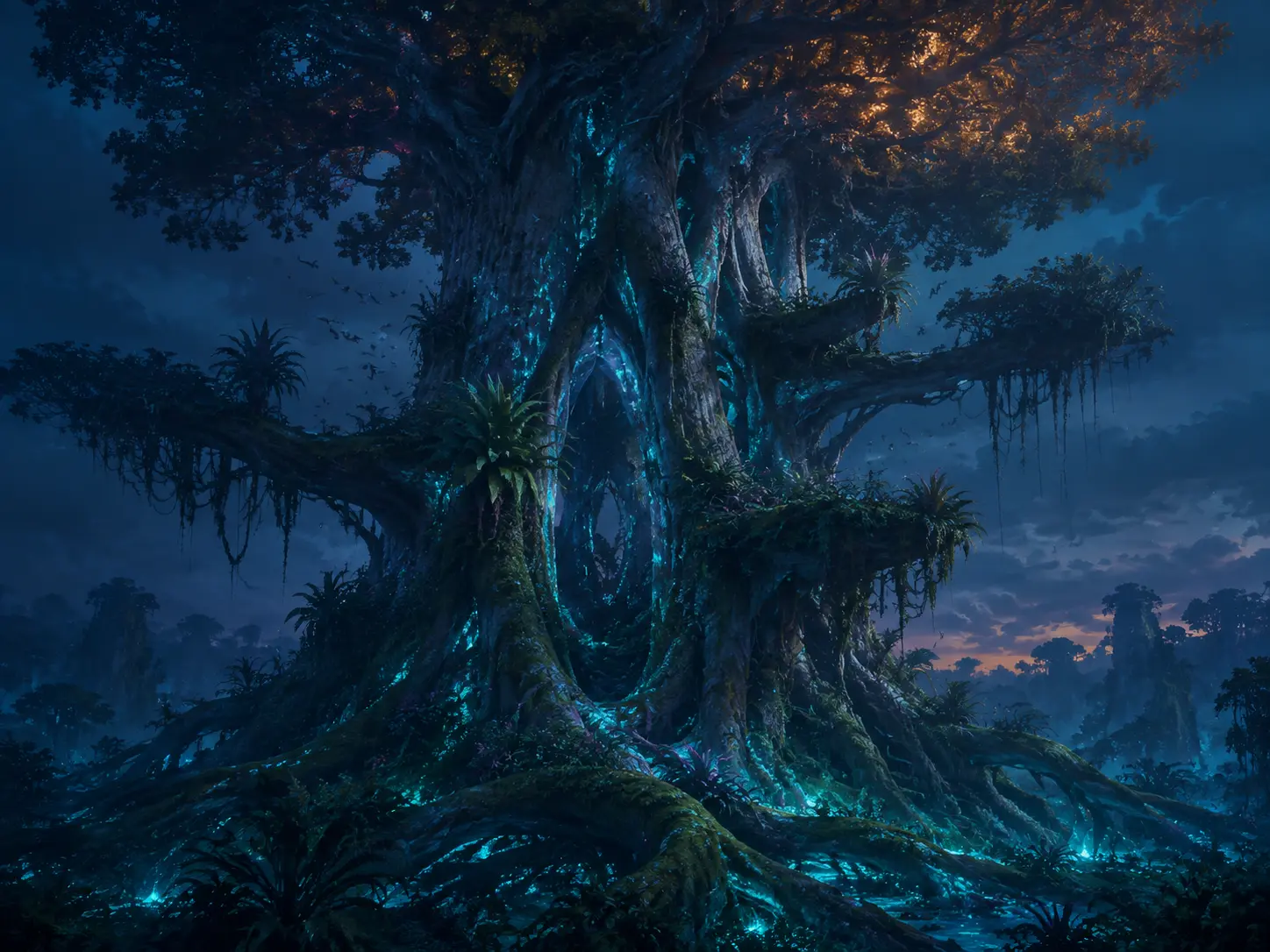
There is a way of watching the fall of Hometree that feels almost indecent, and it is the way a field biologist watches it. Everyone else in the frame is watching a home burn. The clan is scattering, the elders are dying, and the film is doing what it should be doing, which is to make you feel the size of the crime. But if you can hold that at arm's length for the length of a chapter — and I promise we will come back for it — there is a second event happening in the same shot, on the same timescale, with consequences nobody in the film is in a position to notice. Something over three hundred metres tall, which had been standing in that spot for roughly twenty thousand years, has just been removed from an ecosystem. And ecosystems have opinions about that.
Start with the specimen itself, because the numbers matter later. The supplementary Avatar lore — and I flag straight away that these figures come from companion and community material rather than anything stated on screen, so hold them loosely — describes the Omatikaya's Hometree, Kelutral, as standing over three hundred metres, with sources stretching that as far as three hundred and twenty-five. The primary trunk is put near fifty-seven metres across, and the buttressed base with its sprawling prop roots is given a footprint something like a hundred and twenty metres wide. Inside, the trunk is not solid: it is a braided ring of fused vertical columns around a hollow core, with major branches driving inward and upward in a slow helix, which is why a clan can live in it without building anything. And in dialogue, Grace Augustine gives the age: about twenty thousand years. Human writing is around five thousand years old. This tree predates the invention of writing four times over.
Now hold that against a fact this book has already established, and feel the contradiction bite. In an earlier chapter we worked through what happens to Eywa's network when the RDA starts destroying things, and the answer was uncomfortable but mathematically solid: the network barely notices. Felling Hometree — the largest single thing in the region, twenty millennia old, home to a whole clan — produces no detectable failure in the planetary system it belongs to. Eywa does not dim. She does not flicker. Topologically, that tree was expendable.
So which is it? Either Hometree was one of the most important objects on the moon, in which case its destruction should have had systemic consequences and did not — or it was not, in which case the grief is out of proportion to the loss and the film is manipulating us. Neither of those conclusions is satisfying, and neither is correct. The problem is not with Pandora. The problem is that the word we reach for when we want to say "this organism matters more than its size suggests" has been so thoroughly abused that it can no longer do the work we are asking of it.
That word is keystone. Fixing it is the real subject of this chapter, and by the time we are done, the contradiction will have dissolved into something far more interesting than a paradox: two entirely different senses of the word "important," one of which Hometree fails completely, and one of which it satisfies more extremely than almost any organism on Earth.
The word everybody gets wrong
The word has an origin, an author, and a very specific meaning, and all three have been sanded off by decades of nature documentaries.
In the mid-1960s an ecologist named Robert Paine went down to a rocky shore at Mukkaw Bay on the Washington coast with a crowbar and a genuinely brutal idea. He picked a stretch of tide pool and, over and over, month after month, physically pried off every Pisaster ochraceus — the ochre sea star — and threw it into deeper water. Then he left an identical adjacent stretch alone as a control and waited to see what the difference would be. The result is one of the most cited findings in the history of ecology. In the untouched stretch, life stayed varied: fifteen species sharing the rock. In the stretch he had stripped of its one predator, the mussels — no longer being eaten — took the whole substrate, crowding everything else off, and the fifteen species fell to eight. One animal had been holding that community open. Paine reached for architecture to name what he had found, and he chose the wedge at the crown of a stone arch: the keystone.
We have met that experiment before in this book, so I will not relitigate it. What I want is the part that always gets dropped, because the whole chapter turns on it. Paine's keystone had two properties, not one. It had a large effect on its community — everybody remembers that. And it was rare. The sea star was a small fraction of the living weight of that shore. That combination was the entire point of the metaphor. A keystone is remarkable precisely because it is one stone among many and yet the arch will not stand without it. If the wedge at the crown were also most of the mass of the arch, the metaphor would collapse into a triviality: of course removing most of a structure destroys it.
Within twenty years the word had escaped and become a compliment. Anything charismatic and ecologically consequential got called a keystone — top predators, whales, bees, whole forests. By 1993 Mills, Soulé and Doak were publishing a straightforward complaint that the term had been inflated past the point of usefulness, and in 1996 Power and colleagues tried to rescue it by making it measurable. Their proposal was disarmingly simple in spirit, and you do not need the algebra to feel it. Take how much the ecosystem changes when a species is removed. Then divide that by how much of the ecosystem's biomass the species was in the first place. A species that is one percent of the weight and causes a fifty percent change in the community is doing something extraordinary and gets a huge score. A species that is forty percent of the weight and causes a fifty percent change is doing roughly what you would expect a large fraction of an ecosystem to do, and scores low.
The distinction is not pedantry, and this is worth being blunt about, because "does the label matter" is a fair question to ask of any terminological argument. It matters because the two kinds of importance fail in different ways and demand different responses. If a system depends on a keystone, its vulnerability is trophic — it hangs on who eats whom, and you protect it by protecting a predator, which can sometimes be done by moving a few dozen animals. If a system depends on the other kind, its vulnerability is structural — it hangs on the continued physical existence of a great deal of accumulated matter, and there is no equivalent quick intervention, because you cannot airlift in a three-hundred-metre tree. Conflate the two and you will reliably mistake an irreversible loss for a recoverable one. Which, as it happens, is exactly the mistake being made by everyone in the vicinity of that burning stump.
Two kinds of important
Plot an organism by its bulk and by what its removal costs
What it is instead
In 1972, working on the seafloor beneath the Antarctic ice, an ecologist named Paul Dayton needed a term for a kind of organism the keystone idea did not cover. What he kept finding were species that were locally abundant, physically large, and that built the place — sponges and other bulky sessile animals whose bodies constituted the habitat every other species in the assemblage lived in. Their importance was not disproportionate to their bulk. Their importance was their bulk, plus the fact that everything else had arranged itself around the shelter, shade and surface they provided. He called them foundation species, and the name is exact in a way "keystone" is not: a foundation is not one clever stone holding up an arch. It is the mass at the bottom that everything else is standing on.
Set the two side by side and the difference is clean.
Keystone species
Foundation species
There is a second, complementary name for what Hometree does, and it comes from a 1994 paper by Clive Jones, John Lawton and Moshe Shachak that gave ecology one of its most useful pieces of vocabulary: the ecosystem engineer, an organism that changes its habitat physically rather than only by eating and being eaten. They split the idea in two, and the split is the part worth carrying. An allogenic engineer modifies material outside itself — a beaver felling trees and damming a stream, an earthworm rebuilding soil. An autogenic engineer is the modification: its own living body is the structural change it makes to the world. Corals. Kelp. Trees.
That is the sentence to hold on to for the rest of the chapter. A big tree does not build a habitat; a big tree is a habitat, and it makes one out of its own tissue, slowly, over its entire life. It intercepts light and hands down shade. It slows wind. It holds humidity. It catches rain and lets it down gently instead of as impact. It sheds bark and litter and builds soil beneath itself. It fissures and rots and hollows out, and each of those failures becomes somebody's house. None of this is a service the tree performs. It is simply what a large amount of wood standing in one place for a long time does.
And so a third term, the most precise of the three for our particular case: the keystone structure. This is a concept from landscape ecology that shifts the noun from the organism to the feature — a physical element of a landscape that carries biodiversity out of all proportion to the area it occupies. Manning, Fischer and Lindenmayer made the argument in 2006 for a case that sounds trivially small and is not: the isolated large tree left standing in the middle of a cleared paddock. One tree, in an otherwise empty field, functions as a stepping stone for birds crossing the gap, a focal point where seeds rain down and germinate, an island of canopy invertebrates, and a nutrient hotspot. Their title says it plainly — scattered trees are keystone structures — and note that the word keystone is doing legitimate work there, because now it is attached to a structure, where the disproportion is real: a tiny footprint carrying an outsized share of the life.
That is the resolution of our contradiction, and it is worth stating flatly before we go on, because everything after this is consequences. Hometree is a foundation species and an autogenic ecosystem engineer, functioning as a keystone structure. It is not a keystone species. Its importance was never topological and never trophic. It was architectural. Which is precisely why a network built on redundant connections could shrug off its loss while the forest around it could not — those two systems were depending on completely different properties of the same tree. The graph needed a node, and nodes are cheap. The community needed three hundred metres of accumulated physical complexity, and that is the single most expensive thing in ecology.
A tree is an address
So far this is a claim about categories. Let us make it a claim about quantities, because "a tree is a habitat" is the kind of thing that sounds like poetry until somebody counts, and the counts are genuinely startling.
Start in the canopy of a single tropical tree. In 1982 an entomologist named Terry Erwin went into a forest in Panama with a fogging machine and did to nineteen individual Luehea seemannii trees what Paine had done to a tide pool: he emptied them and looked at what fell out. From those nineteen crowns he recovered over twelve hundred species of beetle. Not twelve hundred beetles — twelve hundred species, of one insect order, from one species of tree. And of those, he judged around a hundred and sixty to be host-specific: found on Luehea seemannii and, as far as he could tell, nowhere else. Erwin then extrapolated to a global arthropod diversity of thirty million species, a number that has been argued about ever since and has since been revised down substantially — the current estimates cluster nearer five to seven million. But the argument was always about the extrapolation, never about the count. The count stood, and it says something that should reframe how you look at any large tree: a single tree species can carry dozens to hundreds of animal species that exist on it and on nothing else.
Then there is the soil. Not the soil on the ground — the soil in the air. Where epiphytes pile up on the big lateral limbs of an old tree, their dead tissue and the debris they trap does not fall; it accumulates in place, decade after decade, until the branch is carrying a genuine mat of earth. Nalini Nadkarni's canopy work established both halves of the picture: a single emergent tropical tree can carry over a hundred species of vascular epiphyte and tons of non-vascular plant mass, and the canopy soil beneath them can reach something like thirty centimetres deep. Thirty centimetres of soil, a hundred metres in the air, with its own nematodes, its own mites, its own invertebrate community, and in some forests its own salamanders — animals living out entire lives in dirt that has never touched the ground. The host tree occasionally grows roots out of its own branches to drink from the garden growing on it.
And then the most instructive number in this whole chapter, which comes not from the tropics but from Australian eucalypt forest and the long body of work summarised by Gibbons and Lindenmayer. The subject is the tree hollow — the cavity in a trunk or limb where a bird nests, a possum sleeps, a bat roosts. Hollows are not made by animals. They are made by a slow collaboration of wood-decay fungi, insects working the softened tissue, and mechanical injury from wind or lightning, and that collaboration takes a specific and shocking amount of time. Small hollows begin forming at something like a hundred to a hundred and twenty years. Cavities large enough for a substantial vertebrate need two hundred and twenty to five hundred years or more. Meanwhile, in Australian forests, over three hundred vertebrate species — roughly a third of the mammals and a sixth of the birds — depend on hollows for breeding or shelter, with no substitute available.
Now bring that back to Pandora, and be honest about where the ground gets soft. This is where canon goes quiet, and its silence is the largest gap in the whole chapter. The lore is generous about Hometree as architecture for Na'vi — the alcoves where families sleep, the hollow core, the spiralling internal ramps, the great gathering space at the base. It is nearly silent about Hometree as habitat for everything else. What we get is fragmentary: mountain banshees are described roosting and nesting on the high outer limbs, which is a canonical statement; the visual material shows dense bioluminescent mosses and large epiphytic ferns anchored into the fissures of the trunk columns, which is a statement about depiction; and prolemuris and other small arboreal animals appear to use the mid-canopy branch network, which is an inference from what the films show rather than anything asserted. There is no inventory anywhere of host-specific invertebrates, canopy-soil fauna, specialised fungal decomposers, or obligate pollinators tied to the Hometree species.
Earth has already run this experiment
We do not have to reason from first principles about what happens when a foundation species is removed, because Earth has run the experiment repeatedly over the last century — never on purpose, mostly by accident, and the accidents have been documented with painful thoroughness.
The largest was the American chestnut. Before 1900, Castanea dentata was the defining tree of the eastern American broadleaf forest, in places a quarter to two-fifths of the canopy. In 1904 a fungal blight arrived, Cryphonectria parasitica, and over the following decades it killed on the order of three to four billion trees. Read that number twice; it is the largest ecological loss in recorded North American history and most people have never heard of it. What went with the chestnut is a catalogue of exactly the things we have been discussing. Its wood was unusually rot-resistant, so it held cavities well and for a long time. Its nut crop was enormous and, crucially, reliable every year, which is not true of the oaks that replaced it — and a forest whose mast supply switches from dependable to erratic is a different forest for every animal that eats mast. And it took its specialists with it: several moth species that fed on chestnut and nothing else, including the chestnut clearwing and a case-bearer moth, went extinct or effectively so.
The chestnut itself, notably, did not go extinct — and the way in which it survives is a concept worth having a name for. Its root systems persist and keep sending up shoots; the blight kills those shoots before they can mature and reproduce. The species is alive as tissue and gone as an ecological participant. Ecologists call this functional extinction, and it is a useful reminder that "not extinct" and "still doing its job" are entirely different statements.
The cleanest experiment, though, is the eastern hemlock, because there ecologists got out ahead of the disaster and instrumented it. Tsuga canadensis is a textbook foundation species: it casts a deep evergreen shade, produces slow-rotting acidic litter, and holds streams beneath it cool and stable — an entire microclimate manufactured by one tree species. When the hemlock woolly adelgid began killing hemlock stands across eastern North America, Aaron Ellison and colleagues at Harvard Forest set up something a field ecologist rarely gets: a controlled removal at stand scale. They girdled hemlocks in some plots to simulate the insect's kill, logged others, and left controls, then measured everything.
The results are the anatomy of a foundation-species loss, and they read almost like a checklist of collateral damage. Light hitting the forest floor jumped by orders of magnitude. Soil temperatures rose. Decomposition sped up and nitrate began leaching out into headwater streams — the forest's nitrogen cycle came loose. The specialist birds that needed hemlock shade, black-throated green warbler and Acadian flycatcher among them, simply left, replaced by generalists that will live anywhere. And the plots did not return to hemlock. They went to black birch and stayed there. This is the pattern the ash-dieback literature is now documenting on a continental scale in Europe: Mitchell and colleagues catalogued nine hundred and fifty-five species associated with European ash in Britain, of which forty-four or forty-five are strict obligates — four lichens, eleven fungi, twenty-nine invertebrates — that cannot transfer to oak or beech, because those trees do not offer ash's bark chemistry or its fast-rotting, calcium-rich leaf litter.
American chestnut
3-4 billion
Trees killed by blight from 1904. Up to 25-40% of the Appalachian canopy. Several obligate moths lost with it; the tree survives only as non-reproducing root sprouts.
Eastern hemlock
Nitrogen cycle
Girdling experiments at Harvard Forest: floor light up orders of magnitude, soils warmed, nitrate leached into streams, shade-specialist birds gone, stands converted permanently to black birch.
European ash
44-45 obligates
Of 955 ash-associated species catalogued in Britain, 44-45 are strictly dependent — they cannot move to oak or beech, which lack ash's bark pH and litter chemistry.
Giant kelp
3D to 2D
Lose the kelp and a three-dimensional forest becomes a flat urchin barren — a different stable state that does not revert on its own.
That last entry is the one that makes the keystone/foundation distinction impossible to blur, and it is worth a paragraph because the same ecosystem contains both kinds of species doing both kinds of job. In a kelp forest, the sea otter is the keystone: rare, low biomass, and it works by eating urchins that would otherwise graze the kelp to stumps. Giant kelp is the foundation species: enormous biomass, and it works by being a three-dimensional forest that damps waves and shelters juvenile fish. Remove the otter — the keystone — and the urchins explode and destroy the kelp, which is to say that removing the keystone kills the foundation species. The causal chain runs through the food web. Now remove the kelp directly, with a marine heatwave, and you get the same barren without any predator involved at all. Two different mechanisms, two different interventions, one outcome: a flat, low-productivity alternative stable state that does not spontaneously revert, because the thing that used to provide the structure is no longer there to provide it.
And that is the shape of what happened at Hometree, with one difference that we now have to face, because it is the difference that makes Pandora's case worse rather than better.
The bill arrives late
Here is the part that a damage assessment taken on the day of the felling would get badly wrong, and it is the reason ecologists are so reluctant to count bodies after a disturbance.
When a habitat is destroyed, the species that depended on it do not all die at once. Many of them are still there the following morning — the mobile ones, the long-lived ones, the ones that can forage in the surrounding forest even though the thing they bred in has gone. If you walked the perimeter of the burn a week later with a clipboard you would still find most of the tree's former residents alive somewhere in the vicinity, and you might conclude, reasonably and wrongly, that the biological cost was modest.
But their reproduction has already failed. The cavity that particular bird nested in does not exist; the mat of canopy soil that invertebrate lived in is ash; the specific microclimate that fungus needed is now open sun. Their births have dropped below their deaths, and everything that follows is arithmetic. They will persist for a while — a season, a decade, in long-lived species a century — as a population going quietly to zero. Tilman and colleagues named this in 1994, and the name is one of the best pieces of terminology in ecology because it is honest about the accounting: extinction debt. The habitat destruction happens now. The extinctions are owed, and they are paid later, by instalment, long after the machinery has left and everyone has stopped watching.
The companion idea covers the specialists, and it is the tighter, crueller mechanism. Koh and colleagues in 2004 worked out the mathematics of co-extinction — the loss of a species because the species it depended on is gone — and found the shape depends entirely on how fussy the dependent is. A generalist that can use many hosts shows a curved response: it hangs on as its hosts disappear one by one, and only collapses when the whole host network passes some threshold. But a strict obligate, tied to one host and no other, shows a straight line at one to one. Its host goes, it goes. There is no adjustment period, no alternative, no partial credit. This is exactly the forty-four to forty-five British species that cannot move off ash, and it is why the ash-dieback researchers can name a doomed number now, before the deaths have happened.
Put those two ideas together and you can do the arithmetic the ecologist at the stump cannot. The doomed total is fixed on the day of the felling; the census only catches up to it decades later. Set the tenant list, decide how many of them had nowhere else to go, and then project the census forward.
The tenant ledger of one fallen tree
Fix the doomed total on the day of the felling, then walk a census forward and watch it discover them
- Persist — enough other hosts nearby · 810
- Multi-host species doomed — they collapse late · 118
- Strict obligates doomed — lost the day it fell · 27
Two facts that only look contradictory
We can now go back and settle the contradiction we opened with, and it dissolves cleanly once the vocabulary is repaired.
The network claim is a claim about connectivity. A planetary web of root couplings with enormous redundancy does not care much which particular nodes exist, because signal has many paths and losing one vertex leaves the rest reachable. On that measure — and it is a real measure, not a dodge — Hometree was one node among an astronomical number, and its deletion is unremarkable. Eywa does not flicker, and the mathematics of why she does not is solid.
The habitat claim is a claim about structure, and structure has no redundancy. There is no second copy of that shade, that hollow, that thirty centimetres of soil a hundred metres in the air, those particular fissures in the bark, that specific volume of sheltered space. The forest was not using the tree as a relay. It was using the tree as premises. And premises, unlike connections, cannot be rerouted.
So both statements are true, of the same object, at the same time, because they are statements about two entirely different properties. Topologically expendable. Structurally irreplaceable. There is no paradox; there was only a word doing two jobs it should never have been asked to do at once.
What time builds, and what it charges
So how long would it take to get another one? The question sounds like the sort of thing you ask to be rhetorical, but it has a real answer with a real structure, and the structure is the most transferable thing in this chapter.
Forest recovery runs on two clocks that are almost comically out of step. The first clock is biomass, and it is fast. Clear or burn a patch of forest and pioneer species arrive within a season; secondary trees close over the gap; and within something like thirty to eighty years the site can be back to its full leaf area and standing green weight. From a satellite it looks recovered. In a carbon accounting spreadsheet, it is recovered.
The second clock is structure, and it barely moves. Deep fissured bark, heartwood rotted into cavities big enough to shelter something substantial, thirty centimetres of soil accumulated on a high limb, the full vertical complexity of an old stand — these are the two-hundred to two-thousand-year features, and there is no way to hurry any of them, because each one is a slow physical process running on the wood as it stands. You cannot fertilise a hollow into existence. The forest that looks recovered from the air is, to everything that needed structure, still a construction site.
The two clocks of recovery
Scrub across four orders of magnitude and watch the curves refuse to travel together
- ~3 yr — pioneer vegetation covers the ash
- ~60 yr — canopy closed, biomass nearly full
- ~110 yr — the first small hollows begin to form
- ~350 yr — cavities big enough for large vertebrates
- ~800 yr — deep bark, canopy soil, full complexity
- ~20,000 yr — one Hometree's accumulated structure
Now put Hometree on that scale. About twenty thousand years, if the lore's figure holds. Earth's oldest individual trees run to something under five thousand. So the object destroyed at Sector 12 represents an accumulation four times longer than anything a single organism on our planet has ever managed, and — take the same lore's clan population as roughly a few hundred people with generations of twenty-odd years — the replacement interval works out somewhere in the region of a thousand Na'vi generations. There is no civilisational timescale on which that is a recoverable loss. It is not slow. It is, for every practical purpose, permanent.
Which throws an unexpected light on a canon decision that is usually read purely as strategy. Fourteen years after the felling, when the clan considers moving into another mature Hometree, Jake Sully vetoes it, and his reasoning is tactical: a single fixed enormous structure is a target, and the RDA has bombers. That is a perfectly good military argument. But read it as ecology and it says something bleaker. The Na'vi do not plant Hometrees. According to the lore they cannot — they find ancient specimens that have already developed the hollow architecture over millennia and then move in without damaging them, adapting the space with woven fibre and hung hammocks rather than construction. So the supply of possible Hometrees is not something the Na'vi can add to. It is a fixed inheritance from deep time, drawn down one tree at a time, and every one the RDA burns for a landing pad is subtracted permanently from a stock that took twenty thousand years to produce and cannot be topped up. When the returning fleet incinerates three more Hometrees to clear ground for a base, the ledger entry is not "three trees." It is sixty thousand years of structural accumulation, spent to flatten a parking area.
The afterlife of a giant
I want to end the science on something that is genuinely hopeful, because it is well established and it is not consolation-prize reasoning.
A dead giant is not finished. In the 1980s, after Mount St. Helens erupted and levelled a landscape that everyone assumed had been sterilised, Jerry Franklin, Fred Swanson and their colleagues found the recovery was being driven not by colonisation from outside but by what had survived in place — buried root systems, standing dead trunks, downed logs, seed banks under ash, animals that had been in burrows at the wrong moment and lived. They called these biological legacies, and the concept reorganised how disturbance ecology works. The material a catastrophe leaves behind is not debris. It is the template the next forest is built on.
The fallen trunk in particular has a long second career. A giant on the ground becomes a nurse log: raised above the leaf litter and its competition, holding water like a sponge, slowly softening, seeded with fungi, until seedlings root along its length in a straight line that still marks the shape of the parent a century after it fell. Walk any old temperate rainforest and you can read colonnades of mature trees standing in rows, each row the ghost of a log that rotted out from under them. The tree spends decades as habitat for the specific and substantial community of things that require dead wood — beetles, fungi, salamanders, the woodpeckers that hunt them.
And the corollary is the most policy-relevant finding in the whole field, which Franklin and his colleagues have argued for decades: removing the legacies is worse than the disturbance was. Salvage logging a burned forest — hauling out the standing snags, clearing the fallen trunks, tidying the site — reliably does more long-term ecological harm than the fire, because the fire left the template and the cleanup removes it. The disturbance impoverishes the forest for a while. The tidying impoverishes it for centuries.
Hold that against what the RDA does at Sector 12 and the comparison is grim in a precise way. This was not a disturbance that left legacies. The tree was burned from the inside, the hollow core drawing flame upward like a chimney; then the trunk was collapsed; and then the site was strip-mined, which is the most complete removal of biological legacy that exists — it takes the soil as well. Whether the root system survived is one of the things canon never says, and it is a real question, because on Earth stump-grafted conifers can be kept alive for decades by neighbours feeding them through connected roots, and Pandoran trees are described as far more intimately coupled below ground than ours. If that hundred-and-twenty-metre root base stayed metabolically alive on borrowed carbon, it would change the whole recovery trajectory. If the mining took it, there is nothing to build on.
What a tree does to a language
There is one more category of loss here, and I have deliberately kept it for last so that it lands as science rather than as sentiment — because it is science, with a literature and a definition.
In 2004 Ann Garibaldi and Nancy Turner introduced the term cultural keystone species for an organism so deeply woven into a people's material life, diet, language, ceremony and identity that its loss restructures the culture itself rather than merely inconveniencing it. The canonical example is western red cedar for the First Nations of the Pacific Northwest Coast: canoes, plank houses, poles, rope, woven bark clothing, medicine, ceremony and social standing all run through one tree species. Pacific salmon for the coastal peoples; the saguaro for the Tohono O'odham, whose harvest sets the calendar and whose fruit makes the ceremonial wine. The argument the concept makes is that when such a species goes, the damage is not only economic. Vocabulary loses its referents. Social roles built around harvesting or crafting have nothing to attach to. Ceremonial calendars lose the events they were keyed to. Ecological loss and cultural loss are not two problems that happen to co-occur; at this level they are one process, and conservation practice now generally treats them as such.
This is why the Omatikaya's response to the felling is not merely grief, and why the film is not manipulating you when it lingers. Their dwelling, their ritual centre, the acoustic space their chants were composed for, the specific alcoves their families slept in and the tree their language names as Kelutral were the same object, and it is gone. What Earth ecology says about that situation is not "they will be sad." It is that a predictable, documented restructuring follows, affecting things that look unrelated to trees. The clan that appears in the sequel is not the clan we met — dispersed, mobile, refusing on principle to root itself again. Read through Garibaldi and Turner, Jake's veto stops being only a tactical decision and becomes the visible signature of biocultural loss: a people declining to rebuild the relationship that was used against them.
Honest edges
Time to show the seams, since the whole method of this book is that you should always be able to see them.
The science is the solid part, and it is nearly all of the chapter's weight. Paine's experiment, Dayton's foundation species, Jones, Lawton and Shachak on ecosystem engineering, the keystone-structure literature on scattered trees, Erwin's beetles, Nadkarni's canopy soils, hollow-formation times from Australian eucalypt work, the Harvard Forest hemlock girdling experiment, chestnut blight, ash dieback and its obligate count, Koh on co-extinction, Tilman on extinction debt, Franklin and Swanson on biological legacies, Garibaldi and Turner on cultural keystones — all real, all published, none of it invented for this chapter.
The canon is thinner than it looks, and this is worth stating plainly. Hometree's architecture is shown on screen and beyond dispute: the size, the hollow trunk, the clan living inside it, the felling and its aftermath. But almost every number I have quoted — the three hundred metres, the fifty-seven-metre trunk, the hundred-and-twenty-metre root spread, the clan population — traces to companion and community material rather than to the films, and those sources disagree with each other. The twenty-thousand-year age is the strongest of them, being spoken in dialogue. I have not used the invented species binomial that circulates in the lore, because I could not establish that it comes from an official source.
The inference is the bridge, and it carries most of the chapter's interesting weight: reading Hometree as a foundation species and autogenic engineer rather than a keystone; reconciling the network's indifference with the habitat's destruction; and above all populating the tree with a specialist community that Earth's emergent trees make very likely and that Pandora never confirms.
The speculation is fenced: the recovery trajectory of the burn scar, the fate of the root system, and the twenty-thousand-year replacement horizon. Those are reasoned extrapolations from Earth disturbance ecology, offered because a chapter about irreversibility owes you an estimate of how irreversible — not because the films show any of it.
What we would need to know
The top gap, and it is not close. Canon gives banshees roosting on the high limbs and shows epiphytes on the trunk, and stops. There is no inventory of host-specific invertebrates, canopy-soil fauna, decomposers, or obligate pollinators. Without it, nobody can put a number on the co-extinction bill — every figure in this chapter's biodiversity argument is borrowed from Earth's tropical canopies.
We are told this individual was about twenty thousand years old. That is not the same claim as how long it takes to reach Hometree function — a tree can be far older than the age at which it became habitable. Without a growth curve, the replacement horizon is a guess, and it is the number that decides whether the loss is centuries-bad or millennia-bad.
Unstated, and it matters more than it sounds. That root base is described at over a hundred metres across, and Pandoran trees are coupled below ground far more intimately than Earth's. If the network kept the stump metabolically alive — as neighbouring conifers can do for a grafted stump on Earth — succession at the site looks entirely different from a site whose roots died. Strip-mining the deposit beneath it argues against survival.
Canon never says. If they are widespread climax dominants, each felling is a severe local collapse. If Hometree-capable specimens are rare, the RDA is systematically driving a habitat type toward functional extinction. The difference between those two readings is the difference between a tragedy and an extinction event, and the films do not let us choose.
The story never returns to Sector 12. Everything about the site's trajectory — who colonised it, whether anything giant is regrowing, whether the burn is still bare — is extrapolation from Earth disturbance ecology. A single shot of that clearing in a later film would be worth more than any amount of reasoning.
Back at the stump
Go back to the clearing, on the morning after, and see what the vocabulary has changed.
The temptation on first viewing is to reach for the biggest word available and call the tree a keystone, because it was obviously important and that is the word we have been taught to use for important. But the arch metaphor was never right for this. Hometree was not the small clever wedge holding up a structure it was barely part of. It was the mass everything else was standing on — the shade, the surfaces, the cavities, the soil in the air, the sheltered volume, the premises. It mattered the way a foundation matters, which is to say: not disproportionately at all, but completely.
And that resolves the thing that looked like a contradiction. A network with redundant paths did not need that particular node, so it lost nothing and did not flicker — the mathematics of that is honest and this book has already done it. A forest with no redundant structure lost the only copy of a habitat that twenty thousand years had been required to build. Both true. Different properties of the same tree, and the reason it took a chapter to say so is that we only had one word for two things.
What the reader should carry out of the clearing is not really about Pandora, and it will be waiting the next time anyone proposes that a felled ancient forest can be replanted. Green things regrow fast. Structure does not. A hollow takes two centuries to open. A mat of soil on a high limb takes as long. Deep fissured bark, the crown volume, the whole vertical architecture that everything smaller has arranged itself around — those are not products of wood but of time acting on wood, and time is the only input in ecology that cannot be bought, hurried, subsidised or substituted. This is why a plantation is not a forest and a sapling is not a tree.
The clan grieving in the ash understood something the ecology only formalises. They were not mourning three hundred metres of timber. They were mourning an address, and every language, ceremony, roosting bird, epiphyte garden and hollow-dwelling animal that had that address — assembled slowly, over two hundred centuries, and unmade in an afternoon by people who had come for the rock underneath.
Read next
The Forest as a Cathedral
The Na'vi enter the forest the way one enters a cathedral, and the comparison is more exact than it sounds: a cathedral is built in tiers — nave, galleries, vaulted roof — each with its own light, its own climate, its own inhabitants. So is the Pandoran forest. But a Hometree more than three hundred metres tall runs straight into a wall that every tree on Earth stops short of: the physical limit on how high a living thing can pull water. The story of how a forest sorts itself into floors, and of the line a treetop cannot cross, is one of the most honest lessons forest ecology has to teach.
24 min read
Why Burning Eywa Doesn’t Kill It
Burn a hole in a forest and you have killed a great many trees. Whether you have damaged the network they belong to is a completely different question — and the answer is almost always no. The RDA learns it the hard way: you can fell the largest tree on the moon and the planetary mind does not so much as flicker. The reason lives in percolation theory and network resilience — one of the most useful things mathematics has ever proven about connected things, and the precise map of the four ways it would, finally, fail.
31 min read
Hunters and the Hunted
A viperwolf pack closes its ring on a hexapede in the dark, and you watch a story - hunter, prey, a desperate sprint to safety. But pull back far enough to see not one hunt but ten thousand, and the story turns into a machine: the numbers of hunter and hunted rise and fall together but out of step, locked in a dance neither side chose to begin. The secret is not in the fangs or the speed. It is in a pair of equations simple enough to write on a napkin, powerful enough to explain why culling one species makes another explode, and universal enough to run identically on a moon four light-years from Earth.
34 min read
Pandora’s Smallest Things
A luminous leaf falls to Pandora's forest floor and disappears from the story. Ecology begins exactly where the camera turns away: in an old forest there is no waste, only matter waiting for a mouth small enough to take it. Following that leaf leads from a water-filled pore to an avatar body's microbiome and then into the Red Queen chase between hosts and pathogens—a race with no finish line, where being common is what makes you easiest to catch.
23 min read