

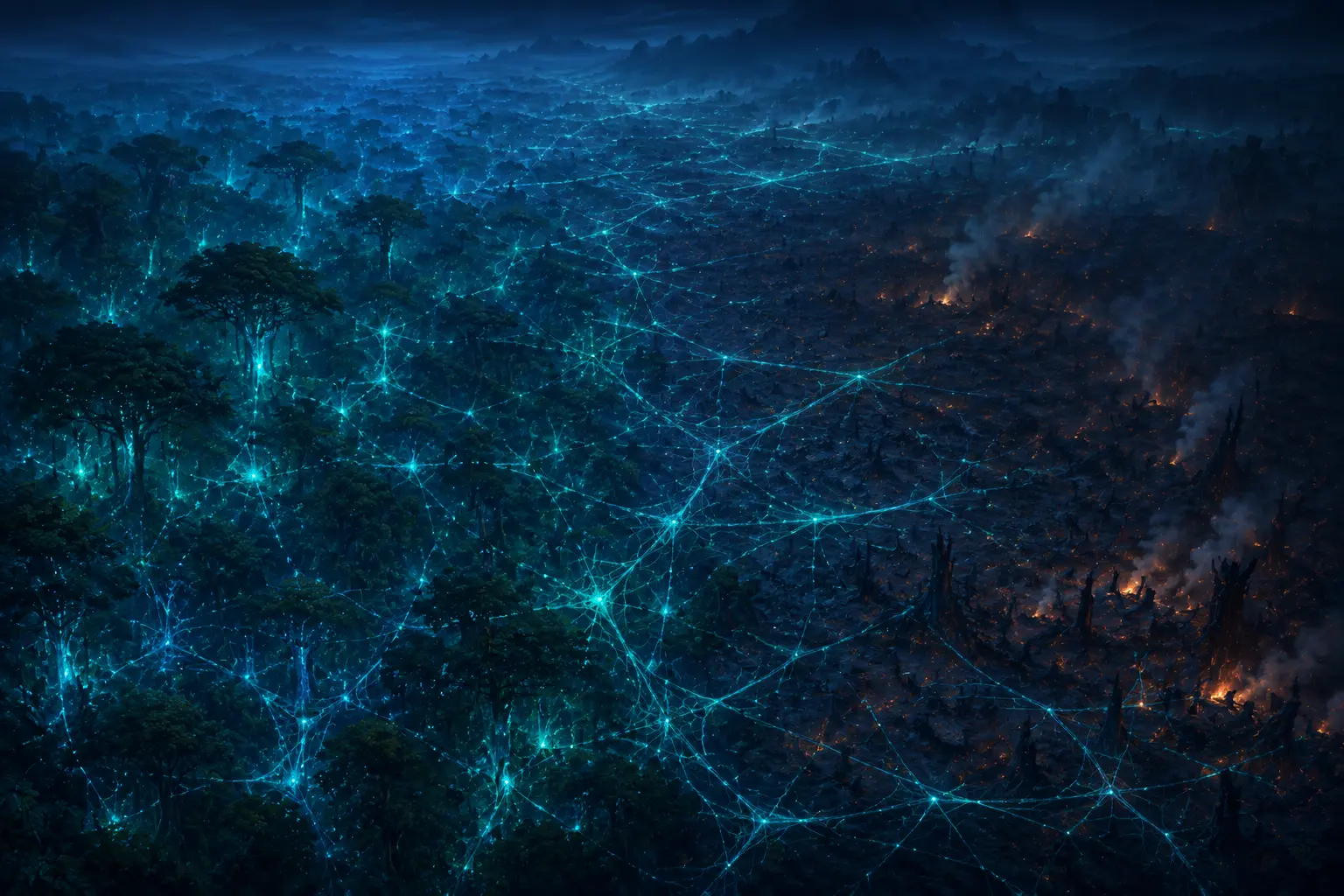
There is a particular kind of confidence that comes over an army when it finds something big to destroy. On Pandora it arrives the morning the bulldozers reach the Tree of Voices. The machine is the size of a building, the tree is sacred, and the calculation behind the assault is brutally simple: hit the enemy where it is holiest and the rest will fall apart. It is the same calculation that fells Hometree a day later, the same one that sends Colonel Quaritch's gunships toward the Tree of Souls at the climax of the first war, the same one that sends harpoons into the tulkun a decade on. Find the important thing. Destroy it. Watch the system collapse.
It never works. Not once, across two wars and an interstellar mining operation, does the destruction of any single Pandoran structure bring down the thing the RDA is actually fighting — the living planetary network the Na'vi call Eywa. The forest burns and Eywa does not die. The largest tree on the moon falls and the network does not so much as dim. This is not because Pandora is protected by magic, and it is not a screenwriter's convenience. It is the single most rigorously understood fact about connected systems on Earth, and it has a precise mathematics, a precise set of experiments, and — crucially — a precise list of the conditions under which it would, finally, fail. To understand why you cannot kill Eywa by burning her, and exactly how you could, we have to treat the planet the way a network scientist treats the internet: as a graph of nodes and links, and ask what it really takes to break one.
The catalog of strikes
Start, as any honest analysis must, with the data — and on Pandora the data is a catalog of destruction. The RDA delivers four distinct blows to the living network over the course of the story, and they are worth laying out precisely, because each one is a different kind of attack, and the difference is the whole lesson.
The first is the bulldozing of the Tree of Voices, the Utraya Mokri, on a morning early in the first film. The Tree of Voices is a stand of willow-like trees fused into a single organism, a place where the Omaticaya hear the recorded voices of their ancestors — a local archive node, in network terms. The corporation calls it a clearing operation; Grace Augustine reads it, correctly, as a deliberate provocation. Either way the result is the same: a sacred local access point is excised. And yet the broader network registers nothing. Other clans across the continent — the Anurai, the Li'ona, the Aranahe — keep their own equivalent sites and report no loss of connection at all. A node is deleted; the planet does not notice.
The second is the felling of Hometree, Kelutral — and this is the one that ought to matter most, because Hometree is enormous. It stands over three hundred metres tall, it has lived for some twenty thousand years, and an entire clan lives inside it. When SecOps brings it down to reach the unobtanium beneath its roots, the devastation is total and the grief is bottomless. Later, returning RDA ships incinerate three more Hometrees and vast tracts of forest just to clear ground for a base. By any human intuition, destroying the biggest living structures on the moon should cripple the network they anchor. It does not. Canon is quietly insistent on the point: the felling of Hometree is a humanitarian and ecological catastrophe, and it is not a network failure. Eywa does not flicker. Whatever Hometree was to the Omaticaya, it was not a load-bearing hub of the planetary mind.
The third blow is the one that breaks the pattern, and it is worth watching closely. Quaritch's assault on the Tree of Souls, the Vitraya Ramunong, is not random clearing. It is target selection. He has correctly identified the one structure that is genuinely different from the others — the single site where the entire clan can link their queues to the root system at once, the highest-bandwidth connection to Eywa anywhere in Omaticaya territory — and he means to destroy it specifically because it is the most connected thing on the map. His reasoning is, for once, sound network strategy: don't waste ordnance on ordinary trees, decapitate the hub. The assault fails, but not because the target was wrong. It fails because Pandora's wildlife mobilises and stops the gunships before they arrive — which means canon never actually shows us what destroying the Tree of Souls would have done. We are left with the most important question of the chapter deliberately unanswered: was the Tree of Souls a single point of failure, or just the biggest of many redundant hubs?
The fourth blow moves to the ocean. In The Way of Water, the RDA's whaling division hunts the tulkun — vast, sapient, culture-bearing marine animals — to harvest amrita from their brains. The tulkun are not scenery; they are mobile, intelligent, data-rich nodes in the same planetary network, communing at the Spirit Tree, the seabed counterpart of the Tree of Souls. Hunting them is the serial removal of high-value nodes. And again the oceanic network absorbs the loss and, eventually, mobilises against the threat. The pattern holds underwater.
Lay the four side by side and a shape appears. Three of the strikes — the Tree of Voices, the Hometrees, the tulkun pods — are, from the network's point of view, random damage. The RDA is not choosing targets by how connected they are; it is choosing them by where the unobtanium is, or where the amrita swims. The destruction is massive but topologically blind. Only the fourth, the Tree of Souls, is a deliberate strike at a hub. That distinction — random damage versus targeted damage — turns out to be the hinge on which the survival of the entire network swings. To see why, we have to leave Pandora for a moment and go to the one place this has been worked out exactly: the mathematics of graphs.
A planet drawn as a graph
To a network scientist, the word "network" has a stripped-down, almost austere meaning. Forget the glowing tendrils and the sacred groves for a moment. A network is just two things: a set of nodes — the things — and a set of edges — the connections between them. A tree is a node. A root-coupling between two trees is an edge. A tulkun is a node; the bond it shares at the Spirit Tree is an edge. Strip Pandora down to this and the whole planetary biosphere becomes a single vast graph — millions of nodes, a tangle of edges — and suddenly all the hard-won mathematics of graphs applies to it directly.
The first thing that mathematics gives us is a number for each node: its degree, simply the count of edges it has. A lonely sapling at the forest edge with two root-connections has degree two. The Tree of Souls, wired to an entire clan's worth of links, has an enormous degree. And the way those degrees are spread across all the nodes — how many lonely saplings there are versus how many giant hubs — is called the degree distribution, and it is the single most important fact about a network's character. It decides, as we will see, whether the whole thing is tough or brittle.
The second gift is the concept that tells us whether the network is even alive as a network. Picture removing trees one at a time and watching the web come apart. At first nothing much happens — pull out a node here, a node there, and signals still find a way across. But the connected bulk of the network — the one big mutually reachable mass that lets a signal at the north pole reach a root at the equator — has a name: the giant connected component, or GCC. The GCC is what "the network works" actually means. As long as a giant component spans most of the moon, Eywa is one connected mind. If enough damage shatters that component into thousands of isolated islands, then every tree can still be perfectly alive and photosynthesising and the network is nonetheless dead — no longer one thing, just a scatter of disconnected fragments that can no longer reach each other.
And here is the first place the popular intuition goes wrong, the one Pandora invites us to correct. It is tempting to think that the more connected a network is, the more robust it must be — pile on enough links and surely nothing can break it. But raw connectivity is not what decides toughness. The shape of the degree distribution does. A network can be enormously connected and still be brittle in exactly the wrong place, and a far sparser one can be nearly indestructible. To see how that can be, we turn to the single most important result in the science of network failure.
The landmark result: random error versus targeted attack
In the year 2000, three physicists — Réka Albert, Hawoong Jeong, and Albert-László Barabási — published a paper with a title that could serve as the epigraph for this entire chapter: "Error and attack tolerance of complex networks." What they discovered explains, with almost eerie precision, everything that happens to Eywa under the RDA's assault.
They started from an observation about the shape of real networks. Many of the networks that actually run the world — the internet, cellular metabolism, airline routes, food webs — are not built like a uniform mesh where every node has roughly the same number of connections. They are wildly lopsided. The overwhelming majority of nodes have very few links, while a tiny minority of nodes — the hubs — carry an immense number. The degree distribution follows what mathematicians call a power law, and such networks have a name: scale-free networks. A handful of mega-connected hubs, an ocean of barely-connected leaves. The internet is like this. So, almost certainly, is Eywa.
Albert and her colleagues then did something simple and devastating. They asked: what happens to a scale-free network if you start deleting nodes? And they ran it two ways. First, random failure — delete nodes blindly, at random, the way a disease or an accident or a wildfire would. Second, targeted attack — delete the highest-degree hubs first, deliberately, the way a strategist would. The two scenarios gave almost opposite results, and the gap between them is the secret of resilience.
Under random failure, the scale-free network is astonishingly tough. The reason is pure statistics: because the overwhelming majority of nodes are low-degree leaves, a blindly random deletion almost always hits a leaf, not a hub. You can tear out a startlingly large fraction of random nodes — Albert's team found you could remove a substantial share of the network — and the giant connected component barely changes. The hubs, which do the real work of holding everything together, are statistically almost never struck, because they are so rare. The network routes around the missing leaves without effort. It is, against accident, almost unkillable.
Under targeted attack, the very same network is pitifully fragile. Aim at the hubs — take out the most connected nodes first — and the giant component collapses after only a tiny fraction have been removed. Every hub you delete strands all the leaves that depended on it; delete a handful and the web fractures into disconnected islands. The thing that made the network robust against random loss — its dependence on a few mega-hubs — is exactly the thing that makes it brittle against a strategist who knows to aim at them.
Now read the RDA's catalog back through this single result, and the whole story snaps into focus. Clear-cutting forest for unobtanium, bulldozing the Tree of Voices, burning tracts of jungle for a landing site, harpooning tulkun pod by pod — from the network's point of view this is random failure. The RDA is deleting nodes by geography, by where the ore is, never by how connected the node is. And because the network is scale-free, that blind deletion overwhelmingly destroys leaves, the abundant low-degree nodes whose loss the giant component never feels. The RDA can level vast areas and the planetary mind genuinely does not notice, for precisely the reason Albert's team proved a scale-free internet could survive massive random router failures: blind damage hits the unimportant nodes almost every time.
And Quaritch at the Tree of Souls? That is the one moment the RDA stumbles, by instinct, onto the targeted attack. He has found a genuine hub and resolved to destroy it for being a hub. Had he succeeded — had he decapitated that node and others like it — he would have been running Albert's second experiment on the living moon, and the mathematics says targeted hub removal is exactly how you shatter a scale-free network. The Na'vi do not refute his strategy. They simply never let him test it. The deepest irony of the first war is that the colonel was, for one moment, thinking like a network scientist — and the planet's wildlife stopped him before the experiment could run.
The cliff edge: percolation
The Albert-Barabási result tells us which nodes matter. But it leaves a more unsettling question hanging. If the RDA simply kept burning — not aiming at hubs, just clearing more and more forest, blindly, forever — would the network survive any amount of random damage? Or is there a point, even under purely random loss, where the whole thing finally comes apart? There is. And the way it comes apart is the strangest and most important idea in this chapter, because it does not happen the way intuition expects.
The intuition is that a network degrades gradually: destroy ten percent of it and it works ten percent worse, destroy half and it works half as well, a steady slope downhill. That intuition is wrong. Connected systems do not fail on a slope. They fail off a cliff. The science of that cliff is called percolation theory, and it began, fittingly, with a question about whether water could find its way through coffee.
Here is the picture. Imagine the forest as a grid, and start removing trees at random, tracking the largest surviving connected patch — the giant component — as you go. Remove a few and almost nothing happens; the giant component shrinks by exactly the few you took. Remove more and still the bulk holds together, signals still crossing from one side to the other by some winding path. The network seems indestructible, shrugging off loss after loss. And then you remove a few more — no different from the ones before — and the entire connected mass abruptly disintegrates into a dust of tiny isolated islands. Not a slope. A cliff. One moment a continent-spanning web, the next a scatter of fragments that cannot reach each other. The exact fraction of removal where this sudden collapse happens has a name: the percolation threshold, written pc.
This is a genuine phase transition, in the same deep mathematical sense as water freezing into ice. Below the threshold the system is one connected, conducting whole; cross it and the system is, suddenly and qualitatively, a different kind of thing — disconnected, insulating, broken. There is no gentle middle. Nudge the temperature of water a fraction below zero and it is not "mostly liquid"; it is ice. Nudge a network's connectivity a fraction below pc and it is not "mostly connected"; it is shattered. The most famous toy version of this is the forest-fire model that physicists actually study: scatter trees on a grid at some density and set one alight, and below a critical density the fire fizzles out locally, while above it the fire suddenly rips clear across the whole grid. The difference between a contained burn and a continent-wide firestorm is a hair's breadth of density on either side of a threshold.
The interactive below lets you stand at that cliff edge yourself. Burn the network down at random and watch the giant component cling on, and on, far past the point you would expect — and then vanish all at once as you cross pc. Then switch the attack from random to targeted, aim at the hubs, and watch the same network collapse after only a few removals. The two modes are the whole chapter in your hands: the same web, indestructible one way and brittle the other.
Burn it down — and find the cliff
Remove part of a scale-free network and watch what stays connected
Removing nodes blindly, by where they sit — not by how connected they are
Now bring this back to the heart of the matter. There is a remarkable mathematical result, proved by Reuven Cohen and colleagues the same year as Albert-Barabási, that for a genuinely scale-free network under random failure, the percolation threshold effectively vanishes — pc creeps all the way toward one, meaning you would have to remove very nearly every node before the giant component finally dies. A scale-free network under random attack does not just resist collapse; it pushes the cliff edge so far back that, for any realistic amount of blind damage, the network never reaches it at all.
That is the precise, honest, mathematical reason burning Eywa does not kill her. The RDA's destruction, however vast it looks from the ground, is random loss on a scale-free network — and random loss on such a network has its percolation cliff shoved so close to total annihilation that clear-cutting a few regions does not come within sight of it. The planet's mind does not flicker when Hometree falls for the same reason the global internet does not collapse when thousands of random routers fail overnight: the cliff is real, but blind damage cannot find its edge. You could burn an astonishing fraction of Pandora and the surviving forest would still be one connected Eywa — right up until, in principle, you crossed the threshold, at which point she would not dim. She would shatter, all at once, in a single catastrophic instant.
Why a forest is built to lose pieces
Topology explains why random damage struggles to break the network. But living networks have a second layer of defence that pure graph theory misses, and it is the reason a biological web is even harder to kill than the internet. Engineers, when they want a system to survive failure, reach for redundancy: install two identical pumps, so that when one dies the other takes over. It works, but it is expensive and brittle in its own way — the backup has to be the same part, doing the same job, in the same place. Evolution almost never builds like that. It builds something subtler and tougher, and it has a name.
The name is degeneracy, and it means something precise: structurally different elements that can perform the same function. Not two copies of one part, but several unlike parts that happen to overlap in what they can do. Your kidneys and your sweat glands and your lungs are structurally nothing alike, yet all three can rid the body of waste; lose one route and the others widen to compensate. Degeneracy is everywhere in biology, and it buys a kind of robustness redundancy cannot: a degenerate system can absorb a blow it was never specifically designed to survive, because the substitute was never a dedicated backup in the first place — it was just a different part with an overlapping talent.
Eywa is profoundly degenerate, and once you have the word for it the canon reads differently. When the Tree of Voices is bulldozed, the Na'vi do not lose their connection to Eywa, because the connection was never routed through that one structure. They can bond at a Tree of Souls. They can bond at the seabed Spirit Tree, a completely different organism in a completely different biome. In Frontiers of Pandora one clan reaches Eywa not through a tree at all but through a giant bioluminescent mushroom. These are structurally unalike access points that do the same network job — the textbook signature of a degenerate system. The RDA keeps destroying specific structures and keeps being surprised that the function survives, because it is thinking in redundancy — kill the part, kill the capability — when Pandora is built on degeneracy, where the capability was never pinned to the part.
There is a third structural idea that completes the picture and finally lets us answer the question canon left hanging. Real networks are modular: they are built of dense local clusters — a single forest, a reef — that are richly wired inside and only sparsely connected to each other. Modularity acts like a firebreak. Damage inside one module tends to stay inside it, because there are few links along which it could spread to the next. But modularity comes with specific weak points. The handful of links that do bridge one module to another are precious, and the nodes that sit on those bridges have a special name in graph theory: articulation points, the vertices whose removal actually does split a connected graph in two.
This is the exact tool we need for the Tree of Souls. The reason its destruction is a real strategic question — and not just more blind clearing — is that it might be an articulation point: the one bridge coupling the local Omaticaya forest module to the wider planetary network. If it is, then destroying it would do something none of the other strikes achieved. It would not kill Eywa; the global network would close over the gap. But it would amputate the local clan from the whole, severing the Omaticaya's access while leaving the planetary mind intact on the far side of the broken bridge. That is a precise, network-theoretic reading of Quaritch's plan: not a decapitation of Eywa, but a surgical isolation of one people from her. Canon never lets the strike land, so we never learn whether the Tree of Souls truly sits on that bridge. But percolation and modularity tell us exactly what to look for, and exactly what the two possible outcomes would have been.
The forest that grows back
There is still something graph theory alone cannot account for, and it is the most important thing of all. A network drawn on paper is static: remove a node and it is gone forever, and the only question is whether the survivors stay connected. But Eywa is not drawn on paper. She is alive, and living networks do something no diagram can — they regrow the nodes they lose. To finish the account of why burning Eywa fails, we have to leave pure mathematics for the science of how living systems recover from catastrophe, and it begins with a distinction that is constantly, expensively confused.
The distinction is between resistance and resilience. Resistance is a system's ability to not be damaged in the first place — the thickness of the bark, the height of the seawall. Resilience is something else entirely: the ability to absorb damage and recover, to take the blow and come back. The ecologist C. S. Holling drew the line sharply in 1973, and it matters here because Eywa is not especially resistant — her trees burn as readily as any — and yet she is extraordinarily resilient. She does not survive the RDA by being hard to hurt. She survives by being almost impossible to keep down.
Two real ecological mechanisms power that recovery, and both have direct Pandoran counterparts. The first is the insurance hypothesis: in a diverse ecosystem, many different species quietly perform overlapping roles, so that when a disturbance wipes out some of them, others are already in place to carry the function forward. Biodiversity, on this view, is not decoration; it is insurance, a portfolio of responses to an uncertain future. It is degeneracy again, written at the scale of a whole ecosystem — and it means a burned patch of forest is reseeded not by one heroic species but by a crowd of them, each hedging against the others' failure.
The second mechanism is the one that truly explains the burn. Earth's fire-adapted ecosystems do not merely tolerate fire; many require it, holding their next generation in reserve precisely against the day everything above ground turns to ash. The reserve is the seed bank — seeds banked in the soil or locked in fire-opened cones, insulated from the heat, waiting to germinate into the cleared and fertilised ground a fire leaves behind. Burn such a forest to the bare earth and you have not ended it. You have triggered it. Within a season the supposedly destroyed ecosystem is greening from a memory it buried before the fire ever came.
Now read the woodsprites again. The atokirina' — the drifting, luminous seeds of the sacred trees, the ones that settle on Jake Sully and that Neytiri reads as a sign from Eywa — are, in the cold language of this chapter, a mobile aerial seed bank and a distributed data-recovery system. They are the seeds of the network's most connected hubs, dispersed on the wind across the whole moon, carrying the instructions to grow new sacred trees wherever they land. Burn a region to sterile ash and the woodsprites from untouched hubs drift in and reseed it — restoring not just trees but the network's connectivity, planting fresh nodes into the gap. Canon even has them physically remake an organism, altering the human Spider so he can breathe Pandoran air. They are Eywa's regeneration made visible: the reason the network replaces its lost nodes faster than blind destruction can accumulate, and therefore the reason the slow climb toward the percolation threshold is, under any normal assault, continually undone.
Notice what that turns the question into. "Faster than blind burning can pull it toward the cliff" is not a threshold claim; it is a claim about two rates, and rates can be compared. Set them against each other and the network either finds a scarred plateau and stays one whole, or loses the race and falls off the cliff on an ordinary afternoon.
Burning against regrowth
Resilience is not armour. It is a rate — and a rate can be outrun.
Reseeding is done by the forest that survives, so it slows as the network shrinks — which is why the losing side of this race accelerates instead of levelling out.
How you would actually kill her
It would be a strange kind of honesty that spent a whole chapter proving Eywa nearly unkillable and then stopped without admitting the obvious: nearly is not entirely. The same mathematics that explains her resilience also draws, with uncomfortable precision, the map of her death. A distributed network is hard to kill by accident and quite possible to kill on purpose, and the difference is exactly the difference between what the RDA did and what it would have had to do. There are four ways across the line, and laying them out is not ghoulishness — it is the proof that the resilience is real rather than magical, because a thing that genuinely could not be destroyed under any conditions would not be resilient. It would just be a miracle.
The first way is targeted hub decapitation — the Albert-Barabási attack mode, executed at scale. Stop clear-cutting at random and start hunting hubs: identify every Tree of Souls, every Tree of Voices, every Spirit Tree, every major bioluminescent relay on the moon, and destroy them simultaneously. A scale-free network fragments after losing only a tiny fraction of its most connected nodes, so this would not require burning much of Pandora at all. It would require burning exactly the right sliver of it. Quaritch's instinct at the Tree of Souls was this strategy in embryo; he simply aimed at one hub instead of all of them at once.
The second way is crossing the percolation threshold by attrition — winning the race against regeneration. The woodsprites reseed faster than blind burning can accumulate damage, so the threshold stays out of reach. But that is a race, not a law. Burn faster than Eywa can regrow, sustain it long enough, and the standing density of the network creeps down toward pc — and then one ordinary day, indistinguishable from the last, the giant component crosses the cliff and the planetary mind shatters into mute fragments. Not a decline. A threshold, reached by outpacing the regrowth that normally holds it back.
The third way is subtler and crueller: sterilising the regeneration itself. Resilience depends entirely on the capacity to regrow, and that capacity has a physical substrate — the seeds, the woodsprites, the living soil. Poison the soil against germination, or destroy the atokirina' in flight, and you have not killed a single mature tree, yet you have converted every future blow from survivable into permanent. A network that cannot regrow is, from the moment its seed bank dies, merely a network being slowly subtracted toward the threshold with no way back.
The fourth way is the most insidious, and it comes from one of the genuinely frightening results in modern network science. In 2010 Sergey Buldyrev and colleagues showed that interdependent networks — two networks that each depend on the other to function — are dramatically more fragile than either alone, because failure ricochets back and forth between them in a cascading failure: nodes fail in network A, which knocks out the network-B nodes that depended on them, which knocks out further A nodes that depended on those, and so on, an avalanche that can level both systems from a single push. Pandora is exactly such a coupled pair. The flora is one network; the fauna — the pollinators, the seed-carriers, the woodsprites and the great beasts that defend the trees — is another, and each depends utterly on the other. Which means the way to kill Eywa might not be to burn a single tree. It might be to release a plague that kills only animals, and let the cascade do the rest: no fauna to disperse seeds or pollinate, so the flora fails, so the remaining fauna starve, the collapse bouncing between the two networks until both are gone. The most efficient way to kill a forest, the mathematics suggests, may be to never touch the forest at all.
The cascade — kill her without a fire
Two coupled networks, and a plague that touches only one
Auditing the claim
Three claims, three very different burdens of proof
- What the evidence shows
- Scale-free networks tolerate random node loss almost completely (Albert-Barabási 2000); Cohen et al. showed the percolation threshold under random failure approaches total annihilation.
- The honest caveat
- This is the real, settled mathematics — but it assumes the damage really is random with respect to connectivity, which the RDA's resource-driven targeting happens to be.
Honest edges
The line worth drawing cleanly is the one between what is established and what is reasoned. The mathematics here is as settled as science gets: graph theory's giant connected component, the Albert-Barabási dichotomy of random-tolerance and targeted-fragility, the Cohen result pushing the percolation threshold toward one for scale-free networks under random failure, percolation as a genuine phase transition, Holling's resistance-versus-resilience, the insurance hypothesis, fire-adapted seed banks, and Buldyrev's cascades in interdependent networks. None of that is Pandoran and none of it is in doubt; it is the real, transferable payload, and it describes the internet, the power grid, and every forest on Earth as exactly as it describes Eywa.
What is canon is the catalog of strikes and their outcomes: the Tree of Voices bulldozed without systemic effect, Hometree felled without the network dimming, the Tree of Souls singled out as the one hub worth a targeted strike, the tulkun hunted and the ocean network enduring, the woodsprites drifting out to reseed. What lies between the firm science and the firm canon is a bridge of inference, and it carries most of the chapter's interesting weight: reading the RDA's resource-driven destruction as topologically random attack, reading the Tree of Souls as a scale-free hub and an articulation point, reading the woodsprites as a regenerating seed bank. That bridge is sound engineering, but it is reasoning, and it is marked as reasoning. The four ways to kill her are further out still — reasoned speculation about what canon never depicts, offered as the necessary proof that the resilience has limits, not as anything the films show.
So burn the forest, and you have killed a great many trees and left the network they belonged to almost untouched — because what you destroyed, the network barely depended on, and what you destroyed regrows. That is not Pandoran magic. It is the plainest lesson connected things have to teach, proven on Earth in the survival of the internet under random failure and the greening of a burned hillside, and it runs underneath your own feet as surely as it runs under Pandora's. Eywa shrugs off the fire for the same reason the network you are reading this on shrugs off a thousand failing routers a night: a sufficiently large, redundant, regenerating, distributed network has no single place where its life is kept, and you cannot kill what is not stored anywhere in particular. The haunting part — the part that should keep an honest reader up at night — is the corollary. No single place is not no place. The mathematics that makes her nearly immortal also names, with terrible precision, the four narrow doors through which even a planet's mind could be made to die.
What stays open
This is the chapter's deliberately unanswered question, and canon withholds the answer on purpose: the wildlife stops Quaritch's assault before the tree is destroyed, so we never see what its loss would have done. The existence of the Spirit Tree underwater and the Trees of Voices in other clan territories argues for redundancy — many hubs, no one of them load-bearing for the whole. But the Tree of Souls is also the only site canon says permits a clan-wide simultaneous connection, which hints it may be a genuine articulation point for its region. Whether it was a hub among hubs or the keystone of the planetary mind is left genuinely open.
The Spirit Tree mirrors the Tree of Souls beneath the sea, which suggests one continuous planet-spanning network crossing the seabed. If so, the forest and ocean are interdependent in exactly Buldyrev's dangerous sense, and a cascade started in one could in principle propagate to the other. But canon never shows the two physically joined, and they could equally be separate networks running the same design — in which case damaging one would leave the other wholly intact. Whether Pandora has one resilient global mind or two independent ones changes the entire vulnerability analysis, and it is never resolved.
Everything rests on the race between destruction and regrowth, but canon never quantifies either rate. We see the woodsprites disperse and we see forests intact a decade after the first war, which implies regeneration comfortably outpaces the damage inflicted — but whether a sustained, industrial-scale burn campaign could push the standing network density down to the percolation threshold faster than the atokirina' could reseed it is precisely the number no one on either side appears to have. The threshold is real; whether the RDA could ever reach it is unknown.