

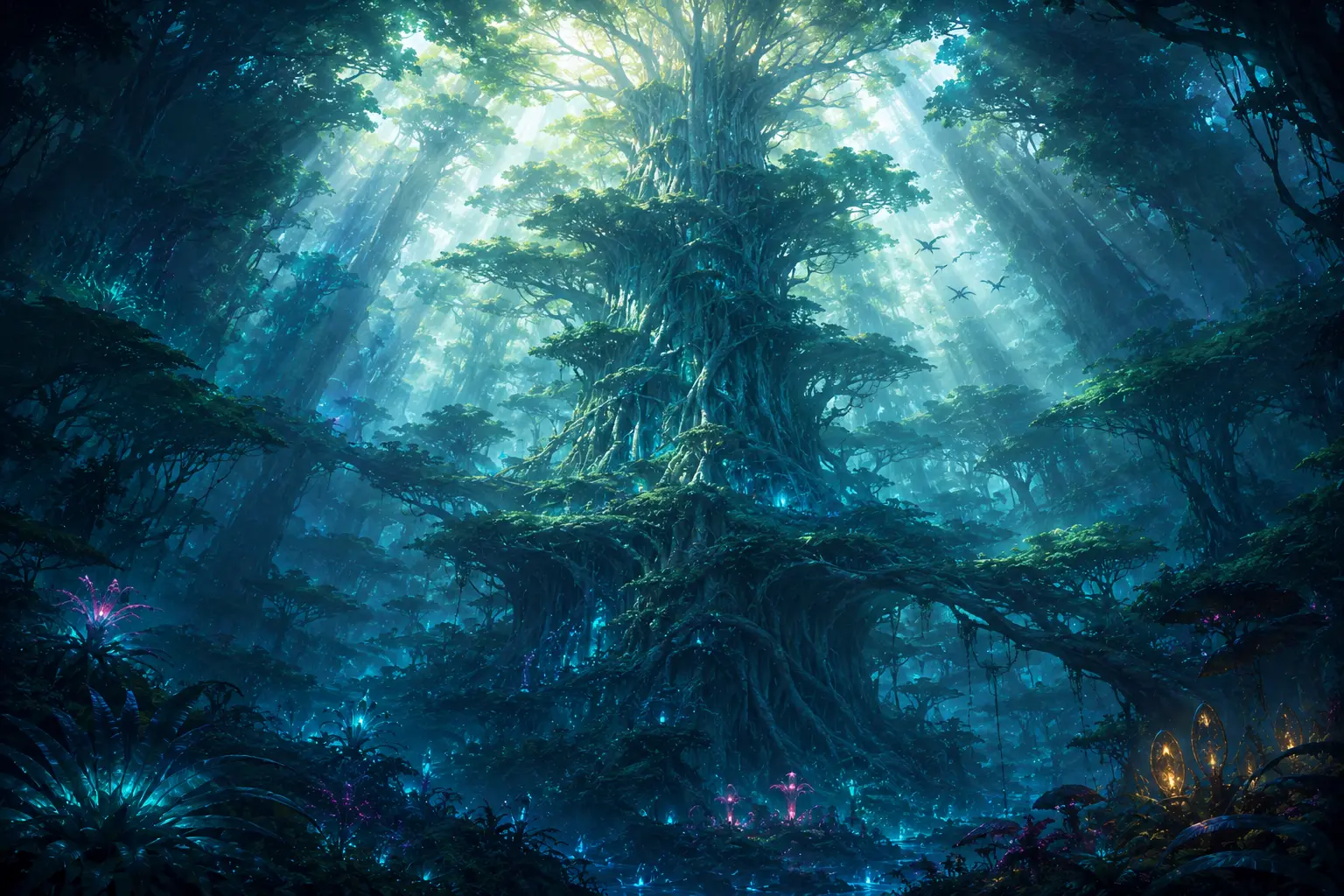
There is a particular feeling the films return to again and again, and it is worth taking seriously rather than waving away as mood. A Na'vi walks into the deep forest and slows down. The voice drops. The body language is the body language of someone entering a sanctuary. Grace Augustine, the chain-smoking xenobotanist who has no patience for sentiment, calls the forest sacred and means it as a scientist. And the camera, every time, does the same thing: it tilts up. It leaves the floor and climbs the trunk of a tree so large it has no business existing, past tier after tier of hanging life, up into a vaulted ceiling of foliage where the light comes through in long pale columns. The forest is being filmed as a cathedral. The question this chapter asks is whether that is just a beautiful image, or whether it is, quietly, a piece of ecology.
It turns out to be ecology. A cathedral is not just a big room. It is a tiered room — a floor you walk on, galleries stacked up the walls, a vaulted roof far overhead, and high windows that let the light fall in shafts from above. Each level has its own light, its own air, its own use. And a forest — a real one on Earth, and the exaggerated one on Pandora — is built exactly the same way. It is not one habitat. It is a stack of habitats, sorted by height, each with its own climate and its own residents. Learn to see the floors, and two things that look like magic on Pandora turn into physics and biology you can carry home: why a single forest can hold such an absurd density of life, and what it really takes for a tree to climb three hundred metres into the sky.
A room with floors
Start with the architecture, because everything else hangs off it. Walk a tropical forest on Earth and an ecologist will point out four broad layers, bottom to top. There is the forest floor — dim, humid, still, carpeted in the slow business of decay. Above it the understory, a shaded zone of saplings and broad-leaved plants straining toward what little light filters down. Higher still the canopy, the dense continuous roof of interlocking crowns where most of the forest's leaves, fruit, and traffic actually are. And punching up through that roof, here and there, a few emergent giants standing alone above everything, taking the full force of the sun and wind. This vertical sorting has a name — forest stratification — and it is one of the most reliable patterns in all of ecology. Forests on different continents, built from completely unrelated plants, converge on the same layered floor plan, because the same physics builds it every time.
What makes the layers real — what makes them genuinely different places to live rather than arbitrary lines drawn on a poster — is that the environment changes steeply as you climb. The single most important gradient is light. The canopy is greedy: the upper leaves intercept the sun first, and each layer of foliage below gets the leftovers. Ecologists put a number on how thick that stack of leaves is — the leaf area index, the total leaf area standing above one patch of ground — and the higher it runs, the less light survives the descent. By the time sunlight reaches the floor of a closed tropical forest, something like one to two percent of what struck the crown is left. Two percent. The plants on the floor are living on the forest's pocket change. And light is only the most obvious gradient. Humidity rises as you descend, into the still, damp air near the ground; temperature swings are violent in the exposed crown and gently buffered below; wind that batters an emergent giant dies to nothing in the understory. Each floor of the cathedral has its own weather.
Now go to Pandora, and the only thing that changes is the scale. The same four-floor architecture is there — a dim, glowing floor; a shaded understory; a dense canopy; emergent giants above — but the building is monstrous. The defining structure is the Hometree, Kelutral in Na'vi, and even by the conservative numbers in the lore it is staggering. The Omatikaya clan's Hometree is described as standing over three hundred metres tall — some accounts push past three hundred and twenty-five — with a trunk roughly fifty-seven metres across and a root system sprawling more than a hundred metres over the ground. For scale: that is more than twice the height of the tallest tree alive on Earth, growing on a trunk wider than a basketball court is long. The film leans into the comparison deliberately. When the human characters first see it, the script reaches for cathedrals and skyscrapers, because those are the only Earth structures in the right size class. The forest is filmed as a cathedral because, on Pandora, the trees really are the size of cathedrals — and then some.
So the cathedral has its floors. The next question is the interesting one: who lives on each, and why don't they all just pile into the best one?
The tenants of each floor
Watch where the animals are, and the layers light up. In the high, wind-raked emergent crowns of the Pandoran forest — the cathedral's vaulted roof — the great fliers rule. The mountain banshee, the ikran, roosts and nests in the topmost branches, using the sheer height as a launch platform: step off a three-hundred-metre crown and you have a long, free fall in which to find the air. The crown is the realm of things with wings, exactly as Earth's emergent layer is the realm of eagles, hornbills, and the canopy's big raptors. Drop into the dense main canopy and the cast changes: this is the floor of climbers and gliders and arboreal foragers, the Na'vi themselves moving through a three-dimensional world of branches, the prolemuris swinging between crowns. Lower, in the shaded understory, the light is thin and the bodies change again. And on the dim forest floor move the big ground-dwellers — the hexapede browsing the sparse undergrowth, the viperwolf pack and the thanator hunting through the gloom where the canopy's leftover light barely reaches.
This is not decoration. It is the single most important idea in forest ecology, and it answers a question that should genuinely puzzle you: how does one forest feed so many species at once without them grinding each other into extinction? Two animals that want exactly the same thing, in exactly the same place, at exactly the same time, cannot coexist for long — one always edges the other out. So how do dozens of herbivores, dozens of predators, share a single forest? The answer is that they don't actually share it. They divide it. And the height axis of the forest is the easiest thing in the world to divide.
Vertical Forest Dive
Drag the elevator to sink through the layers and watch the climate change
The Pandoran forest, in other words, is not one prize that everything fights over. It is a stack of separate addresses. The banshee in the crown and the hexapede on the floor are no more in competition than a rooftop falconer and a basement tenant. Each layer is a distinct ecological niche — a distinct job in a distinct place — and the forest holds as much life as it does precisely because it offers so many of them, stacked vertically in the same patch of ground. The taller and more layered the forest, the more floors there are to let, and the more tenants it can hold. The cathedral metaphor turns out to be an occupancy chart.
The frontier overhead
Here is something that should be a little humbling. For most of the history of biology, the single richest, busiest floor of the forest was also the one we knew almost nothing about — because we couldn't get to it. The canopy is tens of metres up a smooth trunk, and a scientist standing on the ground studying a rainforest is in roughly the position of a scientist standing on the seabed trying to study the ocean's surface. Most of the action is happening far overhead, out of reach. The canopy earned a nickname among the people who finally cracked it: the last biotic frontier.
The person who did more than anyone to reach it is the ecologist Nalini Nadkarni, who borrowed mountaineering harnesses and rope techniques — and later cranes, walkways, and a custom line-launching crossbow — to get herself up into the crowns and stay there. What she found rewrote the canopy from a passive green roof into a teeming ecosystem with a life of its own. The branches up there are not bare wood. They are gardens. Plants called epiphytes — orchids, ferns, bromeliads, mosses — grow on the branches without rooting in the ground at all, pulling their water and nutrients straight from rain and mist. Over time their debris builds up into thick mats of genuine soil perched in the treetops, metres above the earth. And the host trees do something startling in response: they grow roots out of their own branches, downward into the aerial soil mats, to drink from the gardens growing on themselves. There is a whole second forest floor up in the air, complete with its own soil, its own roots, its own water cycle.
How much life is up there? In 1982 the entomologist Terry Erwin tried to find out with a brutally direct method: he fogged the canopies of a single tropical tree species with a knockdown insecticide and counted what fell. From the beetles alone he built a chain of estimates — host-specific species per tree, multiplied across the tens of thousands of tropical tree species, scaled up from beetles to all arthropods, from canopy to whole forest — and arrived at a famous, vertiginous number: perhaps thirty million arthropod species on Earth, the overwhelming majority of them living in the canopy and undescribed by science. The figure detonated a decades-long argument; later workers like Nigel Stork, tightening Erwin's assumptions, pulled the estimate down toward five to ten million. But the argument was always about the exact size of the number, never about its meaning, which stood unchallenged: the canopy is the great reservoir of terrestrial biodiversity, and the floors of the forest are not equally populated. The penthouse is where the crowd is.
Five warblers in one tree
The cleanest proof that the floors of a forest are real, separate addresses comes not from Pandora but from a stand of spruce trees in Maine, and from a young ecologist named Robert MacArthur who, in the 1950s, went looking for an answer to a nagging theoretical problem. The theory said that two species making their living the same way could not coexist — the better competitor would always drive the other out. Yet the spruce woods were full of warblers: five species of small insect-eating birds, all roughly the same size and shape, all hunting insects in the same trees at the same time of year. They were, by the theory, an impossibility. They should not all be there. But they were. So either the theory was wrong, or the birds were not actually doing the same thing.
MacArthur did something deceptively simple. He spent hour after hour watching individual warblers and writing down where in the tree each one fed — how high up, how far out along the branch, whether in the dense old needles near the trunk or the fresh growth at the tips. And the impossibility dissolved into a tidy piece of architecture. The birds had carved the tree into zones. The Cape May warbler worked the very top and the outer tips, snatching insects in the bright, exposed crown. The blackburnian fed high as well but slightly differently. The black-throated green took the middle. The bay-breasted foraged slower and deeper, in the shaded interior. The yellow-rumped worked the lowest branches and the trunk, and dropped to hawk insects out of the air. Five species, one tree — but each one occupying a different floor and a different room of it. They were not competitors at all. They were neighbours with separate apartments in the same vertical building.
That study became one of the founding stones of modern ecology, and the principle it established is exactly the one the Pandoran forest runs on, scaled up by orders of magnitude. MacArthur's warblers split a twenty-metre spruce into five vertical zones. A three-hundred-metre Hometree offers a vertical gradient fifteen times deeper, with room for a far longer ladder of specialists between the glowing floor and the wind-blasted crown. The mechanism is the same; only the number of rungs has changed. Niche partitioning — the dividing-up of a shared resource into non-overlapping specialties — is what lets a forest pack in its impossible diversity, and the height axis is the easiest dimension along which to do the dividing.
There is even a way to put a number on it. In 1961 MacArthur and his brother showed that you could predict the diversity of birds in a habitat astonishingly well from a single measurement — not the variety of plant species, not the climate, but the foliage height diversity: how evenly the leaves were spread across the vertical layers. More floors, more evenly furnished, meant more kinds of birds. Modern ecologists now measure the same thing with airborne and satellite lasers, scanning forests in three dimensions and confirming the old result at planetary scale: structural complexity, the sheer verticality of a forest, is one of the best predictors of how much life it holds. The cathedral's value is in its floors. Which makes the next question unavoidable. If floors are everything, and Pandora's forest has the tallest floors imaginable — how tall can a tree actually be?
The ceiling no tree can break
Here is a fact that sounds made up and is not: there is a maximum height for trees on Earth, and we know roughly what it is. The tallest living tree, a coast redwood named Hyperion, stands about a hundred and sixteen metres. The tallest reliably recorded trees of the past, before the biggest were logged, reached perhaps a hundred and twenty-six. And when biologists work out the physics from first principles, they land in the same place — somewhere around a hundred and twenty-two to a hundred and thirty metres — and then the ceiling comes down. Trees do not trail off gradually toward some vague enormous size. They run into a wall. The question is what the wall is made of, and the answer is water.
A tree has a plumbing problem unlike anything we build. It has no pump. The redwood lifts hundreds of litres of water a day from its roots to its crown a hundred metres up, and there is no heart anywhere in it doing the pushing. Instead it pulls. Water evaporating from the leaves at the top — transpiration — tugs on the water just below it, which tugs on the water below that, all the way down an unbroken thread running through microscopic pipes in the wood called the xylem. Water molecules cling to each other strongly enough that the whole column holds together under tension, like a rope you pull from the top — this is the cohesion-tension mechanism. The entire towering tree is drinking through a hundred-metre straw, powered by nothing but sunlight drying its leaves.
That works astonishingly well, but it gets harder with every metre. The taller the tree, the more the weight of the hanging water column pulls down, and the harder the leaves at the top must pull to keep it rising. Two things mount against them at once: gravity, dragging the whole column down, and friction, as water grinds up through the narrow pipes. At the top of a very tall tree, the tension in the water gets so extreme that the column is on the verge of doing something catastrophic — snapping. When the thread of water breaks, an air bubble flashes into the pipe and the column ruptures; the plumbing of that vessel is dead. The taller the tree climbs, the closer its topmost water runs to that breaking point.
The biologists George Koch and Stephen Sillett climbed the tallest redwoods on Earth in 2004 to measure exactly this, and found the ceiling written in the leaves. Near the top of a hundred-metre redwood, the water is under such relentless tension that the leaf cells can no longer puff themselves full — their internal turgor pressure, the water-pressure that makes a cell firm, falls so low the cells simply cannot expand. So the topmost leaves come out stunted: small, dense, scale-like, a fraction of the lush foliage lower down. And small starved leaves cannot photosynthesize much. Climb high enough and you reach the altitude where a new leaf costs more than it can ever earn back — where the tree, in pure accounting terms, can grow no taller because the top has stopped paying for itself. Koch and Sillett projected the lines to that break-even point and got a number between a hundred and twenty-two and a hundred and thirty metres. The redwoods were already brushing their own ceiling. Earth's tallest trees are not far from the tallest trees that Earth's physics permits.
How tall can a tree get?
Drag the height up to see how much the water column stretches
The crown is still paying its way: water reaches the top under survivable tension.
So now the Pandoran problem comes into sharp focus, and it is a real one, not a quibble. A Hometree at three hundred metres is not a little taller than Earth's limit. It is more than twice as tall as physics should allow. If the cohesion-tension straw snaps somewhere past a hundred and thirty metres on Earth, how does a Kelutral get water to a crown three hundred metres up without its plumbing exploding the whole way? This is the kind of gap where it would be easy to shrug and say "alien tree, alien rules." But the honest move — and the more interesting one — is to ask what would actually have to be true of Pandora for the number to climb, and then check whether Pandora is, in fact, like that.
What Pandora would need to be true
The tree-height ceiling is not a single brute number; it is the output of an equation, and the equation has knobs. Change the conditions a tree grows in, and the ceiling moves. So the right question is not "how can a Hometree break the limit?" but "what would Pandora have to be like for its limit to sit three times higher than Earth's?" — and then we go and check Pandora against that list.
The first and biggest knob is gravity. A huge part of why water gets so strained at the top of a tall tree is that the entire hanging column has weight, and that weight scales directly with gravity. Pull the gravity down and the column gets lighter; the tension at any given height eases; the breaking point retreats upward. Pandora's surface gravity is about eighty percent of Earth's — and that twenty percent discount applies to every metre of the water column, all the way up. Lower gravity does not lift the ceiling by twenty percent in a simple way, but it pushes hard in exactly the right direction, letting a Pandoran tree raise water meaningfully higher than an Earth tree before its plumbing reaches the same danger. For a structure three hundred metres tall, that lighter column matters at every level at once.
The second knob is the air. Pandora's atmosphere is dense — about twenty percent denser than Earth's at the surface — and loaded with carbon dioxide, somewhere around sixteen to eighteen percent, compared to a fraction of a percent on Earth. To us that air is poison, which is why the humans never take off their masks. To a tree it is a gift. A leaf loses water through the same pores it uses to take in carbon dioxide, so on Earth a tree is caught in a permanent bind: open up to feed, and you bleed water; close to save water, and you starve. But in air drenched in carbon dioxide, a Pandoran tree can take in all the carbon it needs while barely cracking its pores open — feeding richly while spending almost no water. Less water spent at the top means less tension on the column, means the straw can run higher before it snaps. The thick, humid air helps from the outside too, slowing evaporation. The very atmosphere that kills the humans is what waters the giants.
Stack those together — a lighter water column from low gravity, and far less water lost from a carbon-rich, humid atmosphere — and the Earthly ceiling of a hundred and thirty metres stops looking like a fixed law of the universe and starts looking like one planet's particular answer. Loosen the two things that set it, and the answer changes. Does it cleanly reach three hundred metres? That is honestly a stretch, and we should say so; the canon numbers were chosen for awe, not for a stress calculation, and even generous physics has to strain to get there. But the gap between "physically impossible" and "physically strained" is the whole game. Pandora's Hometree is not a violation of the rules. It is the rules, run on a planet that happens to have tilted every dial in a tree's favour.
Reading the seams
It is worth being clear about which parts of this chapter are which, because the forest mixes solid film canon, reasonable inference, and a few numbers that were never meant to survive a physics exam.
Biodiversity Multiplier
Grow the tree taller to see how vertical strata multiply niches
The cathedral architecture — the towering Hometree, the vaulted forest, the Na'vi living up inside the trunk — is canon, shown directly on screen. The specific dimensions come from the supplementary lore, and they wobble: different sources give the Omatikaya Hometree anywhere from a little over three hundred metres to past three hundred and twenty-five, and other clans' Hometrees are placed lower, around a hundred and fifty. The vertical sorting of Pandoran animals by height — banshees in the crown, ground-dwellers on the floor — is partly shown and partly a reasonable reading of where the films put each creature. The stratification, the niche partitioning, the light gradient, the warblers, the hydraulic ceiling: all real Earth science, none of it invented for this book. What is inference is the bridge between them — the claim that Pandora's low gravity and dense, carbon-rich air are what let its trees clear the Earthly height limit. That is the best physical story the available numbers support, but it is a story we are telling about the canon, not one the canon tells about itself.
What the forest still won't say
Canon sources disagree badly — the Omatikaya Hometree is given anywhere from a little over 300 m to past 325 m, while other clans' trees are placed nearer 150 m. Worse, it is never clear whether a figure means the living trunk alone or includes the crown, or from what base it is measured. Until the number is pinned down, every physics argument about it inherits the uncertainty: a 150 m tree barely strains Earth's limit, a 325 m one demands the full low-gravity, dense-air explanation.
The whole hydraulic-limit argument assumes a single unbroken cohesion-tension water column, the way a redwood works. But canon describes the Hometree's trunk as hollow and multi-columnar — dozens of fused woody columns around a central core. That hints at internal plumbing the films never specify, and a fundamentally different water-transport design could lift the height ceiling for reasons that have nothing to do with gravity or air. We are reasoning from a redwood; the tree may not be one.
The one-to-two-percent floor light that defines Earth's understory depends on a dense, light-hungry canopy. The films show a layered forest, but we never get a measured vertical light profile for Pandora. If the canopy is leakier than Earth's, the strata would be shallower and the floor far brighter than the chapter assumes — and the whole occupancy chart would shift.
Earth's stratification is built top-down: the canopy takes the light first and the floor lives on the leftovers. But Pandora's forest floor is famously bioluminescent. Light welling up from below inverts part of that gradient — and we have no idea how much that reshuffles which organisms can make a living at which height, or whether it creates strata Earth has no analogue for.
These are not flaws in the world. They are the places where the world hands the science an open question instead of an answer — and an open question you can actually reason about is worth more than a fact you simply memorise.
Back at the base
Return to where we started: the foot of the Hometree, the camera tilting up. What looked at first like reverence for a pretty tree turns out to be the correct response to a piece of architecture. The Na'vi enter the forest the way one enters a cathedral because the forest is one — a tiered structure with a floor and galleries and a vaulted roof, light falling in shafts from the high windows, each level its own world with its own weather and its own residents. The science only sharpens the awe. The forest holds its impossible crowd of life because it has so many floors to let. The crown teems because it is the penthouse, the last frontier overhead. And the tree itself, three hundred metres of living straw drinking sunlight, stands at the very edge of what the physics of water will allow — not breaking the rules, but riding them all the way to a ceiling that a lighter, wetter, carbon-drunk world has quietly raised.
Look up the next time you are under real trees, even ordinary ones. The floors are there too — the canopy taking the light first, the understory in its shade, the warblers in their separate zones, the topmost leaves coming out small and starved at the limit of the climb. Pandora did not invent the cathedral. It only built one big enough that you cannot miss what every forest has always been.
Read next
Hometree as Keystone, Foundation and Cultural Keystone
Everyone calls Hometree a keystone, and everyone is wrong in a useful way. Robert Paine's keystone was rare and worked by eating; Hometree is most of the biomass around it and works merely by standing there. Those are different mechanisms, and telling them apart is what explains how felling Hometree can leave a planetary network untroubled and still be a loss nothing can repay. The idea to carry away: biomass grows back in decades, structure takes centuries — some things only time can build.
38 min read
Convergent, but Not Quite
The first human to walk Pandora's forest kept naming things - that is a panther, that is a wolf-pack, that is an eagle - and was almost always right about the job, never about the build. A moon with its own separate origin of life, built on a six-limbed body plan, keeps stubbornly reinventing Earth's cast of characters. The answer is not that Pandora copied us. It is a law that forces life anywhere to converge on the same short list of good answers - and the deeper truth in why it never converges all the way.
30 min read
Why Banshees Get to Be Big
Banshees and the toruk are big enough to look illegal. And there really is a law: lift, wing loading, and a merciless crossing point between the power a muscle can supply and the power flight demands — a crossing that caps the size of every flapping animal, and on Earth sits around Quetzalcoatlus, the largest creature that ever flew. Pandora does not tear up the equation. It turns just two dials — lower gravity, denser air — and the ceiling slides upward. The story of why a banshee gets to be big is an honest lesson in the limits of flight itself.
31 min read
The Wood-Wide Web Revisited
On Pandora the roots are said to connect everything — an electrochemical network strung across a whole moon. But real roots barely reach past their own canopy, so a world-spanning web cannot be root touching root. There has to be a third party threading between them. On Earth that third party is fungi — and the story of how it links trees, of what it provably does and what is only a beautiful tale that outran the evidence, is one of the most honest lessons forest science has to teach.
32 min read
Floating Mountains, Unobtanium and the Flux Devil
A sixteen-kilometre mountain hanging in mid-air is not magic. It is a physics demonstration scaled up to planetary size - and canon picked the wrong mechanism first, then quietly corrected itself. The answer is not that a field pushes the rock away; it is that a cold disc can lock itself rigidly into empty space.
20 min read