

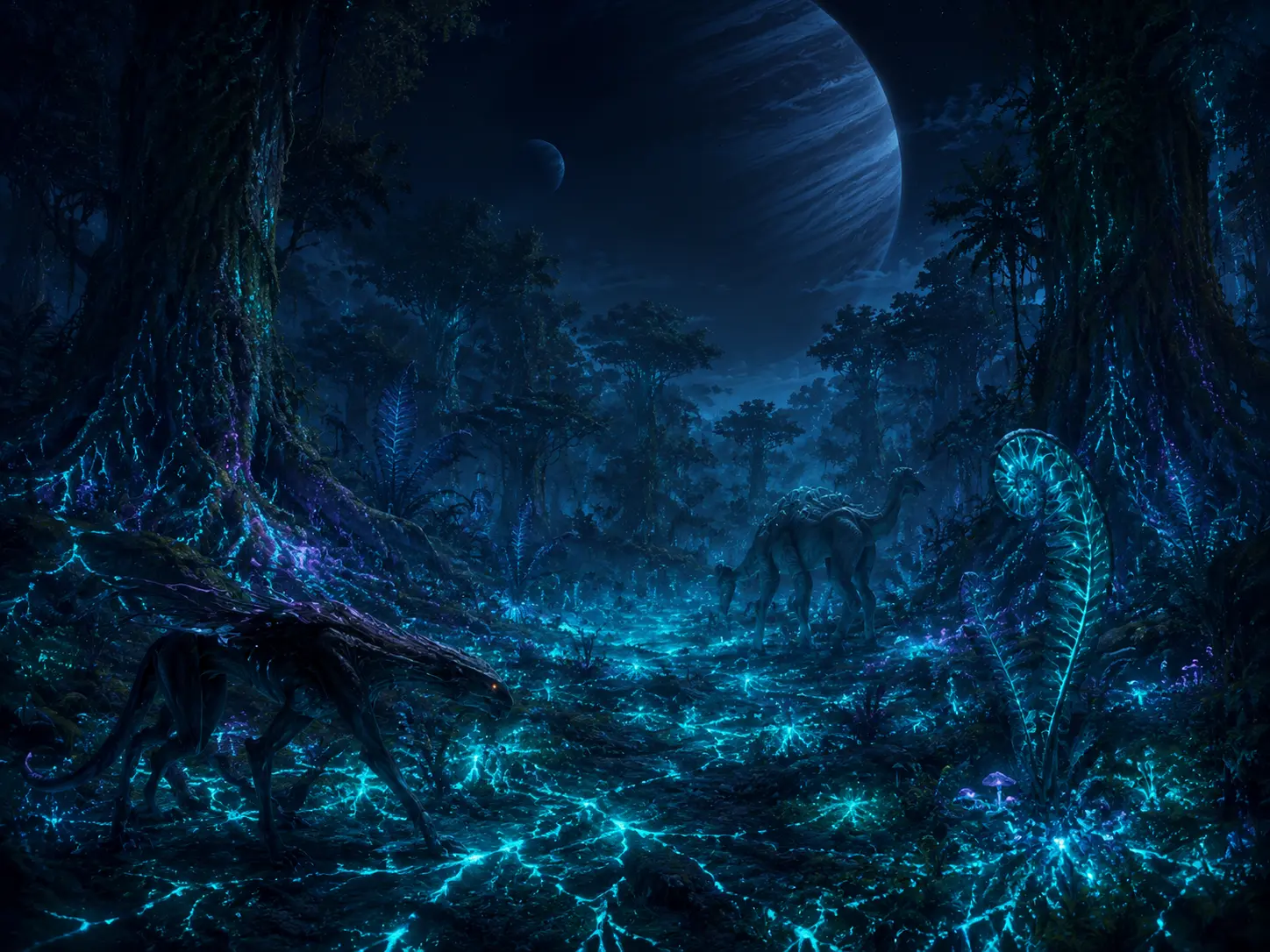
The eclipse comes in the afternoon, and there is a moment just before it that is easy to miss.
The light has not gone yet. Polyphemus has begun to slide across the sun, and what reaches the clearing is a thin, failing, coppery daylight — the kind of light Earth gets in the last two minutes before a thunderstorm, except that nothing here is agitated. Nothing is running for cover. A hexapede that has been browsing the sparse undergrowth all afternoon lifts its head, chews once more, and walks — unhurried, almost bureaucratic — toward the treeline. High above, in a crown three hundred metres up, a mountain banshee that has been riding the thermals all day tips a wing and comes down to its roost. There is no alarm in any of it. It has the unmistakable air of a shift ending on time.
Then the sun goes fully behind the planet, and the world does something no Earth forest has ever done. It lights itself.
Not gradually. The ground comes up: the root networks first, tracing their branching paths under the leaf litter in cyan; then the mosses and the low fungal mats, then the veins in the standing leaves, until the clearing is legible again by a light that is coming from underneath. A spiral-leafed plant that stood open all afternoon folds itself shut. And into that lit clearing, out of the deeper dark where it has been lying up all day, steps something with six legs and a burnished black hide, and behind it another, and another, moving with the loose coordination of animals who do this every single evening at this hour and have never once needed to discuss it.
The Na'vi have a phrase for the hour, and it is a piece of scheduling rather than poetry: be home by eclipse. A child sent out to forage understands it as an appointment. What the child is obeying, and what the hexapede and the banshee and the viperwolf pack are obeying, all at the same instant and in opposite directions, is the question this chapter exists to chase. Because there is an explanation that feels so obvious it hardly seems to need saying — the light went out, so the night animals woke up — and it is, as an explanation, almost worthless. It explains nothing. It is the biological equivalent of saying that a train arrives because it is at the station.
Here is the sharper question, the one that turns a nature documentary into an investigation. That hexapede started walking toward cover before the light was gone. The banshee was already descending. Something in those animals appeared to know what was coming. So: is anything on Pandora actually reading a clock — carrying, somewhere in its cells, an internal timetable that anticipates the dark — or is the whole spectacular changeover just a flinch, a light-switch reflex, a forest that jumps when the room goes dim?
That question sounds unanswerable. It is not. Distinguishing a real clock from a reflex is one of the most elegant experimental tricks biology ever devised, and by the end of this chapter you will be able to run it yourself. But the trick matters far beyond Pandora, because chasing it leads somewhere genuinely unsettling: to the discovery that the clock is not a metaphor at all, that it has a length, that the length is a property of the world the creature evolved on — and that a world can hand a body a day the body is physically incapable of keeping. That last fact is not speculation about aliens. It is a measured, documented failure that happens to human beings, and the RDA walks straight into it the moment it puts a base on this moon.
The clock in the closed cupboard
Start with a plant on a windowsill in Paris, in 1729, because everything else follows from it.
The plant was a Mimosa pudica, the sensitive plant, the one that folds its leaves when you touch it. Left alone, it also opens its leaves in the morning and closes them at dusk, which nobody in 1729 found remarkable — plants respond to the sun, and there is an end to it. But a French astronomer named Jean-Jacques d'Ortous de Mairan, who studied the heavens and was presumably used to thinking about things that keep time, wondered what the plant would do if the sun were taken away entirely. So he put it in a cupboard, in the dark, and closed the door.
The leaves kept opening in the morning. They kept closing at dusk. In total darkness, with no sun to see, no dawn, no dusk, no shadow moving across a floor, the plant went on keeping the schedule it had always kept.
A century later, Alphonse de Candolle did the experiment that turned the curiosity into a measurement. He kept mimosa under constant conditions and, instead of merely noting that the rhythm persisted, he timed it. And the plant, freed from the sun, was not keeping a 24-hour day. It was running a cycle of roughly twenty-two and a half hours. Slightly fast. Slightly wrong.
That small wrongness is the most important detail in this chapter, so it is worth slowing down for.
When an organism is cut off from all external time cues, the rhythm it falls back on is called its free-running period — the clock's own natural length, running free, unchecked by anything outside. And measure it in any creature you like and you find the same mild embarrassment: it is never exactly a day. A human, sealed away from clocks and daylight, drifts on a cycle of about 24.2 hours. A fruit fly runs close to 24. A hamster, close to 24. The fungus Neurospora runs at about 22. De Candolle's mimosa, about 22.5. Every one of them is near a day and none of them is a day, which is why the whole family of rhythms is called circadian — from circa diem, "about a day." Biology built a clock and could not be bothered to set it accurately.
Except that it is not a failure. It is the design.
A clock that ran at exactly 24.000 hours would be a clock with no reason to ever look outside itself, and a world does not stay still: the days lengthen and shorten through the year, the dawn creeps earlier and later, a forest thickens overhead and changes when the light arrives. A perfect clock would keep perfect time and be perfectly, uselessly rigid. A clock that runs slightly fast must be nudged slower every single day, and a clock that runs slightly slow must be nudged faster — and a mechanism that needs a daily correction is a mechanism that is checked against reality daily. The small wrongness is what keeps the clock honest. It is a deliberate looseness in the joint.
So what is doing the ticking? For a long time this was the field's most embarrassing gap: everyone could see the rhythm, nobody could find the clock. The answer arrived from fruit flies, and it is worth a paragraph because the shape of it is so satisfying.
In 1971 Ronald Konopka and Seymour Benzer went looking for flies whose timing was broken, and found three. One ran fast, on a cycle around nineteen hours. One ran slow, near twenty-eight. One had no rhythm at all. All three carried damage to a single gene — which meant, unavoidably, that a clock capable of measuring out a day could be reached and broken by changing one gene, and that the clock was therefore not some diffuse property of being alive but a specific piece of molecular machinery. Following that thread took another two decades and eventually a Nobel Prize, awarded in 2017 to Jeffrey Hall, Michael Rosbash and Michael Young, and what they found at the bottom of it is almost comically simple. A cell makes a protein. The protein accumulates. Once there is enough of it, it goes back and switches off the very gene that produces it. Production stops, the protein is broken down and cleared away, and with the brake released the gene switches back on and starts the whole thing over. A loop that builds its own off-switch, then dismantles it, and does so — this is the entire trick — in almost exactly a day.
That is the clock. Not a pendulum, not a special organ, but a protein that suppresses its own manufacture on a slow enough delay that the round trip takes a day. In mammals the loop is coordinated centrally by a cluster of a few tens of thousands of neurons in the hypothalamus called the suprachiasmatic nucleus — the master clock, which keeps the peripheral clocks running in almost every tissue of the body in step with one another. And lest the mechanism sound like something that requires the full apparatus of a cell, cyanobacteria run a version built from three proteins that keeps a roughly 24-hour rhythm in a test tube, with no cell, no genes being read, nothing alive in the tube at all — just protein, ATP, and time. A clock is a chemistry, not a privilege of the complicated.
How a clock gets set, and how far it can be dragged
A clock that runs slightly wrong needs correcting, and the thing that does the correcting has a name borrowed from German, because German chronobiologists got there first: a zeitgeber, a time-giver. Anything in the environment that recurs reliably enough to reset an internal clock qualifies. Temperature cycles can do it. Regular feeding can do it. Even social contact can, weakly. But on Earth the overwhelming zeitgeber, the one that outranks everything else, is light.
The resetting itself is called entrainment, and the shape it takes is the part worth understanding, because it is not what you would guess. Light does not simply "advance" or "delay" a clock. Its effect depends entirely on when it arrives relative to what the clock currently believes the time to be — and the map of that relationship is called the phase response curve. Light landing in the early part of the creature's subjective night pushes the clock later, delaying it. Light landing in the late part of the subjective night, just before the internal dawn, pulls the clock earlier, advancing it. And light arriving in the middle of the subjective day does approximately nothing at all — a stretch chronobiologists call the dead zone, where the clock has already had its fill of daylight and one more photon carries no information.
Which is exactly the machinery you would build if you wanted a self-correcting clock. A human clock runs a little slow, at 24.2 hours, and so drifts a little later every day; morning light arrives at precisely the phase where it produces an advance, hauling the clock back by the twelve minutes it lost. Every morning, forever. The organism is a clock that gains and a correction that cancels the gain, and the two together keep time better than either could alone.
Now for the fact that this chapter is really about, and the one almost nobody expects.
A clock cannot be dragged just anywhere. Give an organism a light cycle close to its own free-running period and entrainment works beautifully. Push it further and further from that period and there comes a point where the daily correction the clock would need is larger than the largest correction light can deliver — and at that point the clock stops following the world altogether. It does not slow down and settle. It does not adapt. It breaks free and reverts to running on its own period, letting the world's day slide past it. The band of day-lengths that a given clock can be held to is its range of entrainment, and for most organisms studied it is narrow: roughly a couple of hours either side of the clock's own period, sometimes less.
The range of entrainment
How far a clock can be dragged from its own period — and where it lets go
Sit with the size of that window, because it is far smaller than intuition allows. We are comfortable with the idea that a body might find a strange schedule tiring. The finding here is categorically different and much harder: outside a window of a few hours, the mismatch is not tiring, it is impossible. There is no amount of discipline, no adjustment period, no acclimatisation that gets a 24-hour clock onto a 30-hour day, for the same reason that no amount of practice lets you hold your breath for an hour. The mechanism has a range, and past the edge of it the mechanism simply disengages.
Hold on to that. It is the wall the RDA is going to hit, and we will come back to it with a number.
Reflex, or clock?
Now we can go back to the clearing and ask the question properly, because we finally have the vocabulary for it.
When the eclipse falls and the viperwolves come out, there are two completely different things that might be happening, and from the outside they look identical.
The first is entrainment: the animals carry an internal clock, that clock has been set by the daily light cycle, and it has been quietly counting toward this hour all afternoon. Under that account, the wolves are not reacting to the dark. They are keeping an appointment, and the dark merely happens to coincide with it. The hexapede walking to cover before the light failed is behaving exactly as this predicts.
The second possibility is far less romantic and is called masking. Under masking, light or dark acts directly on behaviour without ever touching the clock. The animal is not consulting an internal schedule; the dark simply releases it, the way a lamp being switched off releases a moth. Masking can produce behaviour indistinguishable from clock-driven behaviour — perfectly regular, perfectly punctual, arriving at the same hour every day — for the trivial reason that the light cycle it is following is itself perfectly regular. A stopped clock in a room where someone announces the hour is a very reliable timepiece, as long as nobody stops announcing.
This is not a pedantic distinction. It is the difference between an animal that has a sense of time and an animal that is being told the time by its surroundings, and telling them apart is the discipline's founding skill. There are three standard ways, and the first is the beautiful one.
Take the cue away. Put the animal into constant darkness — no light cycle at all — and watch what happens next. If there was a real clock, it keeps running: the animal goes on becoming active at its accustomed hour, drifting slowly by its own slightly-wrong period, day after day, for as long as you care to watch. That drift is the signature. It is proof of an internal oscillator, and it is exactly de Mairan's cupboard, run on an animal. But if the behaviour was masked, removing the light removes the behaviour's only source of timing, and the rhythm collapses — either falling silent or scattering into disorganised bouts with no daily pattern at all.
Reflex, or clock?
Two mechanisms that look identical — until you take the light away
The other two tests are variations on the same logic. A skeleton photoperiod replaces the day with two brief flashes of light, one where dawn would be and one at dusk, and nothing in between; a genuine clock entrains happily to that skeleton, since dawn and dusk are all it ever needed, while a masked behaviour has nothing to be switched on by. And a T-cycle hands the animal a day of the wrong length — 22 hours, or 26 — and watches whether the behaviour tracks the artificial cycle slavishly (masking, which follows the light wherever it goes) or fights it, drifting and stuttering and eventually breaking free (a clock, colliding with its range of entrainment).
Here is where honesty demands something uncomfortable. Nobody has run any of these tests on Pandora. Canon does not say whether Pandoran life carries an endogenous clock at all, and it certainly never states what its period would be. So when the forest lights up at eclipse, we genuinely cannot say, from the evidence the films provide, whether we are watching a biosphere keep an appointment or a biosphere flinch. What we can say is which way the evidence leans — and the hexapede that started for cover before the light failed is a small, real piece of evidence for the clock, because anticipation is the one thing masking cannot do. A reflex cannot fire early. Only a clock knows what is about to happen.
What the clock is actually looking at
Before we can spend Pandora's light budget we need to know what a clock is even sensitive to, and the answer turns out to be surprisingly specific.
You might assume the clock reads light through the eyes in the ordinary way — that seeing the dawn is how you know it is dawn. It isn't. Mammals reset their clocks through a dedicated channel that has almost nothing to do with vision: a scattered population of cells in the retina that are themselves directly light-sensitive, carrying a pigment called melanopsin, and wired straight to the master clock in the hypothalamus rather than to the parts of the brain that build images. They are not for seeing. They are a light meter, and they report to the clock. This is why a mouse engineered to have no working rods or cones — an animal that is, visually, completely blind — still entrains to a light cycle perfectly well, and why many blind humans do too. The image-forming system and the timekeeping system are separate installations that happen to share a building.
Two details about that light meter matter here. The first is that it is tuned narrowly, peaking in the blue at around 480 nanometres, so the clock does not weigh all light equally — the colour of a light source, not just its brightness, determines how loudly it speaks to the clock. The second is that insects and plants solve the same problem with a different pigment, the cryptochromes, also blue-sensitive, also wired to timing rather than sight. Blue light, arriving at a dedicated meter, is how life on Earth learns the hour.
And the hormone everyone has heard of belongs in the same frame, correctly labelled. Melatonin is routinely called a sleep hormone, and that is close enough to be misleading. It is a darkness signal: the body produces it at night and light suppresses it, so its concentration is a chemical report on how dark it currently is. It does not induce sleep so much as tell the rest of the body what the clock believes the time to be. Which means that anything bright enough to suppress melatonin is bright enough to interfere with the body's account of when night is — and the threshold for that is far lower than most people would guess.
That threshold is exactly the number we need to take to Pandora.
A world with a strange light bill
So: how dark is a Pandoran night, actually?
This is where the chapter has to be careful, because canon supplies almost nothing quantitative and it would be very easy to smuggle in confident numbers that no official source ever stated. What canon does establish, unambiguously, is the qualitative fact: the Pandoran night is never fully dark. Three separate light sources see to that, and it is worth taking them one at a time, because they behave very differently as timekeeping cues.
The first is the ground itself. Pandora's forest floor, its root networks, its mosses and fungal mats and many of its leaves are bioluminescent, and when the light fails they come up lit. The second is planetshine: Polyphemus hangs permanently fixed in Pandora's sky, filling a great wedge of it, and reflects its star's light down onto the moon in a phased cycle much like our own Moon's — except vastly larger and, unlike our Moon, never rising and never setting. The third is the companion star. Pandora orbits in a binary system, and when Alpha Centauri B is in the night sky it contributes a genuine, if dim and orange, second daylight.
Companion material has been quoted as putting numbers on that third source — that at closest approach the companion star runs some two thousand times the brightness of Earth's full moon, and even at its most distant well over a hundred times. Those figures reach us through community compilations rather than a page anyone can hold, so they are best treated as reported rather than established. But even discounting them heavily, the direction is unmistakable and it is the direction that matters: a second sun in the night sky is not a subtle contribution.
Now put those three against the actual scale of biologically meaningful light, because this is where the answer stops being intuitive.
How dark is a night?
The Pandoran light budget against the levels a clock can actually read
Run down that ladder and note where the thresholds fall. Direct sunlight sits around a hundred thousand lux, an overcast day around a thousand, ordinary indoor lighting in the low hundreds — all of it comfortably sufficient to hold a clock in place. Twilight is around ten lux, and that is roughly where human melatonin suppression and phase-shifting begin to bite: the clock is still listening at twilight. Full moonlight is a few tenths of a lux, which sounds negligible and is not — sub-lux moonlight is demonstrably enough to entrain the circalunar clocks of marine animals, and the polychaete worm Platynereis will reset its monthly spawning rhythm off a few nights of light at those levels. Moonlight is faint and biology reads it anyway. Starlight on a moonless night is around a thousandth of a lux, and there the clock has genuinely lost the signal.
And the glowing forest floor? Measured bioluminescence — real photometry on foxfire, on the glowing Panellus and Mycena fungi — comes in below the sub-lux range. Well below. It is a beautiful light and, as a timekeeping cue, it is essentially nothing: orders of magnitude too dim to hold a mammalian clock, or to suppress melatonin, or to do anything a zeitgeber needs to do.
That reversal reframes the whole problem. Earth's clocks evolved against a night that is properly dark — a high-contrast alternation between a hundred thousand lux and a thousandth of one, about eight orders of magnitude, the crispest signal in nature. Pandora does not offer that contrast. Its nights are floored at some elevated level by planetshine, and for long stretches of the year they are lit by a second sun. Pandora's difficulty is not that it lacks light at night. It is that its night is never reliably dark, and a cue that is sometimes strong and sometimes absent is a poor cue.
Which is precisely why the eclipse is so interesting. A sharp, deep, hour-scale plunge into genuine darkness, arriving in the middle of the afternoon, is the one high-contrast light event this moon reliably produces — and it is a kind of event Earth simply does not have. Our planet has never asked a clock to interpret a sudden hour of total dark at midday.
The daily eclipse clock
Polyphemus hangs fixed while the sun slides behind it
There is a subtlety here that the chapter must not paper over, and it comes from Pandora's own orbital mechanics rather than from biology. The eclipse is not a year-round daily event. Because Pandora's orbit is tilted, the moon spends much of its year riding clear of Polyphemus's shadow entirely — no eclipses at all — and only when the geometry lines up does the shadow fall on every single pass. The eclipse arrives in seasons: it comes every afternoon for a stretch, then stops coming, then returns. And that makes it a strange thing to build a clock around. A zeitgeber that vanishes for months is not a foundation; it is at best a periodic recalibration. Whatever keeps time on this moon has to keep time without it for long stretches, which is an argument — not proof, but a real argument — that the underlying timekeeping must be genuinely endogenous rather than cue-dependent. On Pandora, more than on Earth, a creature would need to carry its own clock, because the sky is an unreliable witness.
Night is a job, not a refuge
Everything so far has been about mechanism. Now the ecology, which is where the clock stops being a curiosity and becomes the thing that organises a forest.
The habit of thought worth breaking is this: we treat night as when the day stops. An off-shift. A period of reduced activity that the real business of living happens either side of. Ecologically that is close to backwards. Night is not a gap in the day; it is a second habitat occupying the same physical space, and the reason it exists as a habitat at all is that competition made it one.
The logic is the same logic that stacked the forest into floors, only turned ninety degrees. Two animals wanting exactly the same resource in exactly the same place cannot both persist — one edges the other out. But "the same place" has more dimensions than a map shows. Two predators can hunt the identical clearing, for the identical prey, using the identical technique, and never meet, provided one works while the other sleeps. Time is an axis of the niche, as real as height in the canopy or depth in the soil, and dividing it is called temporal niche partitioning. The vocabulary that follows from it is probably familiar even if the framing isn't: diurnal for the day shift, nocturnal for the night, crepuscular for the specialists who work the narrow margins at dawn and dusk, and cathemeral for the generalists who take work whenever it appears.
One forest, two shifts
Time as an axis of the niche — scrub a Pandoran day and watch the handover
Set the Pandoran roster into that frame and it stops being a bestiary and becomes a staff rota. Canon is reasonably clear about who works nights. The viperwolf — nantang — is described as predominantly nocturnal, a pack hunter whose dark hide is camouflage in a night forest. The thanator, palulukan, the apex land predator, is a nocturnal hunter by preference, equipped with sensory quills and an olfactory range that make it formidable in conditions where eyes are of limited use. The fan lizard, kenten, works nights in the canopy, feeding on night-flying insects, and carries a bioluminescent membrane it can unfurl and spin. On the day shift: the banshee flying and hunting through daylight and twilight and roosting after dark, the hexapede grazing by day, the prolemuris foraging in the canopy by daylight. Some of these are stated plainly in companion sources; some, particularly the day-shift assignments, are inferred from what the films show, and the distinction is worth keeping.
Read as a rota, it makes sense in a way the list alone never could. The night predators are not the day predators being spooky. They are a separate workforce, with separate equipment, exploiting a separate set of opportunities in the same forest — and their existence is why the forest can support as many large predators as it does. Split the day in two and you have two forests to hunt in.
Earth has run this experiment for a very long time, and it left marks on us. There is a hypothesis, still argued over but with real evidence behind it, called the nocturnal bottleneck: that early mammals spent something over a hundred million years confined to the night shift, because the day shift was fully staffed by dinosaurs, and that this long exile is why mammals are built the way we are. The evidence is our own sensory legacy. Most mammals lost two of the four colour-detecting pigments their ancestors had, which is why a bird or a lizard sees a richer world of colour than nearly any mammal — colour is expensive and useless in the dark, so it was allowed to go. Meanwhile whiskers, hearing and smell were elaborated far past what a daylight animal would need. Human colour vision is a partial re-acquisition, a later patch on an animal built for the dark. The hypothesis has honest opposition — fossil eye sockets suggest some Mesozoic mammals were out in the daylight after all — but the sensory asymmetry it explains is not in dispute.
And the process is still running, right now, on us. One of the more striking findings in recent mammal ecology is that animals worldwide are shifting their activity into the night to avoid human beings. Not fleeing to different places — there often aren't any — but to a different time, the one hour of the day we mostly vacate. Species that were happily active in daylight for their entire evolutionary history are becoming nocturnal within a few generations, because the day shift has become dangerous. Temporal partitioning is not a museum piece. It is an ongoing negotiation, and we are one of the parties.
The 26-hour problem
Which brings us to the humans, and to the place where this chapter's science stops being interesting and starts being a diagnosis.
Pandora's day is about twenty-six hours. Set that beside the number from earlier: a human free-running period of about 24.2 hours. The gap is roughly 1.8 hours, and it must be made up every single day — a body on Pandora needs its clock delayed by nearly two hours daily, forever, just to stay in step with the local afternoon.
Now recall the range of entrainment. Under ordinary ambient light, the largest daily delay a human clock can absorb is on the order of an hour, perhaps a little more. The requirement is nearly two. The requirement exceeds the capacity, and not by a rounding error — by something close to double.
So the outcome is not fatigue. It is not an adjustment period. An unassisted human on Pandora free-runs: the master clock disengages from the local day and reverts to its own 24.2-hour rhythm, and from that moment the body's internal night walks steadily out of phase with the world's. Sleep comes about two hours earlier relative to local time each day, then two more, drifting through the Pandoran afternoon and around again. The body is not on Pandora time and cannot be gotten onto Pandora time. It is running its own calendar inside a world that keeps a different one.
A body on the wrong day
What free-running actually looks like, day after day
If that sounds like an exotic alien-planet problem, it is not, and this is the part of the chapter I would most want a reader to carry away. We have measured this exact failure, at home, at a far gentler setting.
Mars has a day of 24.65 hours. The mismatch against a human clock is thirty-nine minutes — trivial, surely, less than the difference between a weekday and a weekend lie-in. And when NASA put mission-control teams on Mars time to operate the rovers, shifting their whole schedule forty minutes later each day, the teams were measurably damaged by it. Sleep loss accumulated. Vigilance degraded. More than half the personnel on Mars-time schedules suffered chronic fatigue and demonstrable desynchrony. Getting people to function on a 24.65-hour day required deliberate clinical intervention: high-intensity blue-enriched light delivered at precisely calculated times, and melatonin administered before scheduled sleep. It worked, but only as managed medicine, not as adaptation.
Thirty-nine minutes needed a treatment protocol. Pandora asks for one hundred and eight.
Canon, interestingly, gets the response roughly right without ever explaining it: the RDA keeps its habitats on Earth-normal artificial light cycles, sealing its people inside a 24-hour day of their own manufacture and simply refusing the local one. That is, in fact, the only workable answer. You cannot entrain a human to twenty-six hours, so you build them a twenty-four-hour box and keep them in it. The cost lands on precisely the people who cannot stay in the box — the pilots, the security details, the avatar drivers working outside on Pandoran time, caught between an indoor day that says one thing and a sky that says another.
And there is a quiet irony in the avatar programme sitting right there, unremarked. An avatar body is grown from a Pandoran-adapted template. If it carries a Pandoran clock, near twenty-six hours, then a driver switching between bodies is switching between two timekeeping systems with incompatible periods — one built for this world, one that cannot be held to it. Canon never raises the question, which is a shame, because it is a genuinely fascinating one.
Reading the seams
It is worth being plain about which parts of this chapter stand on canon, which are Earth science, and which are bridges I have built between them.
The night roster is canon: the viperwolf, thanator and fan lizard working nights, the banshee and hexapede and prolemuris working days, the eclipse falling in the afternoon and the forest lighting itself when it does, the Na'vi holding ceremony after dark and marking the hours in their own vocabulary — trr for day, txon for night, trr-txon for the whole cycle, txon'ong for dusk. The twenty-six-hour day is canon. So is the RDA keeping Earth lighting indoors.
All the chronobiology is real Earth science, none of it invented here: de Mairan's cupboard and de Candolle's measurement, free-running periods, Konopka and Benzer's mutant flies and the Nobel-winning loop that came out of them, the cyanobacterial clock in a test tube, zeitgebers and the phase response curve, the range of entrainment, melanopsin and the retinal light meter, melatonin as a darkness signal, the lux ladder and the sub-lux photometry of glowing fungi, masking and the three tests that expose it, temporal niche partitioning, the nocturnal bottleneck and its honest opposition, the Svalbard reindeer whose clocks fall silent under the midnight sun, the cavefish that lost light entrainment altogether, Platynereis reading moonlight, and the Mars-time rover crews.
What is inference — mine, not canon's — is the central claim that Pandoran life must carry endogenous clocks tuned near twenty-six hours, and that Pandora's floored, unreliable night makes an internal clock more necessary here than on Earth rather than less. The reasoning is sound and the conclusion is, I think, the best available reading. But canon never says it, and the chapter should not pretend otherwise. The arithmetic on human free-running is a firmer bridge: the two numbers are both established, and subtracting them is not speculation.
And some of the Pandora-side detail circulating about night brightness — the companion star's precise multiples of full-moon illumination, exact eclipse durations — traces to community compilations rather than to any page a reader can verify. Plausible, useful for orientation, not canon.
What the dark still won't say
Canon never says, and this is the gap that matters most, because the entire question of whether the night can set a clock turns on the number. Measured Earth bioluminescence is far too dim to entrain anything; a second sun is far too bright to ignore. Somewhere between those two lies the real Pandoran night, and no official source pins it down.
Never established. A ~26-hour period is the reasonable inference from a ~26-hour day, but canon offers no evidence either way, and the alternative — a biosphere running largely on masking, switched on and off by light without any internal clock — is not ruled out by anything the films show.
The films show bioluminescence flaring under a footfall, which is a mechanical response, not a timed one. If that is all the glow does, the forest floor is a stochastic light source that flashes whenever something walks past — and nothing could possibly entrain to it. Whether the glow also has a nightly rhythm of its own is exactly the question canon leaves open.
The sharpest zeitgeber on the moon vanishes for part of the year. On Earth, animals that lose their light cue either free-run or fall back on temperature and feeding rhythms — and Svalbard reindeer simply let the clock go quiet. Which of those Pandoran life does is unknown, and would be the single most informative experiment anyone could run there.
Grown from a Pandoran-adapted template but driven by an Earth-born mind, an avatar sits astride two incompatible periods. If the body runs near 26 hours and the driver near 24.2, then every transfer is a phase shift. Canon raises neither the problem nor a solution.
Be home by eclipse
Go back to the clearing one more time, and to the hexapede that started walking before the light failed.
That small piece of anticipation is the whole chapter in miniature. It is the one behaviour that a reflex cannot produce, because a reflex can only ever be late — it waits for the world to act and then answers. Anticipation requires a model of what is coming, and the only way a browsing animal has a model of the afternoon is by carrying, somewhere in its cells, a loop of protein that has been quietly counting since dawn. The eclipse does not tell it to go. It has already gone. The eclipse only confirms that the counting was accurate.
And that is what the eclipse actually is: not a mood, not a spectacle, but a cue — a sharp instrument of correction handed to every clock on the moon, in the seasons when it comes at all. The forest lighting up beneath it is a shift change on a rota that no one drew up and nothing enforces except the fact that a division of labour lets more animals live in the same wood. The Na'vi child running home is obeying the same schedule as the wolf coming out, in opposite directions, from the same signal.
What none of them can do — what only a visitor discovers, and discovers the hard way — is keep this moon's time without having been built for it. Every creature in that clearing carries a clock inherited from twenty-six hours of turning. The humans in the sealed habitat overhead carry one inherited from twenty-four, and no amount of wanting will stretch it. They will live out their contracts in a box of Earth light, keeping the time of a planet four light-years away, while outside the window a whole world changes shift on the hour, precisely, without ever needing to look up.
Read next
When Glow Is the Norm
On Earth a creature that makes its own light is a curiosity — a few fireflies, a handful of fungi, and a deep ocean we rarely see. On Pandora it is the reverse: when the star sets, the whole forest comes alight. The question is not "why do they glow?" but "why does everything glow?" — and the answer is a chemical reaction that wastes almost no heat, an evolutionary trick reinvented dozens of times, and one ecological rule turned inside out.
22 min read
The Pandoran Umwelt
Put a Na'vi and a human pilot in the same Pandoran forest at night and they will not share a world. The ground lights up beneath the Na'vi's every step; the pilot's instruments go blind in the churning magnetism. The question is not "who sees correctly?" but "why does neither of them see all of it?" — and the answer is an idea born from a tick, widened into a law that governs every sense that ever evolved.
31 min read
Time on Pandora
The Na'vi have a phrase that does the work of a clock: be home by eclipse. It is not poetry but a time of day - the late afternoon when the sun slides behind the giant planet and the world goes dark in the middle of daylight. On Earth a total eclipse is a once-in-a-lifetime wonder; on Pandora it is a daily errand-bell. Following that "why" is the whole of this chapter - and the answer is a single fact about how Pandora moves.
24 min read
The Forest as a Cathedral
The Na'vi enter the forest the way one enters a cathedral, and the comparison is more exact than it sounds: a cathedral is built in tiers — nave, galleries, vaulted roof — each with its own light, its own climate, its own inhabitants. So is the Pandoran forest. But a Hometree more than three hundred metres tall runs straight into a wall that every tree on Earth stops short of: the physical limit on how high a living thing can pull water. The story of how a forest sorts itself into floors, and of the line a treetop cannot cross, is one of the most honest lessons forest ecology has to teach.
24 min read