

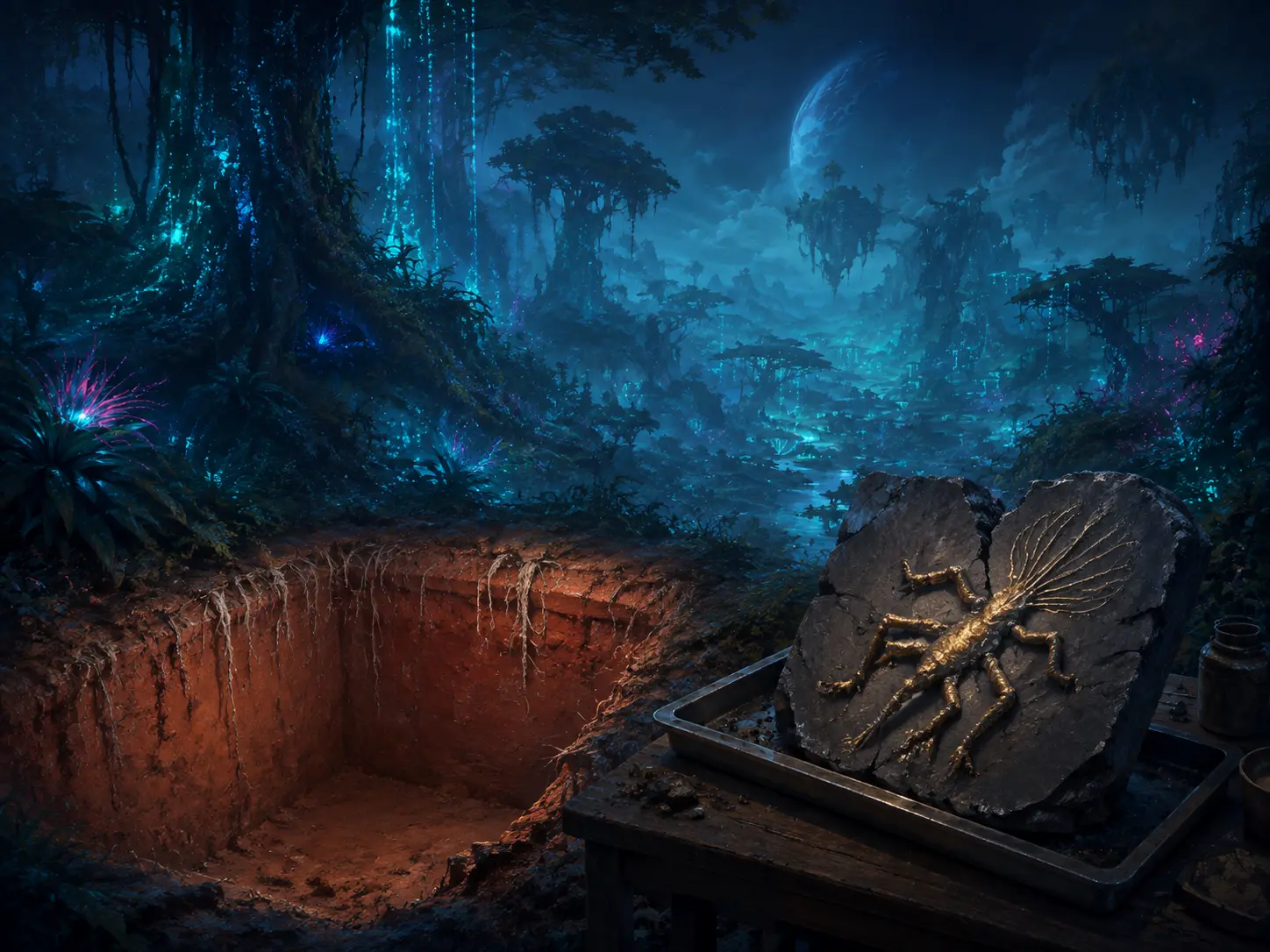
Picture a trench, two metres by one, cut into the floor of a Pandoran rainforest. It has taken four people two days, because the ground is a mat of roots and the rain comes through the canopy in warm sheets that turn the spoil heap to slurry by mid-afternoon. The walls of the pit are a beautiful and monotonous red-orange, the colour of a clay flowerpot: iron-rich soil, leached of almost everything else, threaded with fine white rootlets all the way down. At a metre forty the soil grades into the rotten upper skin of the bedrock, and the digging stops.
Now consider what stands overhead while this hole is being dug. A forest carrying more large-animal flesh per hectare than anywhere on Earth. Six-limbed grazers moving in herds through the understorey. Hunters the size of a rhinoceros. Fliers with wings that span more than twenty metres crossing the gap in the canopy. Trees three hundred metres tall. Millions of years of this, generation on generation, every one of them dying somewhere.
The pit holds none of it. Not a scrap.
That is the real situation, and it is worth being blunt about it before we start explaining it. The Avatar material catalogues Pandoran life in extraordinary detail — anatomy, behaviour, sensory systems, neural interfaces, whole clan ecologies — and it contains, so far as anyone can determine, no fossil record whatsoever. No stratigraphic column. No named geological periods. No described extinct species. Not one bone bed. The RDA runs the largest earth-moving operation in the story, stripping hundreds of millions of cubic metres of rock at Hell's Gate alone, and its survey logs record mineral grade, magnetic flux and shear strength, and nothing else. Nobody on Pandora has ever published a fossil.
So which is it? Is Pandora's deep past simply unknowable — a world whose history exists only in the present tense? Or is that empty pit telling us something specific, if we know how to read it?
The question the empty hole is actually answering
Here is the move that turns this chapter from a complaint into a science. When a palaeontologist digs a hole and finds nothing, the first thing she does is not conclude that nothing lived there. She asks a different question: would this place have kept anything, even if it had?
Because a fossil is not what happens to a body by default. It is what happens to a body when a specific and rather unlikely sequence of events all go right, in order, without interruption, over spans of time that dwarf the animal's own life. Get any step wrong and the record of that animal is not degraded. It is gone — completely, chemically, irretrievably. Which means the density of fossils in a given rock is only partly a fact about the animals that lived there. It is mostly a fact about the rock.
Once you take that seriously, the empty pit stops being a mystery and becomes a measurement. It is not evidence about Pandoran evolution. It is evidence about Pandoran soil. And to see how much difference that distinction makes, we have to count the ways a body can fail to become a fossil.
Five gates, and they multiply
The study of what happens to a body between death and discovery has a name, and it was coined by a Soviet palaeontologist named Ivan Efremov in 1940. He called it taphonomy — literally, the laws of burial — and his insight was that this was a subject in its own right, with its own physics and chemistry, rather than a list of accidents standing between science and the real evidence. The accidents are the evidence. Learn their rules and the gaps in a fossil record become as informative as the fossils.
The rules resolve into five things that must each go right. A body needs tissue durable enough to outlast its own soft parts — mineral, or something equally stubborn. It needs to be buried fast, before scavengers scatter it and weather takes it apart. Once buried, it needs to survive the chemistry of the water in the sediment, which can dissolve bone as readily as preserve it. The rock that forms around it needs to still be there millions of years later, not subducted, cooked, or stripped off by a river. And finally, someone has to cut into exactly that rock and recognise what they are looking at.
The crucial thing about these five is not that each is unlikely. It is that they multiply. Each gate passes some fraction of what reached it, so the odds of the whole sequence are the product of all five — and a product of small fractions collapses with a speed that is genuinely hard to hold in your head. Cut the chance of rapid burial from one in ten to one in a thousand and you have not made fossils rarer by a hundredfold in some abstract sense; you have removed the animal from the record entirely.
Five gates between a body and a fossil
Preservation is not one unlikely event. It is five, multiplied — and the same animal's odds swing four orders of magnitude depending only on where it happens to die.
Bars are per-gate pass rates on a log scale. Values are illustrative orders of magnitude drawn from Earth taphonomy, not Pandoran measurements.
Play with that for a moment and the shape of the answer appears. The gates are not equally weighted, and the heaviest of them is not a property of the animal at all. Tissue durability is about the body. Burial, chemistry, and rock survival are about the place. Which means the same creature, with the same skeleton, can be four orders of magnitude more or less likely to survive into the record depending on nothing but where it happened to lie down.
And the place Pandora is famous for is the worst one on the list.
What a rainforest does to a body
Death starts the clock before anything external touches the body. The animal's own enzymes rupture its cell membranes and begin digesting it from within; its gut bacteria, released from the ordinary business of digestion, turn on the tissue around them. In the warm, wet, oxygen-rich conditions of a tropical forest floor, that process runs at close to its theoretical maximum rate. Soft tissue — muscle, viscera, the fine sensory filaments of a queue, the delicate lamellae inside a Pandoran operculum — is gone in a few days.
Then the bones. In 1978 a palaeontologist named Anna K. Behrensmeyer did something that sounds almost absurdly simple and turned out to be foundational: she walked the Amboseli basin in Kenya, looked at thousands of animal bones lying on the surface, and worked out a scale for how weathered they were. Stage nought is fresh, still greasy. Stage one shows fine cracks running along the grain of the bone. By stage three the hard outer layer is flaking away and the spongy interior is exposed. By stage five the bone has come apart in place into fibrous splinters and a chalky powder that no longer has a shape worth naming. In a warm, wet climate, that whole progression takes ten to fifteen years.
Fifteen years is nothing. It is a fraction of the life of the animal. And in a rainforest, fifteen years does not bring anything like enough sediment to bury a skeleton — the forest floor is not a place where mud accumulates but a place where it is carried away, downhill, in the rain.
Meanwhile the soil is actively hostile. Constant heavy rainfall strips the soluble minerals out of tropical soil and leaves behind a residue rich in iron and aluminium: laterite, the red clay in the pit walls. Rotting leaf litter charges the water percolating through it with organic acids, and the resulting pore water routinely sits below pH 5. Bone mineral — the calcium phosphate that makes a skeleton hard — dissolves in exactly those conditions. What acid does not take, roots and burrowing animals break up mechanically, mixing and re-mixing the upper soil until any layering is destroyed. That churning has its own name, bioturbation, and it means that even the accidental order of who-was-buried-when is scrambled.
That is the correct frame for Pandora's empty pit. A moon whose signature biome is a hyperdense, permanently wet, permanently warm forest with acidic soil is a moon that destroys its own dead with unusual thoroughness. The bestiary is not missing from the record because it is shallow or recent or invented. It is missing because the forest is a shredder, and almost everything anyone would want to find has been dissolved and taken back up into the roots of the trees standing over the hole.
Which raises the obvious next question. If the forest is that destructive, is there anywhere on this moon that isn't?
The engine that buries a forest in an afternoon
There is, and canon hands it to us already running.
A generation before the events of the present story, a volcanic eruption buried the homeland of the Mangkwan clan. Their Hometree — a living structure the size of a small mountain — was engulfed by air-fall ash and low-temperature pyroclastic flows and now stands as a charred, carbonised core protruding from consolidated tephra. The clan that survived rebuilt itself around fire. Whatever did not evacuate in time was entombed where it stood.
Read that as grief and it is a founding trauma. Read it as sediment and it is something else: a conservation deposit forming inside living memory, in the exact manner of the most productive fossil sites Earth possesses.
Ash works for reasons worth naming, because they are exactly the five gates run in reverse. Burial is instantaneous rather than gradual — hours, not millennia. The ash is fine enough (grains under a tenth of a millimetre) to pack against skin, quills, and the leading edge of an operculum, taking a mould at a resolution mud cannot match. It arrives hot enough to sterilise, killing the microbial decomposers along with everything else. And once it settles and compacts, it is nearly impermeable, sealing the body from atmospheric oxygen.
Earth's premier feathered-dinosaur site works precisely this way. The Jehol beds of northeastern China, around 125 million years old, are a stack of lake sediments interleaved with volcanic ash falls, and they have produced articulated dinosaurs with their plumage intact, individual feather filaments visible, and — remarkably — the pigment-bearing organelles inside those feathers still identifiable, which is how we now know what colour some dinosaurs were.
The closer analogy for the Mangkwan Hometree, though, is not palaeontological but archaeological. When Vesuvius buried Pompeii in 79 CE, ash packed around the bodies of the people who did not get out and then hardened. The soft tissue decayed over the following centuries, leaving voids inside solid rock — and in the 1860s Giuseppe Fiorelli worked out that you could pump liquid plaster into those voids and pull out a cast of a person in the position they died in, clothing folds and facial expression included. Herculaneum, hit by hotter surges, got a different treatment: wooden beams and papyrus scrolls were carbonised rather than burnt, converted to almost pure carbon and thereby made inedible to everything that would otherwise have consumed them.
So Pandora is not a world with no fossil archive. It is a world whose archive sits somewhere other than where anyone has been digging. And the ash fields are not even the more interesting half of it.
The chemistry the moon already has
The rarest and most valuable thing a fossil can be is soft tissue turned to mineral. Bone tells you shape; a mineralised muscle tells you how the animal moved, a mineralised gut tells you what it ate, a mineralised eye tells you what it could see. On Earth these are so rare that individual localities producing them are famous by name.
One pathway produces them better than any other, and it produces them fast — days, not millennia. The mineral is iron pyrite, and the process is pyritization: brassy crystals nucleating directly onto decaying tissue, casting muscle fibres and gill filaments at a resolution approaching the cellular. Beecher's Trilobite Bed in New York and the Hunsrück Slate in Germany are built on it. Specimens come out of the rock looking like jewellery.
It requires three things to arrive at the carcass in the right proportion, and on Earth the first of them is the problem.
Pyrite needs reduced sulfide. On Earth there is essentially no free sulfide in surface water; it has to be manufactured on site, by bacteria that respire sulfate and excrete hydrogen sulfide as waste — the reaction that gives estuarine mud its rotten-egg smell. That manufacturing takes time, and it is competing directly against the decay of the very tissue it is meant to preserve. Most of the time decay wins. This is the whole reason pyritized soft tissue is rare.
It needs reactive iron, delivered in the surrounding mud, to bind that sulfide as a solid rather than let it diffuse away.
And — this is the counter-intuitive one — it needs the surrounding sediment to be poor in organic carbon. Not rich. Poor. A carbon-rich bed drives sulfide production everywhere at once, so the available iron is consumed throughout the sediment instead of at the body, pore water acidifies, and the carcass gets nothing. The spectacular pyrite fossils come from carbon-starved muds holding a single corpse.
Now bring in Pandora's air. Canon puts hydrogen sulfide in that atmosphere at over one percent — sustained, because the moon is volcanically far livelier than Earth. That figure is normally cited as the reason humans need a mask. It has a second consequence nobody in the story ever mentions.
Rain falling through an atmosphere carrying that much H₂S arrives charged with dissolved sulfide. Every swamp, oxbow, lake and shallow lagoon on the moon sits in equilibrium with it. Which means the rate-limiting step on Earth — waiting for bacteria to make the sulfide before decay finishes the body — does not exist here. The sulfide is already in the water when the animal falls into it. The limit moves downstream, to how much reactive iron the mud can supply.
The window that casts soft tissue in mineral
Pyrite can replace a muscle at cellular resolution in days — but only inside a narrow chemical window. Pandora's air holds that window open.
Dials are dimensionless 0–100 concentration regimes, not molarities. Thresholds reproduce the relationships measured in Earth pyrite deposits.
The upshot is a genuine inversion. On Earth, exceptional soft-tissue preservation is a freak event we name and number. In a sulfide-charged Pandoran basin it would be closer to the default outcome for anything that sinks into anoxic mud. A moon that appears to have no fossil record may in fact hold, in its lake shales and lagoon floors, brassy three-dimensional casts of animals down to the fine filaments of their neural queues — a class of specimen Earth possesses only a handful of.
And there is a further wrinkle, because Pandoran bodies are not built quite like ours.
A skeleton that refuses to dissolve
Canon is specific, if brief, on one point of Pandoran anatomy: the bones of the Na'vi and of the moon's larger animals are reinforced with naturally occurring carbon fibre. It is offered in the films as an explanation for toughness — why a three-metre humanoid can absorb rifle rounds and keep moving — and it is treated elsewhere in this book as a materials question.
It is also, unintentionally, a statement about fossilisation, and following it out is instructive. Everything from here to the end of this section is inference, not canon; the films never mention Pandoran diagenesis and no source describes what happens to such a bone after burial.
Earth bone is a composite: roughly seventy percent mineral by weight — calcium phosphate — and thirty percent protein, mostly type I collagen. Both halves have known failure modes. Collagen hydrolyses, splitting at its peptide bonds when water gets to it. The mineral dissolves in acid. In a laterite soil at pH 4.5 both processes run to completion, and a skeleton leaves no trace at all.
Carbon fibre fails differently, which is to say it mostly does not. Its structure is sheets of aromatic carbon rings held by covalent bonds — no peptide linkage to hydrolyse, no ionic lattice to dissolve, and a strongly water-repelling surface that gives enzymes nothing to grip. It is one of the more chemically inert structural materials there is.
Run a carbon-reinforced skeleton through the same laterite that erases an Earth bone and the prediction inverts. The mineral fraction goes, exactly as before. The fibre network stays — an interlocked, aligned mesh, still occupying the volume the bone occupied, still carrying its shape. Compress that under later sediment and it should behave like other refractory organic matter under burial: losing volatiles, enriching toward elemental carbon, ending as a flattened carbonaceous compression that survives conditions well past the point where any ordinary fossil has been destroyed.
If that is right — and it is a large if — Pandora's fossil record would be a strange object. Not absent, but written in a different medium: not mineral replacing bone, but structural carbon that was in the bone from the start, persisting into rock that has been heated and squeezed hard enough to erase everything else. The specimens would be black films rather than white bones. Someone looking for the second thing could walk over the first for years.
The animals the record is guaranteed to lie about
Now push the bias in a specific direction, because it does not fall evenly across a bestiary. It has a strong and predictable preference, and knowing that preference lets you predict in advance which Pandoran animals a future rock record will misrepresent — and how.
Start with a piece of ecological arithmetic. In 1981 the ecologist John Damuth measured population densities against body mass across a wide range of mammal species and found a clean relationship: density falls off as roughly mass to the power of minus three-quarters. Double the animal and you get considerably fewer of them per square kilometre, because the energy available in a landscape is finite and a large body is expensive to run. The rule holds across four orders of magnitude of body size and is one of the more robust regularities in ecology.
Apply it to the great leonopteryx. It is an apex aerial predator with a wingspan over twenty metres, which puts it at the top of its food chain and therefore at the bottom of any abundance ranking. There were never many of them. And its habitat compounds the problem: montane ridges and the upper canopy, both of which are erosional environments. Rock is being removed there, not deposited.
Follow one to its death. Either it dies on a mountain ledge — no sediment, active weathering, Behrensmeyer stage five inside a decade — or it falls through the canopy to the forest floor, where scavengers scatter it across a hundred square metres within hours and the laterite finishes the job. The probability of a leonopteryx carcass meeting rapid anoxic burial in favourable chemistry is, as far as one can reason it, close to zero.
So here is a prediction about a fossil record nobody has collected yet. In Pandoran rock, the largest and most spectacular flying predator the moon has ever produced will appear — if at all — as isolated claw cores, tooth fragments, and scraps of carbonised wing spar. A researcher counting specimens would rank it as vanishingly rare, marginal, possibly a late arrival. Which is precisely the error that hid Africa's great apes for a century.
And that error has a formal name and a formal correction, which is the last piece of the toolkit.
The smear
In 1982 Philip Signor and Jere Lipps pointed out something with uncomfortable consequences for the study of mass extinctions. Take several species that genuinely all die out at the same instant. Their fossil records have different densities, because some were common and some were rare. The common one's last fossil sits just below the true extinction horizon; the rare one's last fossil might sit far below it, simply because there were fewer chances to be preserved near the end.
Plot the observed last appearances and an event that was instantaneous looks like a long, staggered decline — with the rare species apparently dying out first, in sequence, over what reads as a protracted crisis. None of that sequence happened. It is an artifact of sampling, and it has been argued over in the literature on the end-Cretaceous extinction for decades precisely because it is so hard to see past.
The correction came in 1989, from David Strauss and Peter Sadler. If a taxon is found at $n$ horizons spread over an observed stratigraphic range $R$, and finds are treated as uniformly distributed through its true range, then the true endpoint lies above the highest find by at most
$$\alpha = R\left[(1 - C)^(-1/(n-1)) - 1\right]$$
with confidence $C$. What that formula does is convert a bare observation into an honest statement. Not "this species ended here," but "this species ended somewhere in this interval, and here is how wide that interval is." And its behaviour at small $n$ is the important part: with two finds the interval is enormous, and with one find it is undefined — infinite — because a single occurrence gives you no range to extrapolate from at all.
Why the last fossil is never the last animal
All five taxa die out at the same instant. Their observed last appearances do not — and how badly they scatter depends only on how often each one turns up.
Section height is in arbitrary units, 0 at the base to 100 at the true extinction. Intervals are the classical Strauss–Sadler estimate α = R[(1−C)^(−1/(n−1))−1].
This is the discipline that lets palaeontology say anything at all about a patchy record. It does not pretend the gaps are not there. It measures how wide the gaps are, and then refuses to make claims narrower than the measurement allows. Applied to Pandora it says something specific and slightly deflating: given the preservation odds worked out above, almost any claim about when a Pandoran lineage appeared or disappeared would come with a confidence interval millions of years wide. That is not a failure. It is the honest number.
Two archives, and the questions each one cannot hear
There is a complication here that no Earth palaeontologist has ever had to think about, and it is the most genuinely alien thing in this chapter.
Pandora keeps its past twice. There is the rock — passive, chemical, indifferent. And there is the network the Na'vi call Eywa: by canon a planet-spanning neural system, accessed through the queue, holding the stored experience of the dead and retrievable by the living. The Tree of Souls is a library you can talk to.
It is tempting to conclude that this makes the rock redundant. Why dig, on a world where you can ask?
Because the two archives are blind in different directions, and the shape of their blindness is not symmetrical.
The network holds what something experienced and was connected to relay. That gives it a fidelity no rock can approach — cadence, emotional context, the texture of a life — and it covers the recent past with a completeness no sediment could. It is also a living system, which means it depends on continuously living infrastructure. When the eruption took the Mangkwan Hometree, it took a node of that network with it. And a network built from what organisms noticed cannot hold what no organism was there to notice.
The rock holds no experience at all. It also holds everything: an ocean's chemistry, a bolide impact, a supercontinent breaking up, the animals that lived and died where nothing was networked to remember them. It does not curate, cannot be persuaded, and does not lose the parts that nobody wanted to keep.
Two archives, two blind spots
Pandora keeps its past twice over. Which record can answer you depends entirely on what you ask.
How did my grandmother's grandmother sing this — her cadence, the words she chose, where she paused?
By canon the network holds the stored experience of the dead, retrievable through the queue. This is exactly what it is for.
A songcord fixes the events and their order, but a knot cannot hold a cadence.
No sediment anywhere records a performance. There is nothing for the question to bind to.
That last question is the one that matters for this chapter. If Pandoran life descends from ancestors that predate the neural interface — and the shared six-limbed body plan across the whole bestiary strongly implies deep common ancestry — then those ancestors were never on the network. They cannot be remembered, because there was nothing to remember them with. Their history exists in exactly one place, and it is the place nobody has looked.
What a first field season would actually do
Which brings us to the claim this whole apparatus was built to test.
Canon asserts, through RDA xenoanthropologists cited in companion material, that the Na'vi have existed in essentially unchanged form for around twelve million years. No morphological drift, no speciation, no population turnover. It is an extraordinary claim — Earth's own lineage went from forest apes to spacecraft in less time — and the evidence offered for it is, on inspection, nothing. No specimens. No sections. No dated horizons. It is an estimate whose derivation is never stated, resting on a fossil record that does not exist.
That is not a reason to dismiss it. It is a reason to design the field season that would settle it.
First, go somewhere else. The instinct is to dig where the animals are, and it is exactly wrong. A record requires accommodation space — ground that is sinking as sediment arrives, so that layers stack instead of being stripped. That means subsiding coastal basins, deltaic wedges, and lake floors. The two most promising targets on Pandora would be a paralic basin behind the eastern reef systems, where fine muds and lagoonal carbonates accumulate under low energy, and a fault-bounded basin adjacent to the volcanic province, where lake shales are interleaved with periodic ash falls. Not the forest. Not the mountains. Not the floating peaks, which have no basins at all and simply shed everything they lose onto the canopy below.
Second, measure a section and date it. This is where the ash beds pay off twice. They preserve bodies, and they also contain volcanic crystals that can be radiometrically dated — which means a stack of lake shales interleaved with tephra is a record with absolute ages bracketing every layer. The dating machinery itself belongs to another chapter (I.9 — Pandora’s Deep Time works through how those clocks are read); the relevant point here is that the same volcanism that makes Pandora's fossils also timestamps them.
Third, find something small and common to correlate with. Vertebrates are far too rare to build a timescale on — that is the whole lesson of the leonopteryx. What you need is an index fossil: something abundant, widely dispersed, and quick to change. On Earth that role goes to ammonites, foraminifera, conodonts, and pollen. On Pandora the obvious candidate is whatever the moon's flora sheds as reproductive spores. If Pandoran spore coats are anything like sporopollenin — the near-inert polymer that lets Earth pollen survive acid digestion and geological time alike — then spores would be everywhere, in marine and terrestrial rock both, giving the resolution that biostratigraphy runs on.
Fourth, measure bodies, not impressions. Test morphological stasis by sampling durable elements — teeth, jaw fragments, robust cranial pieces — from the ancestral Na'vi lineage across continuously dated horizons, and measuring continuous characters on each: tooth-row length, enamel thickness, interorbital distance. Then apply the Strauss–Sadler interval to every observed range, so that each first and last appearance carries its uncertainty rather than pretending to precision it does not have.
Fifth, state in advance what would refute the claim. This is the part that makes it science rather than apologetics. The twelve-million-year stasis hypothesis fails if any of the following turns up: measurable directional change in those characters across dated bins, at rates above what genetic drift alone would produce; a well-dated horizon somewhere in the six-to-eight-million-year range yielding a hominoid with transitional features — a partially fused second humerus like the prolemuris has, functional thoracic opercula, vestigial second eye sockets — which would put the modern Na'vi form far later than claimed; or a demonstration that the modern lineage appears only in very young rock, with the older forms belonging to a separate radiation that died out.
And if none of that turns up — if identical dental and skeletal elements come out of thirty or more horizons across twelve million years of continuously dated section with no measurable drift — then the claim stands, and Pandora has handed evolutionary biology a genuine anomaly requiring a genuine mechanism. Either result is worth the field season. What is not worth anything is the current situation, where the number is asserted and nobody has dug.
Honest edges
The real science in this chapter is solid and load-bearing. Taphonomy as a discipline, Behrensmeyer's weathering stages, the chemistry of pyritization and phosphatization, the Jehol and Pompeii preservation mechanisms, the chimpanzee fossil record, Damuth's density scaling, the Signor–Lipps effect and the Strauss–Sadler interval — all of it is established, cited work, and none of it depends on Pandora existing.
The canon is thinner than the chapter's confidence might suggest, and the thinness is deliberate rather than hidden. What canon actually supplies is: the atmospheric hydrogen sulfide fraction, the carbon-fibre bone reinforcement, the volcanic burial of the Mangkwan Hometree, the network and its stored memory, the RDA's mining operations, the twelve-million-year stasis estimate, and the prolemuris as an intermediate form. That is the whole list. Several details around the Mangkwan eruption circulate widely in community discussion rather than in official material, and this chapter has tried to lean only on the parts that are shown.
Everything connecting those two bodies of fact is inference, and the largest pieces of it are flagged where they occur. That Pandoran laterite behaves like Earth laterite. That the moon's ash beds would cast bodies the way Vesuvius did. That its sulfidic basins would pyritize soft tissue. And most speculatively of all, that a carbon-reinforced skeleton leaves a fibrous ghost where an Earth bone leaves nothing — which follows from what we know about aromatic carbon, and which no source describes.
What stays open
Unknown, and canon is silent rather than negative. There is no published stratigraphic column, no named geological period, no described extinct species, and no RDA palaeontology programme. But the RDA also strips hundreds of millions of cubic metres of rock and logs it only for mineral grade — so the apparent absence reflects what nobody looked for as much as what is not there. One documented feature does hint the other way: canon establishes a petrified forest province, which means Pandoran wood does permineralize under the right groundwater chemistry.
Nobody knows, and this chapter's answer is reasoning rather than reporting. Aromatic carbon has no peptide bond to hydrolyse and no ionic lattice to dissolve, so the fibre fraction should outlast the mineral fraction and leave a structural mesh — but the actual composite architecture of Pandoran bone is never described in any detail, and how the fibre is bonded to the mineral would determine everything about what survives.
Canon states it and never sources it. Whether it derives from a molecular clock, deep core samples, cave stratigraphy, or an assumption is entirely unstated — and since no Pandoran genome and no Pandoran fossil sequence has been published, none of those routes is visibly available. It is currently a claim without a method, which is a different thing from a claim that is wrong.
Not for the questions that matter here. The network holds what living things experienced and were connected to relay, which excludes abiotic planetary history entirely and excludes any lineage predating the neural interface. Since the shared six-limbed body plan implies ancestors older than the queue, the deepest part of Pandora's history is exactly the part the living archive cannot reach.
The wrong hole in the right world
Go back to the pit.
It is still empty, and it will stay empty however deep the team takes it, because there is nothing in that soil to find and there never was. Every animal that died in that forest was dismantled — enzymes, then bacteria, then scavengers, then roots, then acid — inside a span of years so short that no sediment could have intervened. The forest has been eating its own dead for millions of years and it has been extremely thorough.
But the pit is not a verdict on Pandora's past. It is a verdict on a soil type. Four hundred kilometres east, in a basin nobody has surveyed, fine muds have been accumulating under anoxic sulfide-charged water for longer than the Na'vi have existed, and the things that sank into them were not dismantled but cast in pyrite. In the ash fields the same eruption that took a Hometree sealed a whole living community into fine tephra and is holding their outlines in the rock right now, waiting for someone with plaster. The archive exists. It is simply not underneath the animals.
That is the discipline this chapter has really been about, and it generalises past palaeontology and past this moon. The temptation, faced with an absence, is to treat it as a fact about the world. Almost always it is a fact about the instrument — about where you looked, what that place was capable of keeping, and what it was structurally incapable of recording. The empty trench and the pyritized queue are the same world seen through two different filters, and the whole skill is knowing which one you are holding.
Pandora did not fail to keep its history. We have been standing in the one place on it least likely to have been kept, looking down, and concluding that there was nothing to find.
Read next
Pandora’s Deep Time
In a geologist's palm sits a crystal grain smaller than a sand mote, picked from the ancient sandstone of a Pandoran highland. It is a clock. Written into its atomic structure is a number of years - not thousands but billions - and the scar of the collision that built this world. The whole of this chapter is the question of how a stone comes to know its own age, and why the same trick reads the age of any rock in the galaxy.
30 min read
Building the Pandoran Tree of Life
On a dim specimen bench: a thanator skull, an ilu flipper, a tulkun vertebra, and a Na'vi skeleton standing among them. The one tool every Earth phylogeneticist now reaches for first is missing - there is no DNA. Canon is silent on Pandoran molecular biology. And yet the tree can still be drawn, because for a century before sequencing, Earth built its own tree of life from bones alone. The real question is not whether the tree is knowable, but which similarities reveal kinship - and which ones lie.
26 min read
What Keeps Pandora Volcanically Alive?
A generation ago the Mangkwan homeland was old-growth forest. Then a volcano swallowed it, and now they stand on a plain of black lava where a Hometree once rose. The whole of this chapter is a question a physicist would ask of that fire: a moon this small, this old, should have gone cold and dead long ago - so what is still boiling its insides?
20 min read