

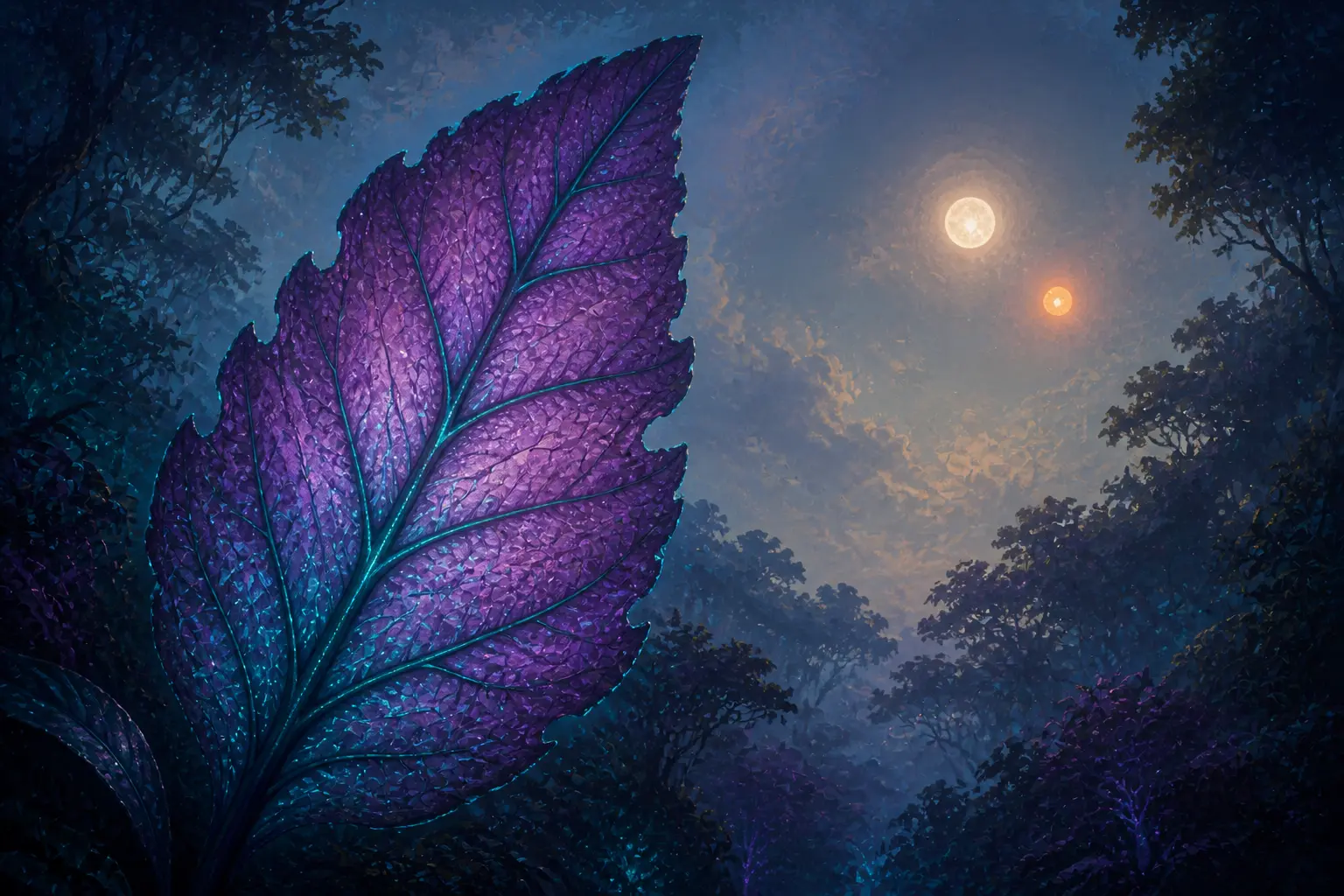
Kneel down in the understorey of a Pandoran rainforest and pick up a fallen leaf. It is broad, ribbed, faintly waxy, and it is violet — not a sickly violet, not autumn violet, but the deep saturated violet of a healthy working organ. Above you the canopy is the same, storey on storey of it, magenta and indigo and near-black, with here and there a shock of orange spiralling out of the litter. Then the light goes, and the forest turns itself on: pinpricks and veins and whole carpets of cold cyan light coming up out of the moss, the roots, the underside of the leaves you were just holding.
The films show us this and never explain it. Canon is generous about what Pandoran plants look like and almost entirely silent about how they work. There is no official sentence anywhere about Pandoran pigments, no mention of a pore on a leaf, nothing about sap. What canon does give us, precisely and in numbers, is the environment: a moon in orbit around a gas giant, under two suns, with gravity at eight-tenths of Earth's, air a fifth denser than ours, and — the figure that reorganises everything else in this chapter — carbon dioxide at something like eighteen to twenty percent of the atmosphere. That is roughly four hundred and fifty times what you are breathing now.
So here is the chapter. Not a catalogue of strange plants. Instead: take one leaf, and follow the carbon all the way through it. In at the surface, fixed into sugar, shipped down the trunk, spent. A leaf is a machine that keeps a ledger, and every line of that ledger is set by physics you can check. Follow it far enough and two things happen. The violet stops being decoration and becomes a strategy. And somewhere in the middle, you will run into the one trade that every leaf on every world has to make, and cannot get out of — which is the thing worth carrying away from all of this.
Start where the leaf starts. With the light.
Green is a habit, not a law
The most useful fact about photosynthesis on Earth is one nobody finds surprising, which is why it goes unexamined: leaves are green. Ask why and you get a circular answer — because chlorophyll is green. But chlorophyll being green is not a fact about chlorophyll's function. It is a fact about chlorophyll's failure. The molecule absorbs strongly in two narrow bands, one in the blue around 430 nanometres and one in the red around 660, and between those two bands, right across the middle of the visible spectrum, it barely absorbs at all. Green light arrives at a leaf and a good deal of it simply leaves again. What you see when you look at a forest is the light your food supply declined to eat.
Plant scientists call that middle stretch the green gap, and it is genuinely odd, because green is where our Sun is most generous. Sunlight peaks, in photon terms, right about there. Life on Earth has spent three and a half billion years optimising the machinery downstream of the pigment to a precision that still embarrasses our engineering — and left the richest part of the spectrum on the table.
Nobody is certain why. There are two serious explanations and they are both instructive. The first is inheritance: oxygen-releasing photosynthesis appears to have evolved underneath older microbial mats whose purple pigments had already claimed the green and yellow photons, so the ancestors of every green plant on Earth grew up in a light environment where blue and red were what filtered through, and they were never able to renegotiate afterwards. The second is stranger and more interesting: absorbing hardest at the peak of your energy supply means your input surges violently whenever a cloud moves or a leaf shifts overhead, and a photosystem fed by a surging input tears itself apart. Absorbing on the two flanks instead, and leaving the peak alone, buys a steadier feed. On that reading, green is not a wasted opportunity but a deliberate refusal — safety bought with efficiency.
Either way, note what neither explanation invokes: any physical law that makes green the correct colour for a photosynthetic organ. Green is contingent. It is the settled outcome of one planet's history under one particular star. Change the star, and there is no reason at all for the answer to come out the same.
What colour should a leaf be?
Pick a sky, then drag the band of light the pigments absorb
What arrives under two suns
Pandora's sky has two stars in it, and they are not interchangeable. Alpha Centauri A is very nearly our Sun's twin — the same spectral class, an effective temperature around 5,790 K, its photon output peaking in the same cyan-green as ours. Alpha Centauri B is a cooler, smaller, orange star, around 5,260 K, and a cooler star does not merely dim: it shifts. Its output slides bodily toward longer wavelengths, peaking somewhere in the orange and trailing a long, generous tail out through the red and into the near-infrared.
B is also far away — tens of astronomical units, on a stretched eighty-year orbit — so on a bright Pandoran afternoon it contributes almost nothing to the total. But "almost nothing" is doing work in that sentence. Canon puts B's night-time contribution at something on the order of a couple of thousand times the brightness of a full moon on Earth. For an animal's eye that is a curiosity. For a leaf that has spent a billion years scraping for photons at the margin, it is a second harvest.
Astrobiologists have actually done this calculation, and not for Pandora. Over the last two decades a body of work — Kiang and Segura and Tinetti and others — has asked what colour a leaf ought to be under stars other than ours, and the answer is consistent: pigments track the star. Around cooler, redder stars, the predicted absorption peaks slide toward longer wavelengths, and the machinery is expected to reach further into the infrared, possibly stacking two low-energy photons to do work one high-energy photon would have done alone. It is one of the more satisfying results in the field, because it converts a question that sounds like fantasy — what colour is alien life? — into an ordinary problem in spectroscopy.
Run that reasoning on Pandora's particular sky and it points one way. A biosphere lit by a solar twin plus a long orange tail, on a moon whose air is thick and hazy, has good reason to build a broad absorber: something that takes in green and yellow and orange and keeps going out past 800 nanometres, well beyond where Earth's chlorophyll gives up. And an organ that absorbs all of that has only one thing left to reflect.
Blue. Violet.
There is one correction to make before moving on, because it is the most common thing said wrongly about this. The green gap does not mean green light is useless to a plant. It means green light is absorbed weakly, and weak absorption is a virtue in a thick leaf: blue and red are consumed in the top cell layers and never reach the bottom, while green sails deeper and gets absorbed by cells that would otherwise sit in the dark. A leaf's interior is lit, in effect, by the wavelengths its pigments are worst at catching.
The other correction concerns the pigments that are not doing the harvesting. Carotenoids — the oranges and yellows — do genuinely widen the catchment, taking in blue-green light and handing the energy on. But anthocyanins, the flavonoids that make red cabbage red and autumn leaves flare, do not. They absorb green light and then keep the energy to themselves. They are sunscreen, coolant, and chemical mop for the reactive fragments that high light produces. This matters here because if you were reaching for a quick explanation of Pandora's violet forest, anthocyanin is exactly the wrong thing to reach for: it would explain the colour and contribute nothing to the feeding. A violet leaf that works has to be violet because its harvesting pigments are broad, not because a sunscreen sits on top of them.
The problem with living next to a gas giant
A leaf under a steady sun has an easy job compared to a leaf on Pandora, and the difference is not brightness. It is interruption.
Pandora is tidally locked to Polyphemus and swings around it in about three and a half days, which means the gas giant regularly slides in front of the primary star and puts the entire day-side of the moon into shadow for up to a hundred minutes at a stretch. This is not dusk. This is a hard cut, on a schedule, several times a week, in the middle of what should be the working day.
Earth plants know a small version of this problem and it is instructive how badly they handle it. Light in a forest understorey arrives in flecks — a gap opens in the canopy, a patch of full sun lands on a leaf, and thirty seconds later it is gone. You would think a leaf would simply photosynthesise faster while the light lasts. It cannot. Two separate throttles get in the way. The enzyme that fixes carbon has to be switched on by a helper protein, and that activation takes minutes, not seconds. And the pores that let carbon dioxide in have to physically swell open, a process of ion pumping and water movement that takes ten to thirty minutes. By the time a leaf is properly ready to exploit a sun fleck, the sun fleck has been over for a quarter of an hour.
Then the opposite problem: too much light. Photosystems fed more energy than they can spend do not idle gracefully; they generate reactive fragments that wreck the machinery around them. So plants carry a dump valve. Under high light the interior of the photosynthetic membrane acidifies, an enzyme converts one carotenoid into another, and the newly made pigment bleeds surplus excitation away as heat instead of letting it reach the reaction centre. This is non-photochemical quenching, and the conversion runs backwards when the light drops again. It is a genuinely elegant piece of engineering: a thermostat made of pigment.
Now put those two mechanisms in a world where the lights go out on a fixed schedule. A Pandoran canopy leaf must ride a hundred minutes of darkness and then be slammed back into the full output of a solar twin, over and over. That is precisely the load the quenching cycle exists to handle, and it suggests a biosphere that would run that cycle hard and continuously — plants for which what is an emergency response on Earth is simply Tuesday.
And during the dark itself the leaf keeps eating. This is worth stating plainly because it is another thing widely got wrong: plants respire constantly, day and night, exactly as you do. Photosynthesis is a second process layered on top, running only in the light. In darkness the second process stops and the first does not, so a plant in the dark is spending down reserves. Earth leaves handle their nightly deficit by banking starch in the chloroplast during the day and breaking it back down in the dark at a rate calibrated to run out almost exactly at dawn — an unglamorous but remarkable bit of accounting. A Pandoran leaf needs that same trick with an extra, irregular hundred-minute withdrawal punched into the middle of the working day.
The most important clumsy enzyme in the universe
We have got photons into the leaf. Now they have to become sugar, and here the story stops being about light and starts being about one specific protein that is not very good at its job.
Its name is Rubisco, and it is the enzyme that grabs carbon dioxide out of the air and attaches it to a carbon skeleton, the first committed step of carbon fixation. Everything you have ever eaten passed through it. It is, by mass, the most abundant protein on the planet — plants build so much of it that it can account for a third to a half of all the soluble protein in a leaf. And it is a plodder: a few turnovers per second, where a respectable enzyme manages thousands. Plants compensate for its slowness the only way available, by manufacturing an absurd quantity of it, which is why the most common protein on Earth is also one of the least impressive.
But the slowness is not the real problem. The real problem is that Rubisco cannot reliably tell carbon dioxide from oxygen.
The two molecules are similar enough in size and shape that the enzyme's active site accepts either. When it takes carbon dioxide, the Calvin-Benson cycle proceeds and sugar comes out the far end. When it takes oxygen instead, it produces a two-carbon fragment that is useless and mildly toxic, and the cell has to run a whole salvage pathway to dismantle it — burning energy and reducing power to do so, and handing back one molecule of carbon dioxide for every two mistakes. This is photorespiration: a leaf spending energy to undo its own error, and losing hard-won carbon in the process.
Why has evolution not fixed this? Partly because it cannot: the two substrates are genuinely hard to distinguish, and sharpening the enzyme's discrimination makes it slower still. Mostly because when Rubisco appeared, there was scarcely any oxygen in the air to confuse it with. The mistake is a legacy fault, inherited from an atmosphere that no longer exists, and every plant on Earth is stuck with it.
The dominant story of the last thirty million years of plant evolution is the arms race against this single flaw. Some lineages evolved a pump: fix carbon first with a different, unconfusable enzyme out in the ordinary leaf tissue, ship the product inward to a sealed inner compartment, and release it there so that Rubisco sits in a chamber where carbon dioxide is artificially concentrated and oxygen barely gets a look in. That is C4 photosynthesis, and maize, sugarcane and most tropical grasses run it. Others separated the two jobs in time instead of space: open the pores at night, when the air is cool and damp, stash the carbon as an acid, then seal up tight through the whole blazing day and release the carbon internally behind closed doors. That is CAM, the strategy of cacti and pineapples.
Both work. Both cost. The pump burns two extra units of chemical energy for every carbon dioxide it delivers, which is a fine price to pay in thin air and a pure waste in rich air.
A hundred turns of one enzyme
Teal caught carbon and made sugar; magenta caught oxygen by mistake
Almost no mistakes left. With this much carbon at the enzyme, oxygen barely gets a turn and nothing has to be cleaned up.
The one trade no leaf escapes
Everything so far has been setup. This is the part to carry away.
A leaf has a problem with no clean solution. To fix carbon it must let carbon dioxide in from the air, and gas can only get into a leaf through a hole. But a leaf's interior is wet — it has to be, since the chemistry runs in water — and a hole that lets gas in also lets water vapour out. There is no membrane, no valve, no trick of geometry that admits one and refuses the other. Both molecules move down their own gradients through the same aperture, at the same time, and the plant's only control is how far to open it.
So every leaf on Earth spends its life running the same negotiation at thousands of tiny doors called stomata. Each is a slit between two specialised cells that swell and slacken to widen or close the gap, driven by ion pumping — potassium and chloride in, water following by osmosis, the cells bowing apart under their own turgor and hauling the pore open. Signals from blue light, from internal carbon levels, from drought hormones, all converge on that one mechanical decision: how wide, right now.
And the terms of the trade on Earth are brutal. Because carbon dioxide is so dilute in our air, the gradient pulling it inward is feeble, so a leaf must hold its pores wide to get any at all. Meanwhile the gradient pushing water out — from a saturated leaf interior to dry air — is enormous. The consequence is a ratio that ought to be better known than it is: a typical land plant loses several hundred molecules of water for every one molecule of carbon it gains. Not as waste. As the unavoidable cost of eating. Nearly all the water that moves through a plant, and a large fraction of all the water that moves through a continent, is spent on this single exchange.
The trade at the pore
Open the pore to feed, and water leaves through the same gap
The leaf is full: carbon arrives faster than the enzymes can spend it, so opening the pore any further buys nothing and costs water.
Now push the ambient carbon dioxide up by a factor of four hundred and fifty and the negotiation stops being a negotiation. The inward gradient becomes so steep that a pore open a sliver delivers more carbon than the enzymes can process. The plant can therefore run almost sealed — a stomatal conductance an order of magnitude below what an Earth leaf needs — and still be carbon-saturated. Pandora's air is denser too, which slows diffusion by about seventeen percent and thickens the still layer of air clinging to a broad leaf, and both of those effects push the same way: less water lost.
This is, I think, the single most consequential physiological fact about Pandora, and canon never mentions it once. A Pandoran plant is not water-limited in the way an Earth plant is. It can be enormous, hold an enormous leaf area, sit in the full glare of a solar twin, and spend a rounding error on transpiration. Everything else about the biosphere — the scale of the trees, the density of the canopy, the surplus available to pay for a glowing forest floor — sits downstream of that one number in the atmosphere table.
Getting the water up there in the first place
The leaf is fed. But it is a hundred and fifty metres off the ground, and it is wet, and nothing is pumping.
This is the part of plant physiology that most reliably surprises people who have not met it. A tree has no heart. There is no muscle anywhere in it, no peristalsis, nothing beating. Water arrives at the topmost leaf of a redwood because the leaf is evaporating, and the water leaving pulls on the water behind it, and water is cohesive enough that the pull transmits down an unbroken thread all the way to the roots. The column is under tension — genuine negative pressure, the liquid being stretched — held together by nothing but the mutual attraction of water molecules. Cohesion-tension, and it is doing all the work, powered entirely by transpiration at the top.
It also has a hard ceiling, and the ceiling is arithmetic. Every metre of height adds about ten kilopascals of hydrostatic tension on Earth, so a hundred-and-twenty-metre tree is already pulling more than a megapascal against gravity alone before friction in the xylem is counted. Add friction and the water potential at the top drops to somewhere around minus two megapascals — the point at which the cells in the topmost leaves can no longer fill and expand, and the leaf stops paying its way. Push further and the stretched column does what stretched things do: it snaps. An air bubble forms, the thread breaks, and that conduit is dead. Koch, Sillett and colleagues measured this in coast redwoods and put the practical limit at roughly 122 to 130 metres, which is very close to where the tallest trees on Earth actually stop.
Pandora relaxes the arithmetic in two independent ways at once. Gravity is eight-tenths of Earth's, so each metre of trunk costs about 7.85 kilopascals instead of 9.81 — a fifth off the bill for free. And the near-sealed pores we just derived mean far less water is being pulled through, so friction and tension both drop. Run those together and a hundred-and-fifty-metre Hometree turns out to be easier, hydraulically, than a hundred-and-twenty-metre redwood. Canon's ordinary Hometrees are not a problem.
How tall can a tree get?
Drag the height up to see how much the water column stretches
The crown is still paying its way: water reaches the top under survivable tension.
The Giant Hometree does not fit. Canon records the Omaticaya's ancestral home at around 460 metres, and at that height gravity alone imposes roughly 3.6 megapascals of tension before friction; add the friction of hauling sap up half a kilometre of trunk and you are pressing against the limit at which water columns cavitate under any conditions. Eight-tenths gravity does not save it. Something else would have to be going on — living cells actively pumping solutes partway up to break the lift into stages, conduits narrow and reinforced enough to hold tensions that would tear ordinary xylem apart, or leaves drinking straight out of the cloud layer so the top of the tree is not fed from the ground at all. Canon does not say. It is a genuine open problem, and I would rather leave it standing than paper over it.
Sugar goes down the same way, and it is slow
Water up is only half a circulatory system. The sugar the leaf just built has to reach everything that is not a leaf: roots, trunk, growing tips, fruit, and — on Pandora especially — whatever is being paid underground.
That is the job of the phloem, and it too runs without a pump. Load sugar into the transport tissue at a sunlit leaf and the concentration there rises, so water is drawn in osmotically from the neighbouring xylem, and the pressure at that end climbs — up to two or three megapascals. At the far end, in a root, the sugar is unloaded and consumed, the water leaves, the pressure falls. The difference pushes the whole loaded column bodily along the pipe. This is pressure flow, proposed by Ernst Münch in the 1920s, and its beauty is that the plant only has to control loading and unloading — the transport takes care of itself.
The loading is worth a sentence because plants solved it two different ways. Some pump sucrose across a membrane against its own gradient, using proton gradients to do it, and reach transport-stream concentrations near a molar. Others use a trick I find more charming: let sucrose diffuse in freely, then immediately staple it into a larger sugar too big to diffuse back out. A one-way door made of chemistry.
Now the scale problem. Phloem sap on Earth moves at something between 0.2 and 2 metres an hour — a walking pace measured in a day, not a second. That is adequate for a tree tens of metres tall. It is a serious constraint on a tree of hundreds, and the reason is geometric rather than biological: doubling the height doubles the distance the sugar must cover while halving the pressure gradient available per metre to push it. Transit time therefore grows with the square of height. An Earth redwood's canopy-to-root delivery already takes over a week.
Shipping sugar down a trunk
No pump — just pressure at the top, and a very long pipe
A workable freight line: sugar reaches the roots while it is still needed there.
Where the surplus goes
Add it all up and a Pandoran canopy tree has a peculiar problem: it makes more sugar than it strictly needs to make wood.
Carbon fixation is running at the enzyme's ceiling with no salvage losses. Water costs almost nothing. The light is a solar twin plus an orange supplement. Under those conditions the constraint on growth is not carbon at all — it is everything else, and mostly nitrogen and phosphorus, which come out of soil and cannot be photosynthesised. Earth already sees this at a small scale: the elevated-carbon-dioxide field experiments of the last thirty years consistently show growth gains that fade as soil nutrients run down, a phenomenon dull enough to be named progressive nitrogen limitation and important enough to complicate every projection of how forests will respond to a changing atmosphere.
So a carbon-rich plant spends its surplus buying the things carbon cannot buy.
Carbon dioxide in Pandora's air
~18–20%
against 0.04% on Earth — about 450× more
Carbon handed back to photorespiration
≈0%
on Earth, roughly a tenth of gross fixation
Daily carbon spent on the glow
0.5–2.5%
an affordable tax, not a free overflow
Carbon exported underground
25–35%
Earth trees pay their fungal partners 10–20%
That last figure is the interesting one. Earth trees hand ten to twenty percent of everything they fix to fungal partners in the soil, in exchange for nitrogen and phosphorus their own roots cannot reach — a trade so ancient it predates leaves. On Pandora, where canon establishes root systems interconnected across the biosphere and fungal networks threaded through them, an export of a quarter to a third of fixed carbon would be at the top of the range Earth biology demonstrates rather than beyond it. And what that export would buy is exactly what a carbon-saturated, nutrient-limited plant needs: minerals, and the running costs of whatever signalling passes between roots.
There is also a genuine botanical trend in canon that fits this picture uncannily well, and it is worth flagging because it is the sort of thing a physiologist would notice before a fan would. A striking number of Pandora's documented plants eat animals. The helicoradian is described as combining light harvesting with the capture of small prey; the direhorse pitcher plant traps megafauna in a digestive pool; the epiphytic tank urns absorb nutrients out of the water pooled in their own leaves. On Earth, carnivory in plants is almost always a nitrogen-acquisition strategy, evolved in bogs and sands where nitrogen is scarce and light and carbon are not. A biosphere with unlimited carbon and limited soil minerals is precisely the setting that would push flora toward carnivory again and again. Canon did not design it that way for physiological reasons. It nonetheless comes out consistent, which is the kind of coincidence worth pointing at.
What canon actually supports, and what it does not
This chapter has been building on canon's numbers, so it is only fair to audit them.
Auditing the claim
Three claims, three very different burdens of proof
- What the evidence shows
- Direct visual canon in both films and the companion art volumes; consistent across rainforest, cloud forest and reef environments.
- The honest caveat
- Canon names no pigment and offers no mechanism. The colour is production design; the biology explaining it is this chapter's inference, not canon's claim.
What canon never says about a Pandoran leaf
Canon is completely silent — not just on pore density, but on whether pores exist at all. Every conclusion in this chapter about the water trade assumes they do, on the grounds that any organism exchanging gas with an atmosphere across a wet surface faces the same problem and has only one class of solution. It is a strong inference. It is not a citation.
Unexplained, and it is the sharpest physiological problem Pandora poses. Dissolved carbon dioxide becomes carbonic acid, and Earth plants suffer enzyme failure and ion chaos above roughly 5 to 10 percent. Pandoran cells would need proton-pumping or buffering machinery well beyond anything we know, and canon describes none. The air that makes Pandoran plants thrive should, by our chemistry, be killing them.
The same shape of problem, from the other direction. Canon puts hydrogen sulfide above one percent, and at those concentrations it shuts down the respiratory enzyme complex in Earth organisms. Pandoran life would need either a sulfide-insensitive respiratory pathway or a way to oxidise sulfide as fast as it arrives. Both exist in Earth microbes; neither is known in a plant.
Canon is specific about bioelectrical signalling through the root connections and says nothing about material transport. But the anatomy it describes — continuous root fusions and fungal bridges — is physically the same plumbing that moves water and sugar between trees on Earth. Whether Pandora's forest actually shares food, or merely shares information, is left entirely open, and it matters enormously for how one reads Eywa.
No official source names one. The spectral argument in this chapter says what such a pigment would have to do — absorb broadly from the green out past 800 nanometres — but not what it is made of. Earth offers candidate architectures in the bacteriochlorophylls and the phycobilins, and canon offers a blank.
The leaf, read
Pick the violet leaf up again.
It is not violet because a designer liked violet, or at least that is not the only true thing to say about it. It is violet because two stars, one of them cooler than ours, deliver a spectrum whose generous part lies further to the red than the spectrum Earth's plants inherited their habits from — and an organ built to absorb all of that has nothing left to reflect except the blue end. The colour is the exhaust of a strategy.
It glows after dark because it can afford to, and it can afford to because the air it breathes is nearly a fifth carbon dioxide, which abolishes the enzymatic error that costs Earth's plants a tenth of everything they fix and lets this leaf run its chemistry flat out. It feeds through pores barely cracked open, and so it spends almost nothing on water — which is why the tree holding it can be a hundred and fifty metres tall in a way no Earth tree manages, and why a quarter or more of what it makes can go underground to buy the minerals that carbon cannot buy.
And the thing it shares with every leaf that has ever existed, on this world or ours, is the door. Carbon in, water out, one aperture, no way to separate them. Earth's leaves pay hundreds of water molecules for each atom of carbon and have organised their entire anatomy around that debt: the pores, the plumbing, the daily rhythm of opening and closing, the shape of a cactus, the height limit of a redwood. Pandora's leaves pay almost nothing, and their entire anatomy is organised around that — the scale, the density, the surplus, the light they can afford to throw away into the dark.
Two worlds, the same constraint, opposite bargains. Which is the useful way to read any biosphere: find the trade the organism cannot get out of, and everything else it does turns out to be a consequence.