

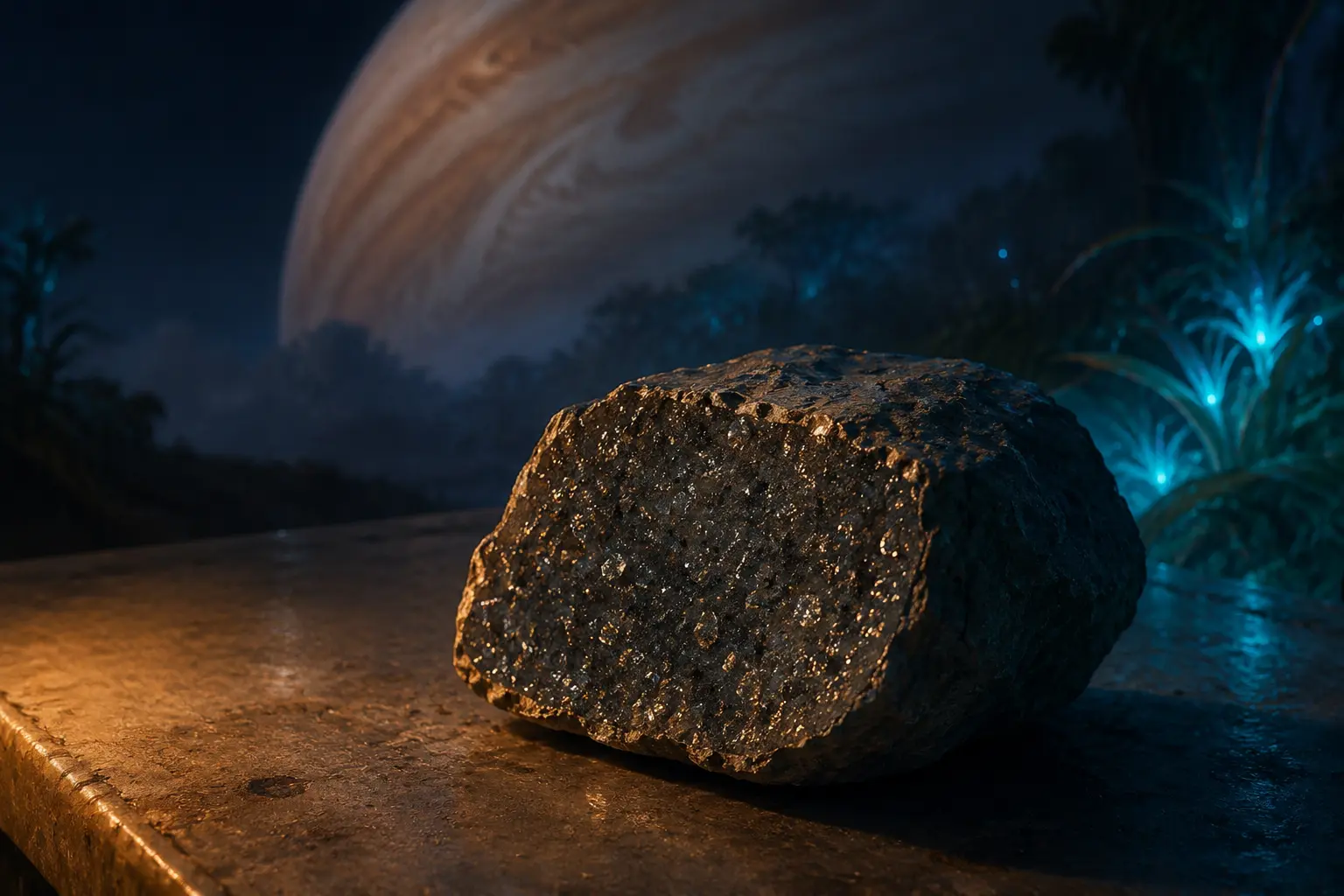
Pick up a stone on Pandora.
Not a remarkable one — no glowing seams, no unobtanium, just a fist-sized piece of the crust from a riverbed somewhere in the Omatikaya forest. Turn it over. It is heavier than it looks, and darker, and when you crack it open the fresh face has a faint metallic glint in it, the way basalt does when there is iron in the melt.
Now ask the question nobody in the films ever asks. Where did this come from?
Not "which volcano" — that is a question about last week, geologically speaking. I mean the atoms. The iron making that glint, the silicon and oxygen locked into the rock around it, the calcium and the magnesium: every one of those nuclei had to be manufactured, individually, by a specific physical process, in a specific kind of place, and then transported here across distances and timescales that make the four-light-year gap between Pandora and Earth look like a rounding error. The stone in your hand is the end of a supply chain that runs back thirteen billion years, and almost every link in it involves something dying.
The films open on a finished world. A breathable-looking sky, a forest, a moon hanging beside a gas giant. This chapter asks what had to happen first — and it turns out that reading the answer off Pandora's own stated properties leads somewhere the films very much did not intend.
The universe had almost nothing to build with
Start at the beginning, because the beginning is unhelpfully empty.
For the first few minutes after the Big Bang, the whole universe was hot and dense enough to be a fusion reactor, and for a while it behaved like one. Big Bang nucleosynthesis ran for roughly a quarter of an hour: protons and neutrons found each other, deuterium formed as soon as the ambient light was too feeble to smash it apart again, and the deuterium fused into helium.
Then it stopped. Not because the fuel ran out — the universe is still three-quarters hydrogen — but because of an accident in the way nuclei are built.
There is no stable nucleus with a mass of five. There is no stable nucleus with a mass of eight. Helium-4 is mass four, and to get past it by the obvious route you would add a proton or a neutron and land on mass five, which falls apart in under a sextillionth of a second. Add two helium nuclei together and you land on beryllium-8, which lives for about a hundred quintillionths of a second and then splits back into the two heliums it came from. Both routes out of helium are closed.
There is one way across — three helium nuclei colliding at essentially the same instant — but that requires a density and temperature the expanding universe blew past long before it could happen at scale.
So the ledger closes early, and it closes short. Hydrogen: about seventy-five percent by mass. Helium: about twenty-five. Deuterium, helium-3 and a whisper of lithium: traces, in the parts-per-hundred-thousand range and below. And then nothing. No carbon. No oxygen. No silicon, no magnesium, no calcium, no iron.
That is the fact the rest of this chapter is built on, and it is worth sitting with for a moment, because it inverts the usual order of things. A world is not a place where matter happens to have gathered. It is a place where the residue of a long industrial history happens to have gathered — and the residue is specific enough to be read.
Reading the receipt
If stars made the elements, then different elements were made in different places, and the proportions in a given sample should be a record of which places contributed to it.
They are. And the record is stranger than "a supernova did it."
Where these atoms were made
Pick a sample from the moon and trace its inventory back to the events that built it
Take the samples in order of increasing violence.
Ocean water is the one place a world still carries the first fifteen minutes. Weigh it and you get a supernova story, because oxygen is sixteen times heavier than hydrogen and dominates the scale. Count the atoms instead and two out of every three are primordial hydrogen, unchanged since before the first star lit. Every glass of water is mostly Big Bang.
A silicate mantle — the bulk of any rocky world — is almost entirely the work of massive stars that collapsed. Oxygen, magnesium, silicon, calcium: these come out of the burning shells of stars above about eight solar masses, blown clear by a core-collapse supernova, and they come out fast, because such stars live only a few million years.
A metallic core shifts the story. Iron is the crossover element: roughly half of the galaxy's iron comes not from collapsing giants but from white dwarfs detonating — Type Ia supernovae, which happen hundreds of millions to billions of years later than core collapses do, because a white dwarf has to be made first and then has to wait. The iron in Pandora's core, and in the haemoglobin of everything walking on its surface, is mostly the ash of exploded stellar corpses.
A heavy-metal vein is where it gets genuinely extreme. Platinum, gold, thorium, uranium: these are not made by fusion at all. They require the rapid neutron-capture process — a flood of free neutrons so intense that nuclei absorb them faster than they can decay, and the only environments we have confirmed doing that are the collisions of neutron stars.
That last one deserves a moment, because we watched it happen. In August 2017 the gravitational-wave detectors caught two neutron stars spiralling into each other, telescopes turned to the resulting glow, and the spectrum of that glow carried the signatures of freshly minted heavy elements. It was the first direct observation of the process, and it settled an argument that had run for sixty years.
So the stone in your hand is not the ash of one event. It is a blend from at least four distinct classes of stellar death, spread over billions of years, and it required them in a particular order: the massive stars first to make the oxygen and silicon, the white dwarfs later to top up the iron, the mergers scattered throughout for anything heavier. A world assembled too early in cosmic history simply cannot be made of the right things.
Which raises the question of when
Pandora's system has a real address, and that turns out to be a gift, because the fiction is silent on exactly the point the science can answer.
Canon never states how old Pandora is. Not the moon, not Polyphemus, not the system. There is no formation account anywhere in the official material — the world simply exists, finished, when the camera arrives.
But Alpha Centauri is not invented. It is the most closely measured star system in the sky after our own, and it has been weighed, aged and chemically assayed by people with real instruments. Two numbers from that work matter here.
The first is age. Asteroseismology — reading the ringing modes of a star's interior the way you would read the timbre of a struck bell — puts Alpha Centauri A and B at about 5.3 billion years, give or take three hundred million. Older than the Sun by roughly three-quarters of a billion years.
The second is metallicity, and it is the more interesting of the two. Astronomers use the word to mean everything heavier than helium — which, from a rock's point of view, means everything a planet is made of. Both stars come in at about 0.22 dex above solar, which translates to roughly 1.6 times the Sun's supply of heavy elements.
That is not a footnote. Giant-planet occurrence scales steeply with host metallicity in the real exoplanet catalogue, for a mechanical reason: metals in the gas mean solids in the disk, and solids in the disk mean cores that can grow before the gas disperses. A system with 1.6 times the Sun's heavy elements is a system with a generous construction budget.
System age — measured
5.3 Gyr
vs Sun: 4.57
Heavy elements vs the Sun
1.6×
vs Sun: 1.0
Age stated by canon
none
No official source dates Pandora, Polyphemus or the system
So canon's gap gets filled from outside, and filled favourably. Pandora's system had more to build with than ours did, and more time to do it in. Both facts will matter shortly — and one of them will not be enough.
Where the factories are
Before we can build a moon we should be honest about the machines that make its raw material, because the way a star works sets the pace of everything downstream.
A star is a slow-motion standoff. Gravity pulls every gram of it toward the centre; the pressure of hot gas pushes back. The standoff holds because the squeezing raises the core temperature until nuclei start fusing, and fusion releases the energy that maintains the pressure. Take the fusion away and the star falls in on itself; take the gravity away and it flies apart.
What is easy to miss is how narrowly this works. At ten million kelvin, two protons approaching each other still have roughly a thousand times too little energy to overcome their mutual electrical repulsion. Classically, nothing should happen at all. Fusion proceeds only because quantum mechanics allows a nucleus to occasionally appear on the far side of a barrier it cannot climb — and because a star contains so many protons that even an absurdly rare event happens often enough to keep it shining.
The consequence is a ferocious sensitivity to temperature, and the consequence of that is the thing that actually governs cosmic chemistry: heavy stars burn out fast.
Star of 25 solar masses
~7 Myr
Burns through its hydrogen and collapses before the disk of a young system would even disperse
Star of 1 solar mass
~10 Gyr
Still on the main sequence after the age of the galaxy's thin disk
Alpha Centauri B, 0.9 solar
~15 Gyr
Longer-lived than the universe is old
Luminosity climbs as roughly the third-to-fourth power of mass, so a star twenty-five times the Sun's mass is a hundred thousand times brighter and spends its fuel a thousand times faster. Those are the stars that make the oxygen and silicon in Pandora's mantle, and they make it quickly — within a few million years of forming. Which is why the enrichment of the galaxy did not have to wait: the first generation of massive stars was already seeding its surroundings while the small stars born alongside them had barely begun.
Inside such a star the burning proceeds in stages, each hotter and faster than the last, and the products stack into concentric shells like the rings of an onion: hydrogen fusing at the outside, then helium, then carbon, neon, oxygen, silicon, and at the very centre a growing ball of iron.
Two details in that sequence deserve naming, because both are load-bearing for the existence of anything at all.
The first is how carbon gets made. Three helium nuclei have to meet, which requires the fleeting beryllium-8 to survive just long enough for a third helium to arrive. It works only because carbon-12 happens to have an excited state at almost exactly the energy the incoming pair brings with it — a resonance that boosts the triple-alpha process by about seven orders of magnitude. Without that coincidence there is no carbon, no oxygen made from carbon, and no chemistry worth discussing.
The second is why the sequence ends. Fusion releases energy only while it is climbing toward more tightly bound nuclei, and binding energy per nucleon peaks right around iron and nickel. Past that peak, fusing costs more than it yields. An iron core cannot pay for its own pressure. So the star's last act is a core that has no way left to hold itself up.
When it collapses, the outcome is spectacular in a way the numbers understate. Over ninety-nine percent of the released energy leaves as neutrinos, which barely interact with anything; the mere one percent that stays behind is enough to unbind the entire outer star and fling it outward at thousands of kilometres per second. We know this is what happens because in 1987 a supernova went off close enough for underground detectors to catch a couple of dozen of those neutrinos, arriving hours before the light.
And then the crucial, easily skipped step: the debris has to mix. Ejecta plough into the surrounding interstellar medium, slow, cool, and over tens of millions of years turbulently blend into the dense cold clouds where new stars form. Every generation of stars therefore begins slightly richer than the last, and a system forming 5.3 billion years ago around a star like Alpha Centauri A inherits the accumulated output of everything that died before it.
Which is where we can finally start building.
A cloud that cannot help falling
Stars and their planets are made in the same event, out of the same material, and the event begins with a cloud deciding it is too heavy to stand up.
The cold molecular clouds where this happens are unimpressive by planetary standards — ten or twenty kelvin, thin enough that a laboratory would call them a hard vacuum — but they are enormous, and gravity cares about totals. There is a threshold, worked out in the nineteenth century, at which a clump's self-gravity beats the internal pressure resisting it: below a certain mass the clump just sits there, and above it the clump falls in. For a typical cold core the crossing point comes out around one or two solar masses, which is a satisfying thing to derive from scratch, because it is roughly the mass of a typical star.
Something usually has to nudge the cloud over the line. A passing shock from a nearby supernova will do it — which closes a pleasant loop, since the same event both enriches the gas and triggers the collapse that turns it into the next generation.
Then rotation intervenes, and this is the step that makes planets inevitable rather than optional.
Every cloud is turning a little. As it shrinks, conservation of angular momentum spins it faster, and material trying to fall straight in along the equator finds itself moving sideways too quickly to reach the centre. Gas falling in along the poles has no such problem. So the collapse is asymmetric: matter piles onto a central protostar from above and below, while everything near the equatorial plane settles into a spinning, flattened disk — a protoplanetary disk. Not a cloud of debris: something thin and orderly, with a temperature and a density that fall off smoothly outward.
That last detail is specific to Pandora's system and worth flagging now, because it becomes a constraint later. Alpha Centauri B swings as close as about eleven Earth-distances from A. A companion that near does not merely light the sky; it gravitationally truncates the disk around its partner. Run the standard truncation estimates and the disk around Alpha Centauri A was cut off somewhere around two and a half to three Earth-distances out.
Which is not much room to build in. Remember that.
The disk sorts its own materials
A disk is not a bag of mixed ingredients. It is a sorting machine, and the sorting principle is temperature.
Gas near the star is hot; gas far out is cold; and every compound has a temperature below which it stops being a vapour and starts being a solid grain. So as you move outward, materials precipitate out of the gas in a strict order — the most refractory first, the most volatile last. Aluminium and calcium oxides condense while it is still well over a thousand kelvin. Silicates and metallic iron follow a few hundred degrees later. Sulfides and the alkali metals wait until it is a few hundred kelvin. Water ice needs to get down to about a hundred and seventy. Carbon dioxide, methane, nitrogen: colder still, out where the disk is barely warmer than interstellar space.
The boundary where water freezes has a name and a disproportionate importance.
The disk sorts its own solids
Move a sampling point outward through a young disk and watch materials freeze out in order
Water is abundant, so freezing it out roughly doubles the mass of solid material available for building. That is why giant planets form beyond the snow line and not inside it: only out there is there enough solid stuff to assemble a massive core quickly enough to matter.
It is also why the inner planets of any system come out dry. A body assembling inside the water line is made of rock and metal because rock and metal are the only things that have condensed there. Its water, if it ends up with any, has to be imported later.
Hold that thought too. It is about to collide with something.
The gap in the middle of planet formation
Here is a problem that took thirty years to solve and is worth a paragraph because it is the most counter-intuitive step in the whole sequence.
Dust grains in a disk stick together when they touch gently, and grow. Fine. Millimetre pebbles, centimetre clumps. But somewhere around the size of a fist to a metre, two things go wrong at once.
The first is that collisions stop being gentle. Turbulence stirs the disk, larger objects move faster relative to each other, and at those speeds a collision shatters or bounces rather than sticks.
The second is worse. The disk's gas is partly held up by its own pressure gradient, so it orbits slightly slower than a free-falling object would. A solid pebble feels no pressure support, orbits at full speed, and therefore experiences a permanent headwind. Drag bleeds off its orbital energy, and it spirals inward. For pebbles in the worst size range the spiral takes a few hundred years — which is nothing. Left alone, the disk's entire solid inventory drains into the star before anything large can form.
The way out is collective rather than individual. When enough pebbles accumulate in one region, they drag the local gas along with them, which reduces the headwind, which lets more pebbles accumulate — a runaway. The pebbles pile into dense filaments — the streaming instability — and once a filament is dense enough its own gravity takes over and it collapses directly into bodies tens to hundreds of kilometres across. No gradual sticking through the forbidden sizes; the disk skips over them.
Once bodies that size exist, growth accelerates. In pebble accretion a planetesimal's gravity bends the paths of drifting pebbles toward it, so it sweeps a volume far larger than its own cross-section, and the biggest object in a neighbourhood grows fastest. Ten Earth masses of solid core in a few hundred thousand years is achievable — comfortably inside the two-to-five-million-year window before the gas disperses.
And a ten-Earth-mass core beyond the snow line is the trigger for something much larger. Its gravity begins holding onto the surrounding hydrogen and helium; the envelope it captures adds to the pull; and past a critical point the process runs away, hoovering up gas until the planet carves a gap in the disk and starves itself. That is how you get a gas giant.
Except that Polyphemus is not beyond the snow line. Canon puts it at about one Earth-distance from Alpha Centauri A — a Jupiter-class planet sitting in the temperate band, on ground where water never froze and the solid budget was thin.
And now the moon
Everything so far has been ordinary. Pandora's system is metal-rich, its disk was viable, its giant planet took a well-travelled route. Now we come to the part that does not work, and it is worth being precise about why, because it is not a matter of taste.
A giant planet, in the act of accreting gas, spins up a miniature version of the disk that made it: a circumplanetary disk, fed from above by inflowing material, orbiting the planet rather than the star. Moons condense out of it. This is where the Galilean moons came from, and it explains their most obvious property — they orbit in the same direction, in nearly the same plane, on nearly circular paths, like a scale model of a solar system.
It also imposes a limit, and the limit is startlingly consistent.
How large a moon a giant can grow
Every satellite system in the Solar System lands near one ten-thousandth of its host's mass
For this moon to be an ordinary disk product, its host would have to weigh about 14 Jupiters — past the roughly thirteen where a planet stops being a planet and starts burning deuterium.
Grown in place — buys the regular orbits Pandora's siblings appear to have, but cannot deliver the mass
Add up Jupiter's four Galilean moons and you get about two ten-thousandths of Jupiter. Saturn's whole satellite system, Titan included, comes to about one and a half ten-thousandths of Saturn. Uranus's five major moons, about one. Three systems, hosts spanning a factor of twenty in mass, and the same answer to within a factor of two.
The mechanism behind that consistency is a negative feedback. A moon growing in the thin circumplanetary disk raises waves in it, and those waves push the moon inward — faster the heavier it gets. So the disk delivers its products to the planet about as fast as it makes them, and the standing inventory never exceeds a small fraction of the host.
Now put Pandora on that plot.
Canon gives Pandora a surface gravity of about 0.80 Earth's and a radius of about 0.75 Earth's. Those two numbers, with nothing else assumed, fix its mass: about 0.45 Earth masses. Against a Jupiter-mass Polyphemus, that is a ratio of roughly 1.4 thousandths — about fourteen times what a circumplanetary disk delivers.
You cannot fix this by making Polyphemus heavier. To bring a 0.45-Earth-mass moon inside the ceiling you would need a host of about fourteen Jupiters, which is past the line where an object stops being a planet and starts fusing deuterium in its core. Nor can you fix it by shaving Pandora: the gravity and radius canon states are not negotiable without changing the world the films show.
There are only three ways out, and the figure above lets you weigh them.
Grow it in place anyway, with an exceptionally rich flow of solids into the circumplanetary disk. The system's high metallicity helps here, and the real literature does show that solid-driven torques can slow or reverse a moon's inward migration under the right conditions. This route keeps the tidy orbital architecture canon implies — Pandora is one of fourteen moons, several of them large — but it is asking the mass ceiling to bend by an order of magnitude, and no observed system bends it that far.
Capture it. Pandora forms as an independent rocky planet in the temperate zone, and is taken prisoner as Polyphemus migrates inward through the same region. Neptune appears to have done exactly this to Triton. This route dissolves the mass problem entirely, because a captured world never had to grow inside anyone's disk. What it costs is orbital tidiness: capture normally leaves a steeply inclined, badly stretched orbit that needs a very long time to circularise, and it does nothing to explain Pandora's large siblings.
Build it from a collision. The circumplanetary disk grows several ordinary moons at the permitted scale, orbital resonances destabilise them during the migration, and two or three merge. Earth's Moon is the product of a collision of this general kind, in reverse. This route reaches the mass, keeps a prograde orbit, and has a bonus: the energy of such a merger would melt the resulting body throughout, which is convenient given what Pandora's density says about its interior.
What the density already told us
I have been treating Pandora's mass as an input. It is worth stopping to notice that it was never stated — it was derived, and the derivation says something about the interior that canon never claims and probably did not intend.
Surface gravity, radius, mass: any two fix the third. Canon gives gravity and radius, so the mass follows, and once you have mass and radius you have mean density. Do the arithmetic and Pandora comes out at about 5.9 grams per cubic centimetre.
Earth is 5.51.
Pandora — density implied by canon
5.9
grams per cm³, from the stated gravity and radius
Earth
5.51
and Earth is more self-compressed than a smaller world would be
Ganymede — an ice moon
1.94
Titan 1.88, Europa 3.01 — the company Pandora is not keeping
That number rules things out. An ice-and-rock moon of the kind giant planets actually grow — Ganymede, Callisto, Titan — comes in under two grams per cubic centimetre, because it is roughly half water. Even Europa, the driest of the big icy moons, only reaches three. Pandora, at nearly six, is not in that family at all. It is denser than Earth despite being smaller, which means less self-compression working in its favour, which means the material itself must be heavier. Pandora is an iron-and-silicate world with a metallic core at least as large a fraction of it as Earth's is of Earth.
Which is a second, independent argument that Pandora is not an ordinary moon. Its mass says a circumplanetary disk did not grow it. Its density says a circumplanetary disk could not have — a disk out where Jupiter-class planets form is stocked with ice, and a body built there comes out light.
And this is where the vice closes, because there is a third thing to explain: Pandora has oceans and an atmosphere. Dense, dry, inner-disk material does not come with water. So the moon needs to be made of the sort of stuff that condenses close in, while carrying volatiles that only condense far out.
Two problems the interior solves at once
The first half of that is not actually hard, because a freshly assembled world is molten, and molten worlds sort themselves.
The heat comes from several sources at once. Accretion itself: every body that falls in arrives at escape velocity and converts its motion to heat. Core formation: as metal separates and sinks, its descent releases gravitational energy throughout the body. And radioactive decay — not the slow uranium-and-thorium warmth that still drives Earth's interior today, but a short-lived isotope of aluminium with a half-life under a million years, abundant enough in the early disk to melt anything that formed within the first couple of million years of it.
The result is a magma ocean, and in a magma ocean elements distribute themselves by chemical preference. Some bind readily to oxygen and stay in the silicate melt; some dissolve into liquid metal and go down with it; some prefer sulfide; some refuse to stay in either and escape as gas. This is planetary differentiation, the sorting that gives every rocky world its layered structure — and it is why Pandora's derived density implies not just heavy material but organised heavy material, iron below and rock above.
It also creates a problem the chapter should name before leaving it, because it is the one place Pandora's cosmochemistry becomes genuinely unresolved.
The second half — the volatiles — turns out to be the part where we can be most confident, because the same forensic trick that solved it for Earth works for anywhere.
Water leaves fingerprints
A tiny fraction of hydrogen atoms are deuterium: one proton, one neutron, twice the mass. Water made with deuterium behaves almost identically to ordinary water chemically, but the ratio between the two depends sharply on the temperature and chemistry of the environment where that water formed. Colder, more distant reservoirs end up deuterium-rich. And crucially, the ratio survives the trip: water delivered to a planet still carries the signature of where it came from.
So we can ask which reservoirs could have supplied an ocean, and check the answer against a measurement rather than a preference.
Reading the receipt on an ocean
Asteroid water plus a second supplier — and only one blend reproduces the value seawater actually has
The nebular gas a planet forms in is far too light. Long-period comets are much too heavy. Comet 67P, measured up close by the Rosetta mission, came in at more than three times seawater's value — a result that effectively removed comets as the main source of Earth's water, since even a modest cometary contribution would push the blend off the measured mark.
What matches, almost exactly, is the water bound into carbonaceous chondrites: dark, primitive asteroids from beyond the snow line, whose minerals hold water chemically rather than as ice. And in the last few years this stopped being an inference from meteorites that fell through the atmosphere and became a direct result, because two spacecraft went and collected samples. Hayabusa2 brought material back from the asteroid Ryugu; OSIRIS-REx brought back Bennu. Both are hydrated, both carry abundant organic matter, and both confirm the isotopic match.
So the delivery route is not mysterious. A world assembles dry inside the water line, and then icy and hydrated bodies from further out are scattered inward — most efficiently during exactly the kind of giant-planet migration Polyphemus has to have undergone. The same event that put Polyphemus in the temperate zone would have flung a great deal of wet material through it.
Back to the stone
So: turn the stone over one more time.
The hydrogen in the water clinging to it is primordial, thirteen and a half billion years old, unchanged since the first quarter-hour of everything. Its oxygen and silicon and magnesium came out of massive stars that lived a few million years each and then blew themselves apart. Its iron is mostly the ash of white dwarfs that detonated, hundreds of millions of years later, once there had been time to make white dwarfs. If there is a thread of something heavier in it, that came from two neutron stars colliding, in about a second, somewhere in the galaxy, before the cloud that made this system had begun to fall in.
All of it was mixed into cold gas, compressed, spun into a disk, sorted by temperature, gathered into pebbles that should have drifted into the star and did not, assembled into a body that melted and sorted itself, and then rained on for a hundred million years by wet asteroids flung inward by a migrating giant.
That is not a poetic way of saying the stone is old. It is a supply chain, and every stage of it is a mechanism we can point at, most of them observed.
What the chapter cannot give you is the last link. Somewhere in that sequence, an Earth-scale rocky world ended up in orbit around a gas giant, and the ordinary route does not produce that. It was grown against the odds, or captured, or assembled from a collision — and the films, which never ask the question, also never close it.
What stays open
Canon never says — there is no stated age for the moon, the planet or the system anywhere in the official material. What we do have is real: asteroseismology puts Alpha Centauri A and B at about 5.3 billion years, roughly three-quarters of a billion older than the Sun. Pandora cannot be older than its star, so that is a genuine ceiling, but nothing fixes where beneath it the moon actually sits.
Unresolved, and not by a small margin. The satellite-to-host mass ratio observed across Jupiter, Saturn and Uranus caps a disk-grown satellite system at about a ten-thousandth of its host; Pandora's derived mass is roughly fourteen times that. Growing it in place strains a well-tested scaling law, capture strains the orbital architecture canon implies, and a moon-moon merger requires a specific violent accident. Canon supplies no formation account to adjudicate between them.
No official source explains it. Planetary differentiation strips dense metal-loving phases into the core with brutal efficiency, so an exotic heavy mineral concentrated at mineable grade in the shallow crust needs a secondary enrichment process — hydrothermal, late-magmatic, or delivered after core formation finished. Any of those is possible; none is stated.
Nobody has offered a mechanism, and it runs against the terrestrial pattern. Earth and Mars are both depleted in xenon relative to the meteorites they formed from, apparently because it was ionised and lost during early atmospheric escape. Retaining it in bulk would require an unusually quiet young star, an anomalous delivery of heavy noble gases, or prolonged release from crustal minerals.
Almost certainly not, though canon does not address it. A Jupiter-class planet cannot assemble a core inside the water line, where solids are scarce — and the companion star truncated Alpha Centauri A's disk at only two or three Earth-distances, leaving a narrow band to build in. Formation beyond the snow line followed by inward migration is the ordinary explanation, and here it is close to a requirement.
Put the stone back where you found it. It has been through more than you have.