

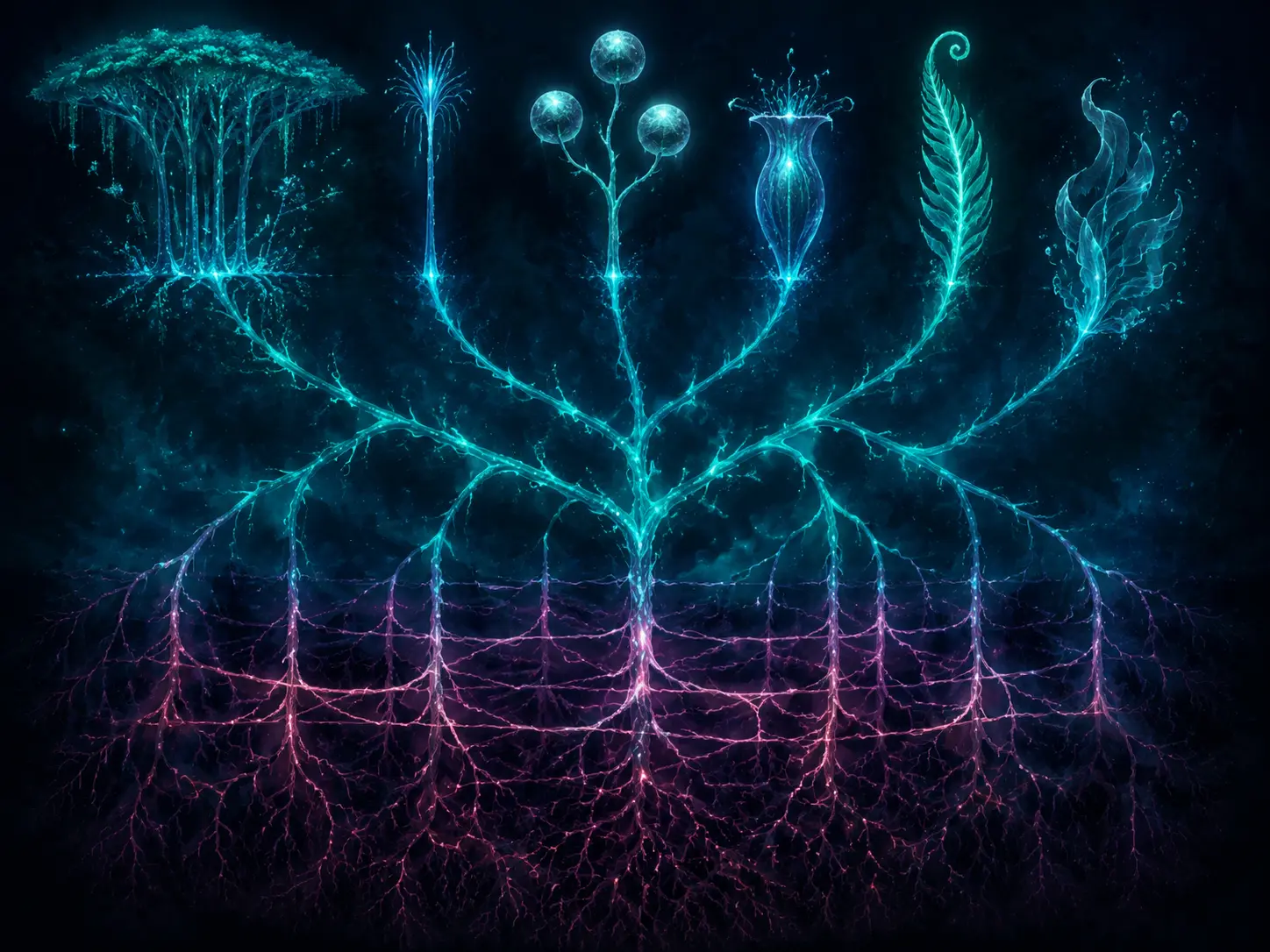
Open the drawer and the smell arrives first: dry tissue, old resin, and a faint sulfur note the fixative never quite lifts. Inside, mounting sheets, each with a pressed and flattened Pandoran plant fixed down with linen tape, and on each sheet a small label in careful handwriting. Helicoradium spirale. Pseudocenia rosea. Fungimonium giganteum. Obesus rotundus. Aloeparilus succulentus. Panopyra aerii. Two dozen of them, all in the same hand, all in the same format — genus first, species second, exactly as Linnaeus laid it down.
It is a beautiful collection and it contains a quiet embarrassment.
A binomial is not a label. It is an argument. When you write Pseudocenia rosea and then Pseudocenia equina, you are asserting that those two plants belong together in a way that neither belongs with anything else on the bench — that somewhere back in time there was one plant that was ancestral to both and to nothing else in the drawer. The genus is a hypothesis about descent, printed in italics and presented as a fact. Every one of these sheets makes that claim. Not one of them has ever been tested.
Compare what has been done to the animals. The Pandoran bestiary has an actual tree: a family of six-limbed creatures united by carbon-threaded bone and the neural queue, the Na'vi nested deep inside it beside the prolemuris, the whole thing built from anatomy by the method Building the Pandoran Tree of Life works through in detail. It even has a date — the Na'vi lineage roughly twelve million years old. The animals have a history.
The plants have a filing cabinet.
And it is not because nobody looked. It is because the flora is genuinely harder, in a way that has nothing to do with Pandora and everything to do with what plants are. So the question for this chapter is not the one you would expect. It is not what does the Pandoran plant tree look like. It is the question you have to answer first: when two plants resemble each other, what have you actually learned?
The answer, worked out painfully on Earth over about two centuries, is: usually less than you hoped. And sometimes something better than you were asking for.
Three ways to be three hundred metres tall
Start where any collector starts — with the biggest things in the drawer, because size is the easiest character to score and the most satisfying to sort by.
Pandora's giants are extraordinary. Kelutral, the Hometree, stands somewhere between a hundred and fifty and three hundred metres with a base broader than fifty, hollow enough inside to house a clan. The beanstalk palm, Saltarus pendulus, goes up a hundred and fifty metres on a single unbranched shaft. The puffball tree, Obesus rotundus, is modest at fifteen metres but unmistakably tree-shaped — a woody column with a crown on top.
Three trees. Group them, name the group Pandora's arborescent lineage, and move on to the next drawer.
Now look inside the trunks, and the tidy group falls apart in your hands.
Kelutral cannot be a solid trunk, and the reason is arithmetic rather than botany. A tree has no pump; it lifts water by pulling on it, and the pull has to beat gravity over the whole height. Even with Pandora's lighter gravity working in its favour, a three-hundred-metre column of water needs something over two megapascals of tension just to stay up — and the mechanical problem is worse than the hydraulic one. So Kelutral does not try. What canon describes is not a trunk but a colonnade: a crowd of vertical prop-stems that fuse where they touch, growing into a hollow load-bearing cylinder. Earth builds exactly this, at a tenth the scale, in the banyan fig.
The beanstalk palm solves the same problem the opposite way. A hundred and fifty metres on one slender shaft is not a strength problem, it is a buckling problem, and you do not beat buckling with a fatter core — you beat it by making the outside of the column stiff and letting the whole thing bend. So Saltarus runs its strengthening tissue as a fibrous sheath around the outside and keeps almost no load-bearing wood at the centre. Earth's version is the giant clubmoss forests of the Carboniferous: Lepidodendron went up forty metres on a trunk that was under a tenth wood by diameter, holding itself together with a thick bark-like periderm instead, and — this is the tell — it grew straight up, made one crown of cones, released its spores, and died. Determinate growth. A plant with a fixed adult size, which no oak or redwood does.
The puffball tree does not solve the problem at all. It sidesteps it. Rather than building a stiff column, Obesus keeps a soft stem and hangs buoyant hydrogen-filled globes off the top, letting gas do part of the work that wood would otherwise have to do. A saguaro cactus reaches twelve metres on the same trick with water instead of hydrogen: internal turgor, a light skeletal frame, no real trunk.
Three giants, three incompatible pieces of engineering. And each one has an Earth counterpart that is nowhere near its relative — the fig, the clubmoss and the cactus are separated by hundreds of millions of years and are not each other's kin in any useful sense. When the same solution appears twice on two different worlds with no shared ancestor anywhere in sight, you are not looking at inheritance. You are looking at convergence — physics getting the same answer twice.
Three ways to be three hundred metres tall
Sort the trunks by how they look, then by what holds them up
By outline, all six are trees and the sort tells you nothing. Height is a response to competition for light, and anything with a growth habit and enough time can reach for it.
This is the single most useful thing botany learned the hard way, and it is worth stating plainly: a tree is not a kind of plant. It is a job. The arborescent habit — a tall self-supporting perennial stem with a crown of foliage on top — was invented independently in at least six unrelated lineages on Earth, and reinvented within some of them more than once. The first things on the planet to look like trees were not plants at all: Prototaxites, an eight-metre column with a metre-wide base, standing in Devonian landscapes four hundred million years ago, turns out from its carbon-isotope signature to have been a giant fungus. The first genuine forest canopy, around three hundred and eighty-five million years ago, belonged to Wattieza, which had no solid wood and held itself up with a peripheral ring of separate xylem strands. Then Archaeopteris, the first tree a modern eye would recognise, combining real secondary wood with reproduction by spores. Then the clubmoss forests. Then the giant horsetails, twenty metres of hollow jointed stem. And much later, from a completely different direction, palms — which have no cambium at all and thicken by a different mechanism entirely, scattering closed bundles through soft tissue like steel rods in concrete.
Every one of those is a tree. None of them is closely related to the others. Which means the honest answer to "are Pandora's giants one lineage?" is almost certainly no — and the drawer full of names cannot tell you which of them go together, because it sorted on the one character that never groups anyone.
What the pitcher is really telling you
If height is a trap, surely a complicated organ is safer. Nobody grows a lidded, waxed, enzyme-filled vessel for catching animals by accident. Four of the sheets in the drawer belong to plants that do.
Pseudocenia rosea, the Chalice plant, is a two-to-four-metre urn on the rainforest floor that fills with digestive fluid and dissolves whatever falls in. Pseudocenia simplex, the Leaf pitcher, is a single modified leaf that folds shut on contact. Panopyra aerii is a small rosette that grows on the branches of Kelutral, catching rainwater and falling debris in the cup formed by its overlapping leaf bases. And Pseudocenia equina, the Direhorse pitcher, is the strangest of the four: the same vessel, the same shape — and no digestive enzymes at all. Its basin has become a nectar well, sized and positioned for the head and long feeding tongue of the direhorse, which drinks and carries pollen away on its face.
Four urns. The collector's instinct says family.
Earth says: look at the ground.
What a pitcher actually tells you
Leach the soil and watch which vessels start paying for themselves
This is the condition that keeps inventing the pitcher — on Earth, ten to twelve times over, in families that are not close kin. The Direhorse pitcher is the tell: it keeps the identical vessel with the digestion switched off, its basin converted to a nectar well, exactly as Nepenthes lowii on Earth abandoned carnivory to become a tree-shrew feeding station. And Panopyra reaches the same urn from the canopy, with no soil beneath it at all.
Carnivory in plants has evolved independently somewhere between ten and twelve times on Earth, in families that are not close relatives — the tropical pitcher plants of Southeast Asia, the trumpet pitchers of North America, the Australian pitcher plant, the bladderworts, the sundews, the Venus flytrap. They arrive at the same organ because they face the same accountancy. A plant needs nitrogen and phosphorus. Normally it buys them from the soil with carbon spent on roots. But on ground where those nutrients have been leached out — bog, sand, and above all wet tropical soil under heavy year-round rain — the roots stop paying, and a leaf folded into a vessel that digests an insect becomes the cheaper purchase. The trap is not a family trait. It is a soil reading, and it appears wherever the reading comes out the same.
Which reframes Pandora's four urns completely. They do not tell you those plants are related. They tell you the Omatikaya rainforest floor is nutrient-poor, which for a warm biosphere under constant rain is exactly what you would predict. The vessel is the biosphere reporting on its own ground.
And then there is the Direhorse pitcher, which is the most interesting sheet in the drawer, because it is a trap with the trapping switched off. Earth has done this too, and recently enough to be caught in the act: Nepenthes lowii, on the mountains of Borneo, keeps its pitcher but has largely given up on insects. Its upper vessels produce copious sugary secretions on the lid and function as a feeding station for tree shrews, which perch on the rim, eat, defecate into the cup, and thereby deliver the nitrogen the plant used to catch for itself. Same organ, opposite mechanism — outsourced rather than hunted.
Pseudocenia equina has made the same move. Canon states the loss of digestion and the direhorse mutualism directly; what it does not say, and what has to be marked as inference, is the order of events. But the direction is not really in doubt. Digestive enzymes are expensive machinery that no lineage builds in order to not use, so a non-digesting pitcher among digesting relatives is overwhelmingly likely to be a pitcher that stopped, not one that never started. Which means the Direhorse pitcher is not a primitive form. It is a derived one, and it is evidence of exactly the kind of rapid, specific coevolution that a biosphere supposedly frozen in stasis for tens of millions of years should not be producing. Hold on to that. It comes back.
The order things had to be invented in
So resemblance keeps failing. Height fails, organs fail. What is left?
What is left is the thing that cannot be reinvented casually: the order of acquisition. Some inventions are prerequisites for others. You cannot have a seed before you have a spore wall tough enough to survive dry air, because the seed is built out of that wall. You cannot have a tall stem before you have a way to stop your water pipes collapsing under their own suction. Those dependencies do not care about habitat or fashion. They are structural, and they run in one direction only — which makes them the closest thing a botanist has to a clock.
Earth's sequence is now known in some detail, and the surprising part is where it starts. Land plants did not come from the sea. They came from fresh water — from the streptophyte algae, and specifically from the group that includes the modest conjugating green algae you find in pond scum, the Zygnematophyceae. That was settled by sequencing the nuclear genes of a thousand plant species at once, and it overturned the older guess, which favoured the structurally fancier stoneworts. The winner was the plainer organism.
Better still, the genomes of those pond algae showed something nobody expected: the toolkit for living on land was already there, in the water. The chemistry for making UV-screening pigments, the hormone signalling that lets a cell respond to drying out, the machinery for organising a body along an axis — all of it present in freshwater algae that never left the pond. Some of it had been acquired horizontally from soil bacteria. Life did not build the land kit after arriving on land. It arrived carrying most of it, because a pond margin already dries out.
Then, over roughly seventy million years, the actual inventions:
- A cuticle — a waxy waterproof skin, which appears in the record as isolated fragments around four hundred and sixty million years ago.
- Sporopollenin, a biopolymer so chemically stubborn it still survives in rock today, wrapped around spores so they could travel through dry air. Those spores show up in the mid-Ordovician, about four hundred and seventy-five million years back, and they are the first direct evidence of plants on land.
- Stomata — controllable pores, because a waterproof skin that works has just cut off the plant's carbon supply.
- Rhizoids, then true roots, for anchorage and water.
- And finally the tracheid: a dead, hollow, lignin-stiffened cell that carries water without imploding. That one unlocked everything vertical, because it solved suction and support in the same tissue.
The Rhynie Chert in Scotland — a hot-spring deposit dated to 407.6 ± 2.6 million years — froze that whole moment in silica, cell by cell. You can look at Aglaophyton, which had conducting cells but not proper tracheids, standing next to Rhynia, which had them. The transition is not inferred there. It is visible.
Now hold that sequence against the Pandoran drawer, and notice what is missing.
There is no basal plant. No algae-grade organism, no simple creeping form, no bare unbranched stalk — nothing that looks like a step on the way to anything. The flora in the cabinet is all crown: fully realised giants, specialised carnivores, epiphytes with contractile tentacles. It is as if someone had collected Earth's plants and kept only the redwoods, the orchids and the Venus flytraps.
And there is a deeper silence. Every land plant on Earth alternates between two distinct multicellular bodies — a gametophyte that makes eggs and sperm, and a sporophyte that makes spores. In a moss the gametophyte is the plant you see and the sporophyte is a small stalk living on it. In a fern the arrangement has flipped: the fern is the sporophyte, and the gametophyte is a thumbnail-sized scrap on the soil. In a seed plant the gametophyte has shrunk to a handful of cells hidden inside pollen and ovule. That progressive takeover by the spore-making generation is arguably the largest single reorganisation in plant history — alternation of generations, and the shift of dominance across it, is the backbone every other plant character hangs on.
Canon says nothing about it. Not one word, for any Pandoran plant. We have detailed reproductive behaviour — woodsprites that steer themselves through the air toward bioelectric fields, Croquembouche fruit that detonates and flings acid-coated seeds fifty metres, Tarsyu propagating clonally by basal saplings — and no indication whether any of it involves two alternating bodies or one. Which means the character that would let us place these plants relative to each other is precisely the character nobody recorded. Not a gap in the fossils. A gap in the notes.
The reef that used to live on land
One group in the drawer looks like it should settle everything, and instead it does something better: it shows the method working.
The reef flora of the eastern sea — the Airbell, whose fronds hold pressurised air the Metkayina breathe from while diving, and the submerged spirit tree in the Cove of the Ancestors — could in principle be the most important material on the bench. If Pandoran plants began in water, marine forms might be the ancestral stock and the whole land flora a departure from them. That would be the base of the tree.
Or they could be the exact opposite: land plants that went back.
This is a real question with a real answer, and you get at it not by looking at what the marine plants have but at what they have wrecked.
Three features decide it. First, the Airbell's air cavities. Internal gas-filled channels are not an algal trait — algae do not need them, because water carries dissolved gas to every cell of a thin body. They are what a land plant builds when it has to get oxygen down to roots buried in airless mud. Second, canon describes degenerate stomatal patterning on those submerged fronds: not the absence of stomata, but the remains of them. You cannot lose an organ you never had. Third, the submerged spirit tree carries the same electrochemical tendrils and the same queue-compatible connections as its terrestrial counterpart — a networked-plant feature, showing up underwater.
Three broken land features. The reef flora is a return, not an origin.
Earth ran this experiment. Seagrasses — Zostera, Posidonia, the whole submarine-meadow flora — are flowering plants. Not algae, not seaweed: angiosperms with roots, veins and flowers, which went back into shallow salt water three or four separate times and paid for it. They lost their stomata entirely. They kept extensive internal air channels. And they gave up airborne pollen for pollen that drifts in water, a solution so unusual it was doubted for years. A seagrass meadow is a lawn that emigrated.
Which lands the point this chapter has been circling. That reef is not the bottom of Pandora's tree. It is a branch that turned around. And the specimens that would be the bottom — whatever simple aquatic phototroph everything else came from — are not in the drawer at all.
The plant that flinches
Now for the sheet that does not fit anywhere, and which is the most Pandoran thing in the cabinet.
Helicoradium spirale — the helicoradian, loreyu — is a six-to-eight-metre spiral leaf standing beside a river. Brush against it and it does not wilt or sway. It retracts, whipping down into a sheath at its base in a fraction of a second, like something startled. Canon files it, along with the anemonoid, the cat-ear shrub, the Panopyra tank and the woodsprites, under a category the field guides invented because nothing else would hold them: zooplantae. Plant-animals. Organisms that photosynthesise and also possess, in canon's own phrasing, the rudiments of a nervous system, with contractile fibrils working as muscle does.
That category is an admission of defeat, and it is honest about it. The production botanist who designed much of this flora said as much: these organisms cannot be filed under either kingdom without breaking the kingdom.
Which raises the question that actually matters for a family tree. Is the zooplantae grade old or new?
Two possibilities, and they point in opposite directions.
The first says old. Somewhere near the base of Pandoran multicellular life sat an organism that had both things at once: photosynthetic machinery and contractile protein fibres with electrical signalling to drive them. Everything descends from it. The animal lineage discarded the photosynthesis to specialise in moving; the plant lineage kept both and put the contractile tissue to work on defence, on tracking sound, on catching prey. Under this reading, zooplantae are not weird hybrids at all — they are the least modified survivors of a common ancestral condition, and the sharp plant-animal split we take as universal is a local Earth accident.
The second says new. Autotrophic plants independently evolved rapid movement several times, or acquired the machinery sideways through the root network, and the resemblance among helicoradian, Panopyra and cat-ear is convergence of exactly the kind this chapter has spent its length warning about.
Here is why the question is genuinely hard, and why I will not pretend it is settled. Earth plants already move fast without any of this. Mimosa pudica folds its leaves within a second or two of being touched. The Venus flytrap snaps in under a tenth of a second. Neither has muscle or nerves. They use rapid ion movements that dump water pressure out of specialised cells, and they propagate the signal with genuine action potentials running through ordinary plant tissue — the same glutamate-receptor and calcium-wave machinery every plant carries. So a fast-moving plant is not, by itself, evidence of animal ancestry. Earth is proof of that.
But canon does not describe turgor collapse. It describes contractile fibrils, muscle analogues, and rudimentary nervous systems, distributed across organisms with completely different growth habits — a giant single leaf, a canopy tank, a woody shrub, an airborne seed. That distribution is the interesting part. Convergence explains one lineage acquiring a trick. It strains at four unrelated habits acquiring the same specific tissue.
So the balance of the canon evidence favours the deep-retention reading, and I will say plainly that this is inference and not a small one — it rests on how much weight a companion-book phrase like "rudiments of a nervous system" can carry, and that phrase was never written to bear a phylogeny. If it turns out those fibrils are turgor machinery described loosely, the whole argument collapses into ordinary convergence and Earth was the better guide after all.
What is not in doubt is where the zooplantae sit if the reading holds: not as a curiosity off to one side, but near the root, as the branch that kept what everything else gave up.
Why the tree will not stay a tree
There is one more thing wrong with the drawer, and it is structural rather than factual. The filing cabinet assumes that plants come in nested boxes — that every species sits inside exactly one genus, every genus inside one family, all the way up. A tree of nested boxes.
Plants do not do this. Not on Earth, and emphatically not on a moon whose flora is wired together underground.
The animal tree mostly behaves. Lineages split, and afterwards they stay split; a cat and a dog have not exchanged genetic material since their ancestors parted. That is why animal phylogenies can be drawn as clean forks and why the method in Building the Pandoran Tree of Life works as well as it does on the bestiary.
Plants break the fork four separate ways.
They duplicate their entire genome. Not rarely — routinely. Roughly seven in ten living flowering-plant species carry at least one whole-genome duplication somewhere in their ancestry, and there are ancient duplications underlying all seed plants and all angiosperms. Polyploidy is not a pathology in plants; it is a normal mode of speciation.
They make new species by hybridising, in a single generation. Spartina anglica, a salt-marsh grass, appeared in Britain around 1890 as the fertile allopolyploid offspring of two other cordgrasses and is now a species in its own right. Tragopogon miscellus did the same in North America in the twentieth century, twice, in different places. On a strict tree diagram there is no way to draw a branch with two parents — but that is what happened.
They pass genes sideways. Amborella trichopoda, a shrub from New Caledonia that sits at the very base of the flowering-plant tree, has acquired five entire foreign mitochondrial genomes from mosses, green algae and other flowering plants by direct contact. Ferns picked up a light receptor called neochrome from hornworts about a hundred and eighty million years ago and used it to photosynthesise better in the deep shade under angiosperm canopies. That is horizontal gene transfer, in plants, doing something consequential.
And they swap chloroplasts. Hybridise, then backcross repeatedly, and a species can end up carrying another species' chloroplast genome inside its own nuclear identity — plastid capture. Which is why the tree you get from chloroplast genes and the tree you get from nuclear genes routinely disagree, and why a botanist quoting a phylogeny has to say which genome it came from.
None of that is Pandoran. All of it is Earth, and all of it is standard.
Now add what canon actually says about Pandora. Root tips of neighbouring plants form direct electrochemical contacts. The Unidelta tree grafts its roots to a different species and pumps its own defensive alkaloids into that neighbour's root system, building a shared chemical perimeter. The giant fungus Fungimonium penetrates root cortices to trade mineral ions for photosynthetic carbon. Those are not metaphors for connection. They are described as physical tissue continuity between organisms that are not the same species.
The tree that will not stay a tree
Add the sideways channels and count the loops
Drawn this way the flora looks like an animal phylogeny: forks all the way down, each lineage descending from exactly one ancestor. Plants on Earth almost never behave like this.
The group names in that diagram are mine, not canon's — labels of convenience for clusters the flora falls into once you sort by construction rather than silhouette. What is not a convenience is the shape. Count the edges: a tree with this many nodes can carry exactly one fewer edge than it has nodes, and the moment a lateral channel joins two branches you exceed that count and close a loop. A closed loop is the formal signature of a network.
So the honest deliverable for Pandoran flora is not a cladogram. It is a network — mostly tree-shaped, because ordinary descent plainly happened, with a real and probably substantial amount of sideways traffic woven through it. Anyone who hands you a clean bifurcating diagram of Pandoran plants is either simplifying deliberately or has not thought about the roots.
The one place the flora is dated
Everything so far has been a tree without a clock. There is exactly one place on Pandora where plant history has a date attached, and it is a wound.
A generation ago — around thirty Earth years — a volcanic eruption incinerated the Mangkwan clan's Hometree and buried their territory under lava and sulfurous tephra. The Ashlands are still, three decades on, close to bare: no closed canopy, and a sparse flora of heavily armoured fire-tolerant forms rooted in raw volcanic ground.
That is a dated starting line, which makes it the only stretch of Pandoran floral history that can be checked against anything. Life After the Volcano takes the recovery apart properly — why the ground says no, what a severed root network costs, why this landscape is stalled rather than merely slow. What matters here is narrower: what arrives first, and what that ordering says about the flora as a whole.
Earth's answer comes from four well-measured disasters. At Krakatau, wind-carried fern spores and cyanobacteria were established on sterilised rock within about three years. Surtsey, the island that surfaced off Iceland in 1963, has been watched from its first day. The Mount St Helens blast zone showed that scattered survivors matter more than distance. And Hawaiian lava flows of known ages give a clean sequence of ground at every stage of weathering.
The pattern is consistent, and the constraint is not what people expect. Fresh volcanic rock is not short of minerals — it has phosphorus, potassium, calcium, magnesium in abundance. What it has none of is usable nitrogen, because nitrogen comes from air and living things, not from rock. So succession stalls until something can fix it out of the atmosphere. On the pumice plain of Mount St Helens the job fell to a lupine, which built small islands of fertility that later arrivals could colonise. Only then does the sequence move: crusts and spores first, then nitrogen fixers, then animal-carried heavy seeds once there is enough cover to attract the animals, then — thirty to fifty years in — a closed canopy, with full diversity centuries away.
Which tells you what the Ashlands should look like now, and roughly does: crusts and pioneers, sclerified survivors, no canopy. And it isolates the Pandoran difference sharply. On Earth a seedling needs light, water and nitrogen. On Pandora, if canon means what it says about the root network, a Kelutral seedling may also need connection — and connection is the one resource a lava field cannot supply, because the thing that carried it was burned out of the ground. A flora wired together underground gains a great deal in a mature forest and loses something Earth plants never had to lose when the wiring is cut.
Honest edges
Time to mark the borders, because this chapter has been building a structure on uneven ground and the reader should know where it is thin.
What is canon: the organisms and their descriptions. The named flora with their binomials, sizes and habitats; the Chalice plant's carnivory and the Direhorse pitcher's loss of it; the helicoradian's retraction; the Airbell's air stores; the submerged spirit tree; the root grafting and the fungal conduit; the zooplantae category and the phrase about rudimentary nervous systems; the Ashlands and their approximate date. Note also that much of this comes from companion material and field-guide compilations rather than from the films, which puts a good deal of it a tier below hard canon before we even start reasoning.
What is real Earth science, and load-bearing here: the independent origins of arborescence, carnivory, C4, succulence, epiphytism and the marine return; the freshwater streptophyte ancestry of land plants and the terrestrialization sequence; alternation of generations and the sporophyte takeover; polyploidy, hybrid speciation, horizontal gene transfer and plastid capture; the nitrogen bottleneck in primary succession. None of that is in question. It is where the chapter's confidence comes from.
What is inference, and should be read as such: that the three giants are separate arborescent lineages rather than one; that the Direhorse pitcher lost carnivory rather than never having it; that the reef flora is a secondary return; that the zooplantae grade is ancestral retention rather than convergence; and the group labels in the network diagram, which are mine.
What is frankly unresolved: everything the drawer never recorded. No basal plant. No date for any floral event except a volcano. No statement of whether these organisms even have two alternating generations, which is the character the whole Earth framework hangs on. And one tension the chapter cannot resolve — canon describes a biosphere held in equilibrium for tens of millions of years, and also describes a pitcher shaped to one animal's face. Those two claims do not sit comfortably together. Rapid, exact, mutual specialisation is what a lineage does while it is actively evolving. Earth's own long-stable lineages tell us that morphological stasis is never genetic stasis: Ginkgo has looked much the same for a very long time and accumulates mutations at an ordinary rate. A flora can look still. It cannot be still.
The drawer, and the blank sheet
Go back to the herbarium bench and the blank sheet waiting for a diagram.
It is still blank, and it will stay blank, because the tree that belongs on it cannot be drawn from what is in the drawer. But the afternoon was not wasted, because we now know precisely what kind of thing is missing — and that is a more useful result than a confident wrong diagram.
Three of the sheets are giants that share a silhouette and no construction. Four are urns reporting on the same leached soil. One group is a return from the sea, wearing its ruined stomata as the receipt. Several are organisms that flinch, and may be the oldest things in the cabinet rather than the strangest. And running underneath all of them, invisible on any sheet because you cannot press it and mount it, is a root network that moves material between organisms that are not the same species — which means the honest diagram was never going to be a tree in the first place.
What the flora needs is not more collecting. It is the boring, unglamorous work: sequence the plastid genome across every green thing and see whether it is one lineage or several; find out whether these plants have a gametophyte at all; put a microscope on a root junction and settle whether that network is the plant's own tissue or a fungus wearing the plant as a host, because those two answers give completely different trees. And then, since no Earth organism can serve as an outgroup, work out how to root the thing from within.
The last line is the one worth carrying off the bench, and it is not about Pandora. The RDA's collectors did what every naturalist does: they sorted by what they could see. Two centuries of Earth botany says that instinct is not merely imperfect but systematically wrong, because a plant's shape is mostly a report on where it lives — the soil, the light, the water, the neighbours — and only occasionally a report on where it came from. The drawer is full of information. Almost none of it is about family. That is not the collection's failure. It is what a plant is.
What stays open
Almost certainly several, though this is inference rather than canon. The three described constructions — a hollow colonnade of fused prop-stems, a slender shaft strengthened only around its outside, and a soft stem propped by gas cavities — are not variations on one design; they are incompatible engineering, and each has an Earth counterpart in a lineage unrelated to the other two. Earth invented the tree independently at least six times, so a moon with three constructions almost certainly did it more than once. What would settle it is anatomy plus sequence, and neither exists.
The canon distribution favours ancient: contractile fibrils and rudimentary nervous systems turn up across four completely different growth habits — a giant single leaf, a canopy tank, a woody shrub and an airborne seed — and convergence is a strained explanation for the same specific tissue appearing in all four. But the reading leans hard on a companion-book phrase that was never written to carry a phylogeny, and Earth shows that plants achieve very fast movement with water pressure and action potentials and no muscle at all. If those fibrils turn out to be turgor machinery loosely described, the deep-retention argument collapses into ordinary convergence.
Nobody has recorded it, and that is a much bigger hole than it sounds. On Earth the two-body life cycle and the progressive dominance of the spore-making generation is the framework every other plant character is placed against — it is how you tell a moss-grade organism from a fern-grade one from a seed plant. Canon gives detailed reproduction for several Pandoran species and never once distinguishes a haploid from a diploid body. Until someone looks, the flora cannot be placed on any scale at all.
This is the single most consequential unanswered question, because the two answers give different trees. If root junctions are plant-to-plant contacts made of the plants' own tissue, the network is an inherited character and it defines a real clade. If the connection is mediated by fungal filaments threading between root cortices, it is a planet-wide symbiosis that has co-opted unrelated lineages — in which case the network says nothing about descent and every plant sharing it might be a distant relative. Canon supports both readings in different places, and a microscope on one junction would decide it.
Read next
Building the Pandoran Tree of Life
On a dim specimen bench: a thanator skull, an ilu flipper, a tulkun vertebra, and a Na'vi skeleton standing among them. The one tool every Earth phylogeneticist now reaches for first is missing - there is no DNA. Canon is silent on Pandoran molecular biology. And yet the tree can still be drawn, because for a century before sequencing, Earth built its own tree of life from bones alone. The real question is not whether the tree is knowable, but which similarities reveal kinship - and which ones lie.
26 min read
How Does a Pandoran Plant Feed?
A violet leaf in Pandora's understorey is not a production designer's whim — or rather it is, but there is still a biologically correct answer to why it could be violet. A leaf is the colour of the light it refuses, and under two suns unlike ours, a different refusal pays. From there we follow the carbon the whole length of a tree.
31 min read
Life After the Volcano
We assume life always comes back: a forest burns and regrows, a wound scars over. But the Mangkwan Ashlands have stayed barren for a generation, and that is no strange exception — it is the rule Earth taught us on the flank of one volcano in 1980. Recovery is not a promise; it is a bargain struck with whatever survived underground.
21 min read